
中国的东北刺猬中鉴定出一种新型的β冠状病毒()。
Identification of a Novel Betacoronavirus () in Amur Hedgehogs from China.
机构信息
Department of Microbiology, Li Ka Shing Faculty of Medicine, The University of Hong Kong, Hong Kong 999077, China.
State Key Laboratory of Emerging Infectious Diseases, The University of Hong Kong, Hong Kong 999077, China.
出版信息
Viruses. 2019 Oct 24;11(11):980. doi: 10.3390/v11110980.
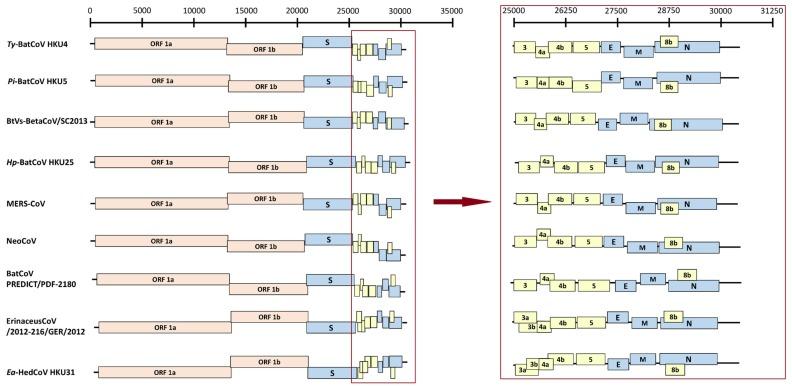
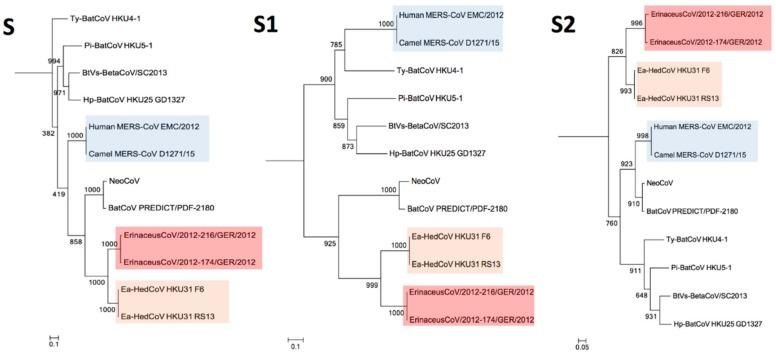
While dromedaries are the immediate animal source of Middle East Respiratory Syndrome (MERS) epidemic, viruses related to MERS coronavirus (MERS-CoV) have also been found in bats as well as hedgehogs. To elucidate the evolution of MERS-CoV-related viruses and their interspecies transmission pathway, samples were collected from different mammals in China. A novel coronavirus related to MERS-CoV, hedgehog coronavirus HKU31 (-HedCoV HKU31), was identified from two Amur hedgehogs. Genome analysis supported that -HedCoV HKU31 represents a novel species under , being most closely related to CoV from European hedgehogs in Germany, with 79.6% genome sequence identity. Compared to other members of , -HedCoV HKU31 possessed unique non-structural proteins and putative cleavage sites at ORF1ab. Phylogenetic analysis showed that -HedCoV HKU31 and BetaCoV Erinaceus/VMC/DEU/2012 were closely related to NeoCoV and BatCoV PREDICT from African bats in the spike region, suggesting that the latter bat viruses have arisen from recombination between CoVs from hedgehogs and bats. The predicted HKU31 receptor-binding domain (RBD) possessed only one out of 12 critical amino acid residues for binding to human dipeptidyl peptidase 4 (hDPP4), the MERS-CoV receptor. The structural modeling of the HKU31-RBD-hDPP4 binding interphase compared to that of MERS-CoV and bat CoV HKU4 (-BatCoV HKU4) suggested that HKU31-RBD is unlikely to bind to hDPP4. Our findings support that hedgehogs are an important reservoir of , with evidence of recombination with viruses from bats. Further investigations in bats, hedgehogs and related animals are warranted to understand the evolution of MERS-CoV-related viruses.
虽然单峰骆驼是中东呼吸综合征(MERS)流行的直接动物来源,但与 MERS 冠状病毒(MERS-CoV)相关的病毒也在蝙蝠和刺猬中被发现。为了阐明 MERS-CoV 相关病毒的进化及其种间传播途径,从中国不同的哺乳动物中采集了样本。从两只东北刺猬中鉴定出一种与 MERS-CoV 相关的新型冠状病毒,刺猬冠状病毒 HKU31(-HedCoV HKU31)。基因组分析支持 -HedCoV HKU31 代表一个新种,与德国的欧洲刺猬中的 CoV 最为密切相关,基因组序列同一性为 79.6%。与其他成员相比,-HedCoV HKU31 在 ORF1ab 上具有独特的非结构蛋白和假定的切割位点。系统发育分析表明,-HedCoV HKU31 和 BetaCoV Erinaceus/VMC/DEU/2012 与 Spike 区来自非洲蝙蝠的 NeoCoV 和 BatCoV PREDICT 密切相关,表明后者的蝙蝠病毒是由刺猬和蝙蝠中的 CoV 重组产生的。预测的 HKU31 受体结合域(RBD)仅具有与人类二肽基肽酶 4(hDPP4)结合的 12 个关键氨基酸残基中的 1 个,hDPP4 是 MERS-CoV 的受体。与 MERS-CoV 和蝙蝠 CoV HKU4(-BatCoV HKU4)的 HKU31-RBD-hDPP4 结合界面的结构建模表明,HKU31-RBD 不太可能与 hDPP4 结合。我们的研究结果支持刺猬是重要的,证据表明与蝙蝠病毒发生了重组。需要进一步调查蝙蝠、刺猬和相关动物,以了解 MERS-CoV 相关病毒的进化。




 Zotero 插件