
比较骨髓和牙髓间充质干细胞在兔颅骨骨缺损模型中的成骨潜能和骨再生能力。
Comparing the Osteogenic Potentials and Bone Regeneration Capacities of Bone Marrow and Dental Pulp Mesenchymal Stem Cells in a Rabbit Calvarial Bone Defect Model.
机构信息
Department of Obstetrics and Gynecology, Taipei Medical University Hospital, Taipei 110, Taiwan.
School of Dentistry, College of Oral Medicine, Taipei Medical University, Taipei 110, Taiwan.
出版信息
Int J Mol Sci. 2019 Oct 10;20(20):5015. doi: 10.3390/ijms20205015.
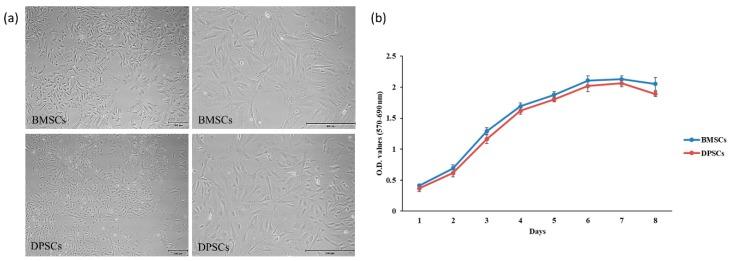
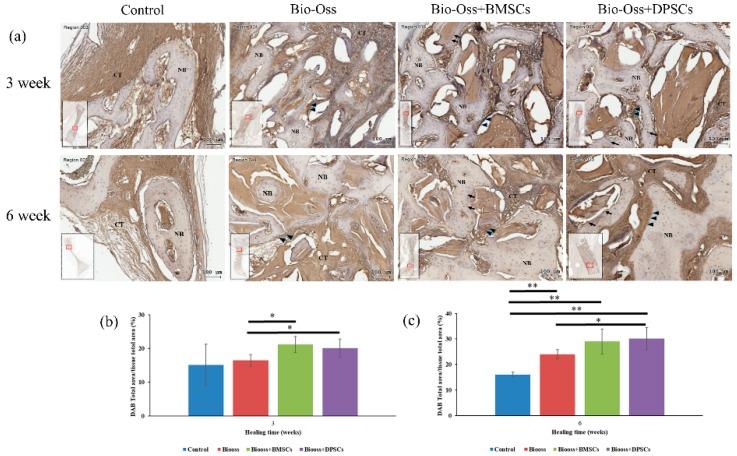
The bone regeneration efficiency of bone marrow mesenchymal stem cells (BMSCs) and dental pulp mesenchymal stem cells (DPSCs) combined with xenografts in the craniofacial region remains unclear. Accordingly, this study commenced by comparing the cell morphology, cell proliferation, trilineage differentiation, mineral synthesis, and osteogenic gene expression of BMSCs and DPSCs in vitro. Four experimental groups (empty control, Bio-Oss only, Bio-Oss+BMSCs, and Bio-Oss+DPSCs) were then designed and implanted in rabbit calvarial defects. The BMSCs and DPSCs showed a similar morphology, proliferative ability, surface marker profile, and trilineage-differentiation potential in vitro. However, the BMSCs exhibited a higher mineral deposition and expression levels of osteogenic marker genes, including alkaline phosphatase (ALP), runt related transcription factor 2 (RUNX2), and osteocalcin (OCN). In the in vivo studies, the bone volume density in both MSC groups was significantly greater than that in the empty control or Bio-Oss only group. Moreover, the new bone formation and Collagen I / osteoprotegerin protein expressions of the scaffold+MSC groups were higher than those of the Bio-Oss only group. Finally, the Bio-Oss+BMSC and Bio-Oss+DPSC groups had a similar bone mineral density, new bone formation, and osteogenesis-related protein expression. Overall, the DPSCs seeded on Bio-Oss matched the bone regeneration efficacy of BMSCs in vivo and hence appear to be a promising strategy for craniofacial defect repair in future clinical applications.
骨髓间充质干细胞(BMSCs)和牙髓间充质干细胞(DPSCs)与异种移植物联合在头面部区域的骨再生效率尚不清楚。因此,本研究首先比较了体外 BMSCs 和 DPSCs 的细胞形态、细胞增殖、三系分化、矿化合成和成骨基因表达。然后设计了四个实验组(空对照、仅 Bio-Oss、Bio-Oss+BMSCs 和 Bio-Oss+DPSCs)并植入兔颅骨缺损。BMSCs 和 DPSCs 在体外具有相似的形态、增殖能力、表面标志物谱和三系分化潜能。然而,BMSCs 表现出更高的矿化沉积和更高的成骨标志物基因的表达水平,包括碱性磷酸酶(ALP)、 runt 相关转录因子 2(RUNX2)和骨钙素(OCN)。在体内研究中,两个 MSC 组的骨体积密度均明显大于空对照或仅 Bio-Oss 组。此外,支架+MSC 组的新骨形成和 Collagen I/osteoprotegerin 蛋白表达高于仅 Bio-Oss 组。最后,Bio-Oss+BMSC 和 Bio-Oss+DPSC 组具有相似的骨矿物质密度、新骨形成和成骨相关蛋白表达。总体而言,在体内,接种 Bio-Oss 的 DPSCs 与 BMSCs 的骨再生效果相当,因此在未来的临床应用中似乎是一种很有前途的颅面缺损修复策略。



 Zotero 插件