
一线 BRAF/MEK 抑制剂、抗 PD-1 抗体或纳武利尤单抗/伊匹木单抗治疗晚期 BRAF V600 突变黑色素瘤患者的真实世界生存情况。
Real-world survival of patients with advanced BRAF V600 mutated melanoma treated with front-line BRAF/MEK inhibitors, anti-PD-1 antibodies, or nivolumab/ipilimumab.
机构信息
HonorHealth Research Institute, Scottsdale, AZ, USA.
Division of Public Health, Study Design and Biostatistics Center, Department of Family Medicine, Huntsman Cancer Institute, University of Utah, Salt Lake City, UT, USA.
出版信息
Cancer Med. 2019 Dec;8(18):7637-7643. doi: 10.1002/cam4.2625. Epub 2019 Nov 2.
BACKGROUND
The optimal treatment sequence for patients with advanced BRAF V600 mutant melanoma is unknown. BRAF/MEK inhibition (BRAF/MEKi), single agent anti-PD-1 (aPD-1) antibodies and combination immune checkpoint inhibition with nivolumab and ipilimumab (niv/ipi) are all approved; however, they have not been prospectively compared. Therefore, we sought to compare overall survival of patients with advanced BRAF mutant melanoma treated with either front-line BRAF/MEKi, aPD-1, or niv/ipi.
METHODS
Patients with advanced BRAF mutant melanoma who had received BRAF/MEKi, niv/ipi, or aPD-1 in the front-line setting were identified from a nationwide database comprising de-identified patient-level structured and unstructured data derived from electronic health records. Survival was compared using Kaplan-Meier curves and log-rank analysis. Univariate and multivariate Cox regression models were used to measure the effect of front-line treatment, age (>64 or not), LDH (elevated or not), and Eastern Cooperative Oncology Group (ECOG) performance status (>1 or not) on survival.
RESULTS
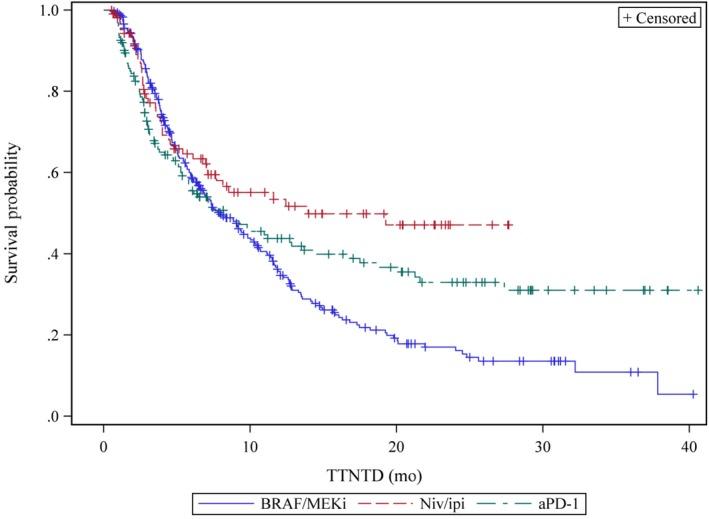
Five hundred and sixty seven patients with advanced disease and treated with front-line aPD-1 (n = 162), BRAF/MEKi (n = 297) or niv/ipi (n = 108) were identified. With a median follow-up of 22.4 months, median overall survival (OS) for patients treated with front-line niv/ipi was not reached (NR) while median OS for patients treated with aPD-1 or BRAF/MEKi was 39.5 months and 13.2 months, respectively. Front-line treatment with PD-1 and niv/ipi were associated with statistically longer survival than BRAF/MEKi in multivariate analyses.
CONCLUSIONS
In our real-world retrospective analysis, patients with advanced BRAF mutant melanoma treated with front-line niv/ipi or aPD-1 had longer survival compared to those treated with front-line BRAF/MEKi.
背景
对于晚期 BRAF V600 突变黑色素瘤患者,最佳治疗顺序尚不清楚。BRAF/MEK 抑制(BRAF/MEKi)、单药抗 PD-1(aPD-1)抗体和纳武利尤单抗和伊匹单抗联合免疫检查点抑制(niv/ipi)均已获得批准;然而,它们尚未进行前瞻性比较。因此,我们旨在比较接受一线 BRAF/MEKi、aPD-1 或 niv/ipi 治疗的晚期 BRAF 突变黑色素瘤患者的总生存期。
方法
从包含来自电子健康记录的匿名患者级结构化和非结构化数据的全国性数据库中,确定了在一线治疗中接受过 BRAF/MEKi、niv/ipi 或 aPD-1 的晚期 BRAF 突变黑色素瘤患者。使用 Kaplan-Meier 曲线和对数秩分析比较生存情况。使用单变量和多变量 Cox 回归模型来衡量一线治疗、年龄(>64 岁或否)、乳酸脱氢酶(升高或否)和东部合作肿瘤学组(ECOG)表现状态(>1 或否)对生存的影响。
结果
确定了 567 名晚期疾病患者,他们接受了一线 aPD-1(n=162)、BRAF/MEKi(n=297)或 niv/ipi(n=108)治疗。中位随访 22.4 个月后,接受一线 niv/ipi 治疗的患者中位总生存期(OS)未达到(NR),而接受 aPD-1 或 BRAF/MEKi 治疗的患者中位 OS 分别为 39.5 个月和 13.2 个月。多变量分析显示,一线治疗 PD-1 和 niv/ipi 与生存时间延长相关。
结论
在我们的真实世界回顾性分析中,与接受一线 BRAF/MEKi 治疗的患者相比,接受一线 niv/ipi 或 aPD-1 治疗的晚期 BRAF 突变黑色素瘤患者的生存时间更长。

 Zotero 插件