
日本慢性肌肉骨骼疼痛患者的多学科疼痛管理项目:一项队列研究。
Multidisciplinary pain management program for patients with chronic musculoskeletal pain in Japan: a cohort study.
作者信息
Takahashi Naoto, Takatsuki Kozue, Kasahara Satoshi, Yabuki Shoji
机构信息
Department of Pain Medicine, Fukushima Medical University School of Medicine, Fukushima 9601295, Japan.
Pain Management Center, Hoshi General Hospital, Koriyama 963-8501, Japan.
出版信息
J Pain Res. 2019 Aug 21;12:2563-2576. doi: 10.2147/JPR.S212205. eCollection 2019.
INTRODUCTION
Multidisciplinary pain management is a useful method for treating chronic musculoskeletal pain. Currently, few facilities in Japan offer multidisciplinary pain treatment, especially in the inpatient setting. We implemented a multidisciplinary pain management program based on International Association for the Study of Pain recommendations. This study described our initial efforts in implementing the program, and reported 3- and 6-month follow-up results.
MATERIALS AND METHODS
Our pain management team included orthopedic surgeons, psychiatrists, nurses, physical therapists, clinical psychologists, pharmacists, and nutritionists. The 3-week inpatient pain management program comprised exercise therapy, psychotherapy, and patient education. We evaluated patients using the Brief Pain Inventory (BPI), Pain Catastrophizing Scale (PCS), Pain Disability-Assessment Scale (PDAS), Hospital Anxiety and Depression Scale (HADS), Pain Self-Efficacy Questionnaire (PSEQ), EuroQol Five Dimensions (EQ-5D), and physical examinations (flexibility, muscle endurance, walking ability, and physical fitness). Statistical analyses were performed using paired -tests and Wilcoxon matched-pairs signed-rank sum tests with Bonferroni correction after the Friedman test.
RESULTS
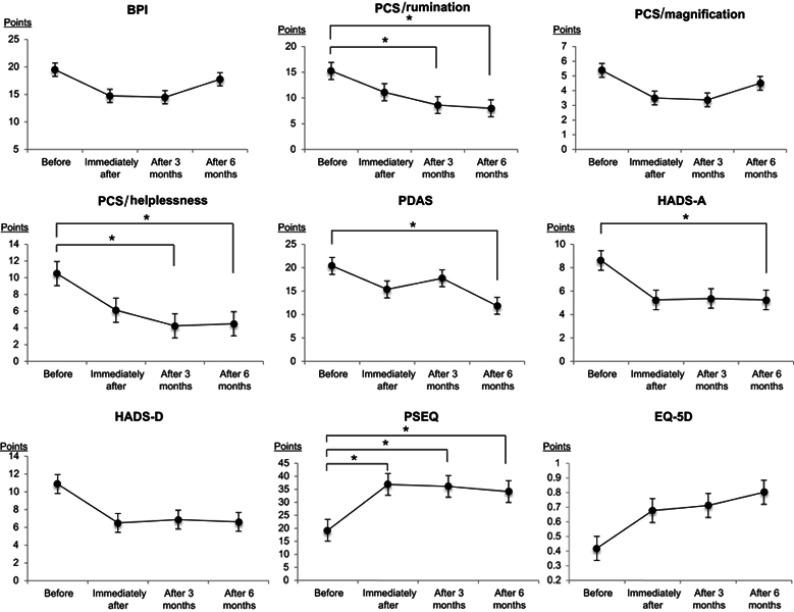
Data for 23 patients were analyzed before and immediately after the program. Statistically significant improvements were seen in BPI, PCS, PDAS, HADS, PSEQ, EQ-5D, flexibility, muscle endurance, walking ability, and physical fitness. Eight patients were also assessed 3 and 6 months after the program. PCS (rumination and helplessness) scores and flexibility showed significant improvement at 3 and 6 months. Significant improvement was seen in PDAS and HADS (anxiety) scores and muscle endurance at 6 months, and in PSEQ scores immediately and at 3 and 6 months.
CONCLUSION
Our inpatient pain management program can improve patients' physical function and ability to cope with chronic musculoskeletal pain, which supports improved quality of life. Our program is currently being expanded to better assist patients with chronic musculoskeletal pain.
引言
多学科疼痛管理是治疗慢性肌肉骨骼疼痛的一种有效方法。目前,日本很少有机构提供多学科疼痛治疗,尤其是在住院环境中。我们基于国际疼痛研究协会的建议实施了一项多学科疼痛管理计划。本研究描述了我们实施该计划的初步努力,并报告了3个月和6个月的随访结果。
材料与方法
我们的疼痛管理团队包括骨科医生、精神科医生、护士、物理治疗师、临床心理学家、药剂师和营养师。为期3周的住院疼痛管理计划包括运动疗法、心理治疗和患者教育。我们使用简明疼痛评估量表(BPI)、疼痛灾难化量表(PCS)、疼痛残疾评估量表(PDAS)、医院焦虑抑郁量表(HADS)、疼痛自我效能问卷(PSEQ)、欧洲五维健康量表(EQ-5D)以及体格检查(灵活性、肌肉耐力、行走能力和身体素质)对患者进行评估。在Friedman检验后,使用配对t检验和经Bonferroni校正的Wilcoxon配对符号秩和检验进行统计分析。
结果
对23例患者在计划实施前和实施后立即进行了数据分析。在BPI、PCS、PDAS、HADS、PSEQ、EQ-5D、灵活性、肌肉耐力、行走能力和身体素质方面均有统计学意义的改善。8例患者在计划实施后3个月和6个月也进行了评估。PCS(反复思考和无助感)评分和灵活性在3个月和6个月时显示出显著改善。6个月时,PDAS和HADS(焦虑)评分以及肌肉耐力有显著改善,PSEQ评分在即刻、3个月和6个月时均有显著改善。
结论
我们的住院疼痛管理计划可以改善患者的身体功能以及应对慢性肌肉骨骼疼痛的能力,这有助于提高生活质量。我们的计划目前正在扩大,以更好地帮助慢性肌肉骨骼疼痛患者。


 Zotero 插件