
锌缺乏对大鼠血清、粪便、尿液和肝脏中十二种矿物质及微量元素稳态的影响。
The effects of zinc deficiency on homeostasis of twelve minerals and trace elements in the serum, feces, urine and liver of rats.
作者信息
Yu Qingli, Sun Xiaohan, Zhao Jiali, Zhao Lan, Chen Yanfeng, Fan Lina, Li Zixiang, Sun Yongzhi, Wang Maoqing, Wang Fan
机构信息
1National Key Disciplines of Nutrition and Food Hygiene, Department of Nutrition and Food Hygiene, School of Public Health, Harbin Medical University, 157 Baojian Road,Nanggang District, Harbin, China.
2Department of Pediatrics, The Second Affiliated Hospital of Harbin Medical University, Harbin Medical University, Harbin, Heilongjiang Province China.
出版信息
Nutr Metab (Lond). 2019 Oct 30;16:73. doi: 10.1186/s12986-019-0395-y. eCollection 2019.
BACKGROUND
Zinc deficiency can change the concentrations of minerals and trace elements in the body. However, previous studies still had many limitations.
OBJECTIVE
To reveal the effects of zinc deficiency on homeostasis of 16 minerals and trace elements.
METHODS
Forty-five rats were divided randomly into three groups: normal zinc diet (30 mg/kg), low zinc diet (10 mg/kg), and pair-fed diet(30 mg/kg). The concentrations of 16 minerals and trace elements in serum, feces, urine, and liver were measured by inductively coupled plasma mass spectrometry. The excretion of 16 elements in urine and feces were calculated and compared.
RESULTS
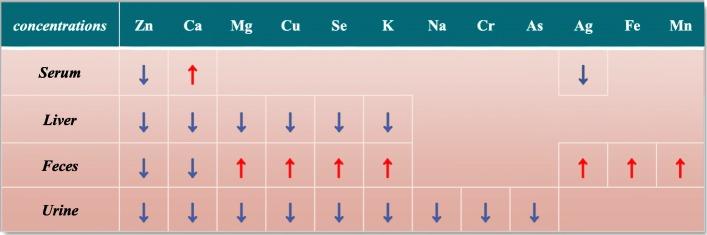
Zinc-deficient rats exhibited significant changes in up to 12 minerals and trace elements. The low zinc diet induced decreased excretion of zinc and concentrations of zinc in serum, feces, urine, and liver. Zinc deficiency increased feces concentrations of Mg, Cu, Se, K, Ag, Fe and Mn; decreased the concentrations of Mg, Cu, Se, K in liver and urine, and a diminished amount of Ag was observed in serum. Decreased urinary concentrations of Zn Ca, Mg, Cu, Se, K, Na, As and Cr, suggested that zinc-deficient rats increased the 9 elements' renal reabsorption. Decreased concentrations of Ca in liver, urine, and feces, decreased excretion in urine and feces and increased serum total Ca suggested that zinc deficiency increased the redistribution of Ca in serum or other tissues. Zinc deficiency increased excretion of Cu, Se, Fe; and decreased the excretion of other 8 elements except for Ag.
CONCLUSIONS
Zinc deficiency changed the excretion, reabsorption and redistribution of 12 minerals and trace elements in rats. Our findings are the first to show that zinc deficiency alters the concentrations of Ag, Cr, and As.
SUPPLEMENTARY INFORMATION
accompanies this paper at 10.1186/s12986-019-0395-y.
背景
锌缺乏会改变体内矿物质和微量元素的浓度。然而,以往的研究仍存在许多局限性。
目的
揭示锌缺乏对16种矿物质和微量元素稳态的影响。
方法
将45只大鼠随机分为三组:正常锌饮食组(30毫克/千克)、低锌饮食组(10毫克/千克)和配对喂养组(30毫克/千克)。采用电感耦合等离子体质谱法测定血清、粪便、尿液和肝脏中16种矿物质和微量元素的浓度。计算并比较尿液和粪便中16种元素的排泄量。
结果
缺锌大鼠体内多达12种矿物质和微量元素出现显著变化。低锌饮食导致锌排泄减少以及血清、粪便、尿液和肝脏中锌浓度降低。锌缺乏使粪便中镁、铜、硒、钾、银、铁和锰的浓度升高;肝脏和尿液中镁、铜、硒、钾的浓度降低,血清中银含量减少。尿液中锌、钙、镁、铜、硒、钾、钠、砷和铬的浓度降低,表明缺锌大鼠增加了这9种元素的肾重吸收。肝脏、尿液和粪便中钙浓度降低,尿液和粪便中排泄减少,血清总钙升高,表明锌缺乏增加了钙在血清或其他组织中的重新分布。锌缺乏增加了铜、硒、铁的排泄;除银外,其他8种元素的排泄减少。
结论
锌缺乏改变了大鼠体内12种矿物质和微量元素的排泄、重吸收和重新分布。我们的研究结果首次表明锌缺乏会改变银、铬和砷的浓度。
补充信息
本文的补充信息见10.1186/s12986-019-0395-y。


 Zotero 插件