
度洛西汀治疗骨关节炎的短期疗效及安全性:一项系统评价与荟萃分析。
The short-term effect and safety of duloxetine in osteoarthritis: A systematic review and meta-analysis.
作者信息
Gao Shi-Hua, Huo Jian-Bin, Pan Qi-Mou, Li Xi-Wen, Chen Hai-Yun, Huang Jun-Han
机构信息
The Second Affiliated Hospital of Guangzhou University of Chinese Medicine, Guangzhou, China.
出版信息
Medicine (Baltimore). 2019 Nov;98(44):e17541. doi: 10.1097/MD.0000000000017541.
BACKGROUND
Previous clinical trials indicated that duloxetine may be effective in the treatment of osteoarthritis (OA) pain. This meta-analysis is conducted to evaluate short term analgesic effect and safety of duloxetine in the treatment of OA.
METHODS
Electronic databases were searched in February 2019, including PUBMED, EMBASE, Cochrane Database of Systematic Reviews, Cochrane Central Register of Controlled Trials, Web of Science. All eligible studies should be randomized controlled trials (RCTs) comparing duloxetine treatment group to placebo about OA pain relief and safety outcomes.
RESULTS
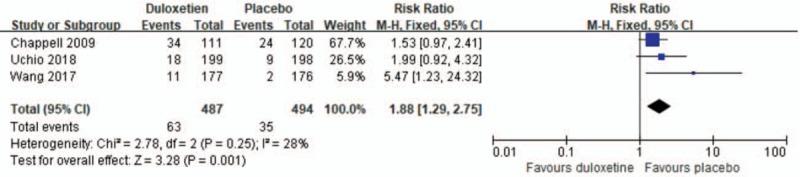
Five RCTs with 2059 patients were involved in this systematic review and meta-analysis. Compared to placebo, duloxetine treatment showed significant better result, with higher reduction pain intensity (mean difference [MD] = -0.77, P < .00001), higher rates of both 30% and 50% reduction in pain severity (risk ratio [RR] = 1.42, P < .00001; RR = 1.62, P < .00001), lower mean Patient Global Improvement-Inventory (PGI-I) score (MD = -0.48, P < .00001). The results of the Western Ontario and McMaster Universities (WOMAC) score change from baseline to endpoint also favored duloxetine treatment group in all four categories, including total (MD = -5.43, P < .00001), pain (MD = -1.63, P = .001), physical function (MD = -4.22, P < .00001), and stiffness score (MD = -0.58, P < .00001). There were higher rates of treatment-emergent adverse events (TEAEs) (RR = 1.32, P < .00001) and discontinuation (RR = 1.88, P < .00001) in duloxetine group. However, there was no significant difference in the incidence of severe adverse events (SAEs) between these 2 groups (RR = 0.84, P = .68).
CONCLUSION
Duloxetine was an effective and safe choice to improve pain and functional outcome in OA patients. However, further studies are still needed to find out the optimal dosage for OA and examine its long-term efficacy and safety.
TRIAL REGISTRATION NUMBER
CRD42019128862.
背景
既往临床试验表明,度洛西汀可能对骨关节炎(OA)疼痛的治疗有效。本荟萃分析旨在评估度洛西汀治疗OA的短期镇痛效果及安全性。
方法
于2019年2月检索电子数据库,包括PUBMED、EMBASE、Cochrane系统评价数据库、Cochrane对照试验中心注册库、科学网。所有符合条件的研究均应为比较度洛西汀治疗组与安慰剂组在OA疼痛缓解及安全性结局方面的随机对照试验(RCT)。
结果
本系统评价和荟萃分析纳入了5项RCT,共2059例患者。与安慰剂相比,度洛西汀治疗显示出显著更好的结果,疼痛强度降低幅度更大(平均差[MD]= -0.77,P <.00001),疼痛严重程度降低30%和50%的发生率更高(风险比[RR]= 1.42,P <.00001;RR = 1.62,P <.00001),患者总体改善量表(PGI-I)平均得分更低(MD = -0.48,P <.00001)。西安大略和麦克马斯特大学骨关节炎指数(WOMAC)评分从基线到终点的变化结果在所有四个类别中也有利于度洛西汀治疗组,包括总分(MD = -5.43,P <.00001)、疼痛(MD = -1.63,P =.001)、身体功能(MD = -4.22,P <.00001)和僵硬评分(MD = -0.58,P <.00001)。度洛西汀组治疗中出现的不良事件(TEAE)发生率(RR = 1.32,P <.00001)和停药率(RR = 1.88,P <.00001)更高。然而,两组间严重不良事件(SAE)的发生率无显著差异(RR = 0.84,P =.68)。
结论
度洛西汀是改善OA患者疼痛和功能结局的有效且安全的选择。然而,仍需要进一步研究以确定OA的最佳剂量,并考察其长期疗效和安全性。
试验注册号
CRD42019128862。


 Zotero 插件