
源自具有不同侵袭特性的肝癌细胞的外泌体通过TGF-β/Smad信号通路介导上皮-间质转化。
Exosomes derived from HCC cells with different invasion characteristics mediated EMT through TGF-β/Smad signaling pathway.
作者信息
Qu Zhen, Feng Jiawei, Pan Hua, Jiang Yong, Duan Yunfei, Fa Zhenzhong
机构信息
Department of Hepatopancreatobiliary Surgery, The First People's Hospital of Changzhou, the Third Hospital Affiliated to Soochow University, Changzhou, Jiangsu, People's Republic of China.
Department of Hepatobiliary Surgery, The People's Hospital of Liyang, Liyang, Jiangsu, People's Republic of China.
出版信息
Onco Targets Ther. 2019 Aug 23;12:6897-6905. doi: 10.2147/OTT.S209413. eCollection 2019.
BACKGROUND
Exosomes are nano-sized biological vesicles released by many kinds of cells, which play an important role in tumor metastasis through transporting cytokines, RNAs and proteins. However, the molecular mechanisms of exosomes in hepatocellular carcinoma (HCC) metastasis are not completely understood.
MATERIALS AND METHODS
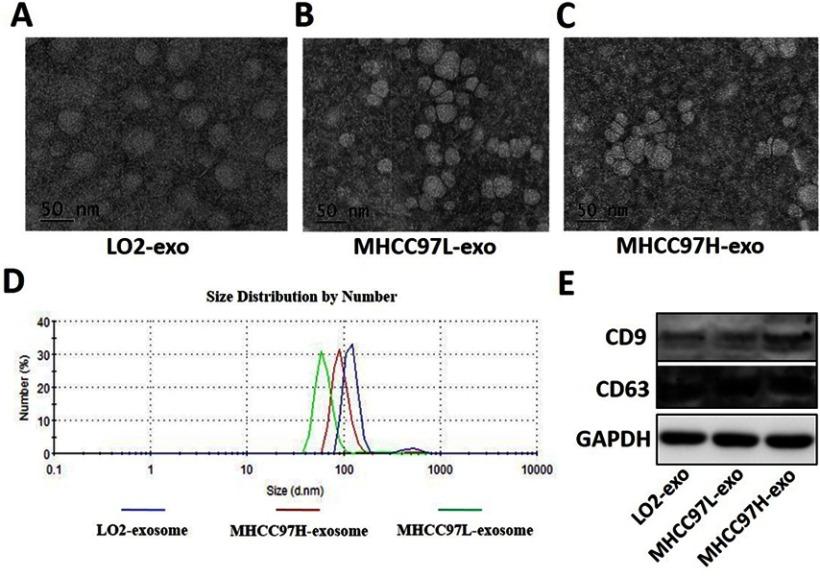
Exosomes derived from hepatoma cell lines with different invasion characteristics. Exosome characteristics, cell migration and invasion, and effects on major signal transduction pathways deregulated in cancer cells were analyzed by transmission electron microscopy (TEM), wound-healing assay, Trans-well invasion assay and Western blot-based assays, respectively. Moreover, exosomes effects on tumor metastasis in vivo were investigated by subcutaneous transplantation tumor model of athymic nude mice.
RESULTS
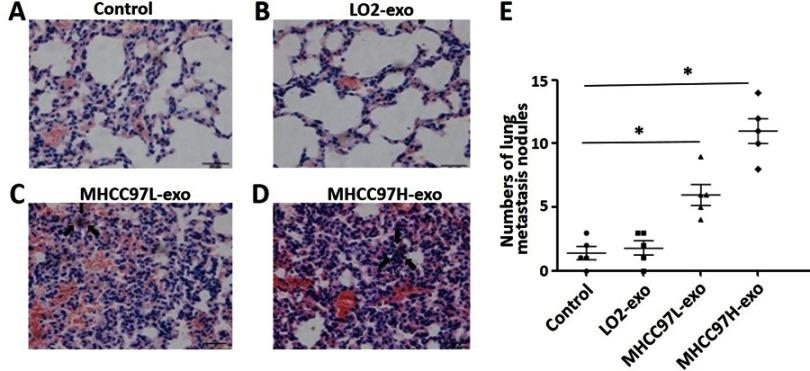
Exosomes derived from hepatoma cells can promote the migration and invasion of recipient cells, induce the decrease of E-cadherin expression, increase the expression of Vimentin and promote epithelial-mesenchymal transition (EMT) in cells. Moreover, highly invasive hepatoma-cells-derived exosomes effects are stronger than low-invasive hepatoma cells and normal liver cells exosomes. Mechanistic studies showed that the biological alterations in recipient HCC cells treated with MHCC97H and MHCC97L-derived exosomes were caused by inducing EMT via TGF-β/Smad signaling pathway. In vivo experiments also suggest that highly invasive hepatoma cells derived exosomes are more likely to promote lung metastasis of HCC in nude mice.
CONCLUSION
Our results reveal the important role of tumor-derived exosomes in the migration and invasion of recipient cells and exosomes may be the novel therapeutic and prognostic targets for HCC patients.
背景
外泌体是多种细胞释放的纳米级生物囊泡,通过运输细胞因子、RNA和蛋白质在肿瘤转移中发挥重要作用。然而,外泌体在肝细胞癌(HCC)转移中的分子机制尚未完全阐明。
材料与方法
从具有不同侵袭特性的肝癌细胞系中提取外泌体。分别通过透射电子显微镜(TEM)、伤口愈合试验、Trans-well侵袭试验和基于蛋白质免疫印迹的试验分析外泌体特征、细胞迁移和侵袭以及对癌细胞中主要信号转导通路失调的影响。此外,通过无胸腺裸鼠皮下移植瘤模型研究外泌体对体内肿瘤转移的影响。
结果
肝癌细胞来源的外泌体可促进受体细胞的迁移和侵袭,诱导E-钙黏蛋白表达降低,增加波形蛋白表达并促进细胞上皮-间质转化(EMT)。此外,高侵袭性肝癌细胞来源的外泌体作用强于低侵袭性肝癌细胞和正常肝细胞来源的外泌体。机制研究表明,用MHCC97H和MHCC97L来源的外泌体处理的受体肝癌细胞中的生物学改变是由通过TGF-β/Smad信号通路诱导EMT引起的。体内实验还表明,高侵袭性肝癌细胞来源的外泌体更有可能促进裸鼠肝癌的肺转移。
结论
我们的结果揭示了肿瘤来源的外泌体在受体细胞迁移和侵袭中的重要作用,外泌体可能是HCC患者新的治疗和预后靶点。


 Zotero 插件