
邮寄人乳头瘤病毒检测试剂盒与常规护理提醒对宫颈癌筛查率、癌前病变检出率和治疗效果的影响:一项随机临床试验。
Effect of Mailed Human Papillomavirus Test Kits vs Usual Care Reminders on Cervical Cancer Screening Uptake, Precancer Detection, and Treatment: A Randomized Clinical Trial.
机构信息
Department of Epidemiology, University of Washington, Seattle.
Kaiser Permanente Washington Health Research Institute, Seattle.
出版信息
JAMA Netw Open. 2019 Nov 1;2(11):e1914729. doi: 10.1001/jamanetworkopen.2019.14729.
IMPORTANCE
In the United States, more than 50% of cervical cancers are diagnosed in underscreened women. Cervical cancer screening guidelines now include primary human papillomavirus (HPV) testing as a recommended strategy. Home-based HPV self-sampling is a viable option for increasing screening compliance and effectiveness; however, US data are needed to inform health care system implementation.
OBJECTIVE
To evaluate effectiveness of mailed HPV self-sampling kits vs usual care reminders for in-clinic screening to increase detection and treatment of cervical intraepithelial neoplasia grade 2 or worse (CIN2+) and uptake of cervical cancer screening.
DESIGN, SETTING, AND PARTICIPANTS: Randomized clinical trial conducted in Kaiser Permanente Washington, a US integrated health care delivery system. Women aged 30 to 64 years with health plan enrollment for 3 years and 5 months or more, a primary care clinician, no Papanicolaou test within 3 years and 5 months, and no hysterectomy were identified through electronic medical records and enrolled from February 25, 2014, to August 29, 2016, with follow-up through February 26, 2018.
INTERVENTIONS
The control group received usual care (annual patient reminders and ad hoc outreach from primary care clinics). The intervention group received usual care plus a mailed HPV self-sampling kit.
MAIN OUTCOMES AND MEASURES
Two primary outcomes were (1) CIN2+ detection within 6 months of screening and (2) treatment within 6 months of CIN2+ detection. Screening uptake within 6 months of randomization was a secondary outcome.
RESULTS
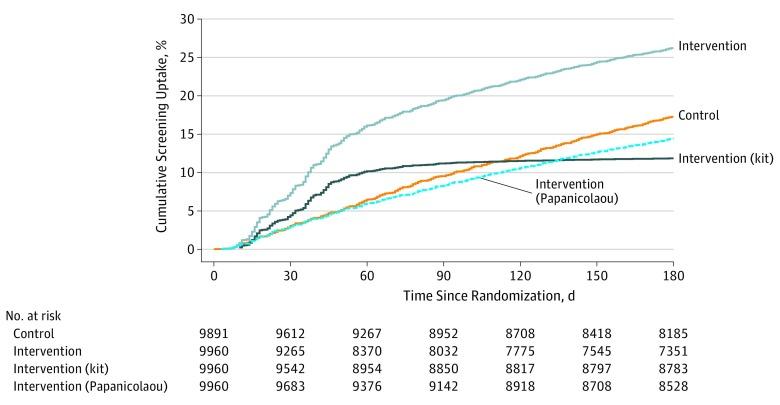
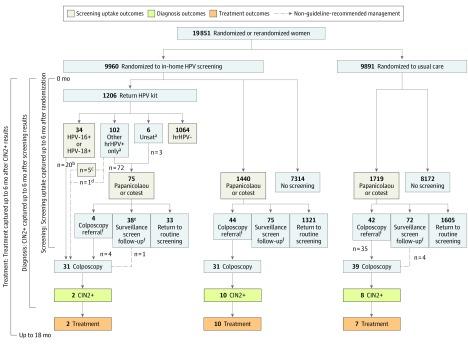
A total of 19 851 women (mean [SD] age, 50.1 [9.5] years) were included, with 9960 randomized to the intervention group and 9891 randomized to the control group. All women randomized were included in analysis. In the intervention group, 12 participants with CIN2+ were detected compared with 8 in the control group (relative risk, 1.49; 95% CI, 0.61-3.64) and 12 cases were treated vs 7 in the control group (relative risk, 1.70; 95% CI, 0.67-4.32). Screening uptake was higher in the intervention group (2618 participants [26.3%] vs 1719 participants [17.4%]; relative risk, 1.51; 95% CI, 1.43-1.60).
CONCLUSIONS AND RELEVANCE
Mailing HPV kits to underscreened women increased screening uptake compared with usual care alone, with no significant differences in precancer detection or treatment. Results support the feasibility of mailing HPV kits to women who are overdue for screening as an outreach strategy to increase screening uptake in US health care systems. Efforts to increase kit uptake and follow-up of positive results are warranted to maximize detection and treatment of CIN2+.
TRIAL REGISTRATION
ClinicalTrials.gov identifier: NCT02005510.
重要性
在美国,超过 50%的宫颈癌是在筛查不足的女性中诊断出来的。宫颈癌筛查指南现在包括初级人乳头瘤病毒(HPV)检测作为推荐策略。基于家庭的 HPV 自我采样是提高筛查依从性和效果的可行选择;然而,需要美国数据来为医疗保健系统的实施提供信息。
目的
评估邮寄 HPV 自我采样试剂盒与常规护理提醒相比,对增加宫颈上皮内瘤变 2 级或更高级别(CIN2+)的检出率和治疗率以及增加宫颈癌筛查率的有效性。
设计、地点和参与者:在美国综合医疗保健提供系统凯泽 Permanente Washington 进行的随机临床试验。通过电子病历确定了年龄在 30 至 64 岁之间、健康计划参与时间为 3 年零 5 个月或以上、有初级保健医生、在过去 3 年零 5 个月内没有巴氏试验和没有子宫切除术的女性,并于 2014 年 2 月 25 日至 2016 年 8 月 29 日登记入组,随访至 2018 年 2 月 26 日。
干预措施
对照组接受常规护理(年度患者提醒和初级保健诊所的临时外展)。干预组接受常规护理加邮寄 HPV 自我采样试剂盒。
主要结局和测量
两个主要结局是(1)筛查后 6 个月内 CIN2+的检出率和(2)CIN2+检出后 6 个月内的治疗率。随机分组后 6 个月内的筛查率是次要结局。
结果
共纳入 19851 名女性(平均[标准差]年龄,50.1[9.5]岁),其中 9960 名随机分配至干预组,9891 名随机分配至对照组。所有随机分组的女性均纳入分析。在干预组中,与对照组(8 例)相比,12 例患者检测出 CIN2+(相对风险,1.49;95%置信区间,0.61-3.64),12 例患者接受治疗,而对照组为 7 例(相对风险,1.70;95%置信区间,0.67-4.32)。干预组的筛查率更高(2618 名参与者[26.3%]与 1719 名参与者[17.4%];相对风险,1.51;95%置信区间,1.43-1.60)。
结论和相关性
与单独常规护理相比,向筛查不足的女性邮寄 HPV 试剂盒增加了筛查率,在癌前病变的检出率或治疗率方面没有显著差异。结果支持向需要筛查的女性邮寄 HPV 试剂盒作为一种外联策略的可行性,以增加美国医疗保健系统的筛查率。需要努力提高试剂盒的使用率和对阳性结果的随访,以最大限度地提高 CIN2+的检出率和治疗率。
试验注册
ClinicalTrials.gov 标识符:NCT02005510。

 Zotero 插件