
瘦素、肥胖和瘦素抵抗:25 年后我们在哪里?
Leptin, Obesity, and Leptin Resistance: Where Are We 25 Years Later?
机构信息
Laboratory of Epigenomics in Endocrinology and Nutrition, Epigenomics Unit, Instituto de Investigacion Sanitaria de Santiago (IDIS), Complejo Hospitalario Universitario de Santiago (CHUS/SERGAS), 15706 Santiago de Compostela, Spain.
CIBER de Fisiopatologia de la Obesidad y Nutricion (CIBERobn), Instituto Salud Carlos III, 28029 Madrid, Spain.
出版信息
Nutrients. 2019 Nov 8;11(11):2704. doi: 10.3390/nu11112704.
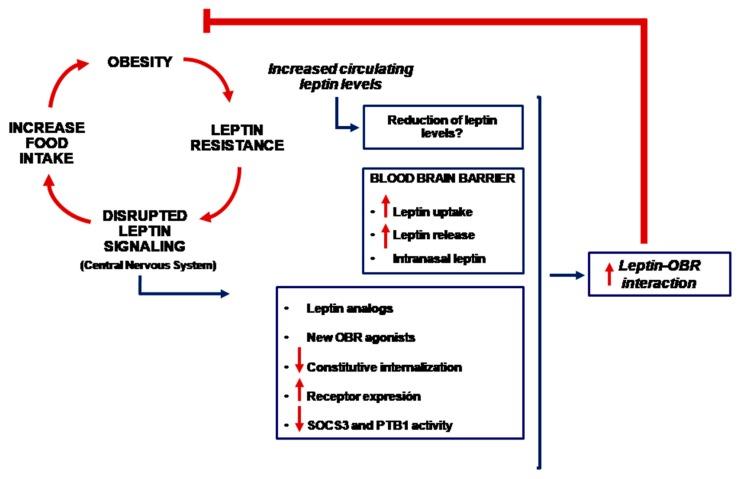
Leptin, a hormone that is capable of effectively reducing food intake and body weight, was initially considered for use in the treatment of obesity. However, obese subjects have since been found to have high levels of circulating leptin and to be insensitive to the exogenous administration of leptin. The inability of leptin to exert its anorexigenic effects in obese individuals, and therefore, the lack of clinical utility of leptin in obesity, is defined as leptin resistance. This phenomenon has not yet been adequately characterized. Elucidation of the molecular mechanisms underlying leptin resistance is of vital importance for the application of leptin as an effective treatment for obesity. Leptin must cross the blood-brain barrier (BBB) to reach the hypothalamus and exert its anorexigenic functions. The mechanisms involved in leptin transportation across the blood-brain barrier continue to be unclear, thereby preventing the clinical application of leptin in the treatment of obesity. In recent years, new strategies have been developed to recover the response to leptin in obesity. We have summarized these strategies in this review.
瘦素是一种能够有效减少食物摄入和体重的激素,最初被认为可用于治疗肥胖症。然而,肥胖患者的循环瘦素水平较高,且对外源给予的瘦素不敏感,这一现象被称为瘦素抵抗。目前尚未充分阐明瘦素抵抗的分子机制。阐明瘦素抵抗的分子机制对于将瘦素作为肥胖症的有效治疗方法具有重要意义。瘦素必须穿过血脑屏障(BBB)到达下丘脑才能发挥其抑制食欲的作用。瘦素穿过血脑屏障的运输机制尚不清楚,从而阻碍了瘦素在肥胖症治疗中的临床应用。近年来,人们开发了新的策略来恢复肥胖患者对瘦素的反应。我们在本文中对这些策略进行了总结。

 Zotero 插件