
帕博利珠单抗治疗难治性、微卫星不稳定/错配修复缺陷型转移性结直肠癌的 II 期开放标签研究:KEYNOTE-164。
Phase II Open-Label Study of Pembrolizumab in Treatment-Refractory, Microsatellite Instability-High/Mismatch Repair-Deficient Metastatic Colorectal Cancer: KEYNOTE-164.
机构信息
Sidney Kimmel Comprehensive Cancer Center at Johns Hopkins, Baltimore, MD.
Asan Medical Center, Seoul, Republic of Korea.
出版信息
J Clin Oncol. 2020 Jan 1;38(1):11-19. doi: 10.1200/JCO.19.02107. Epub 2019 Nov 14.
PURPOSE
KEYNOTE-164 (NCT02460198) evaluated the antitumor activity of pembrolizumab in previously treated, metastatic, microsatellite instability-high/mismatch repair-deficient (MSI-H/dMMR) colorectal cancer (CRC).
METHODS
This phase II open-label study involved 128 centers worldwide. Eligible patients were age ≥ 18 years and had metastatic MSI-H/dMMR CRC treated with ≥ 2 prior lines of standard therapy, including fluoropyrimidine, oxaliplatin, and irinotecan with or without anti-vascular endothelial growth factor/epidermal growth factor receptor monoclonal antibody (cohort A) or ≥ 1 prior line of therapy (cohort B). MSI-H/dMMR status was assessed locally. Patients received pembrolizumab 200 mg every 3 weeks for up to 2 years until progression, unacceptable toxicity, or withdrawal. The primary end point was objective response rate by RECIST version 1.1 by independent central review. Secondary end points were duration of response, progression-free survival (PFS), overall survival, safety, and tolerability.
RESULTS
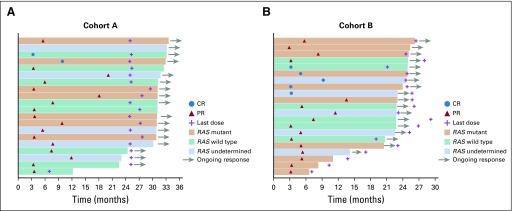
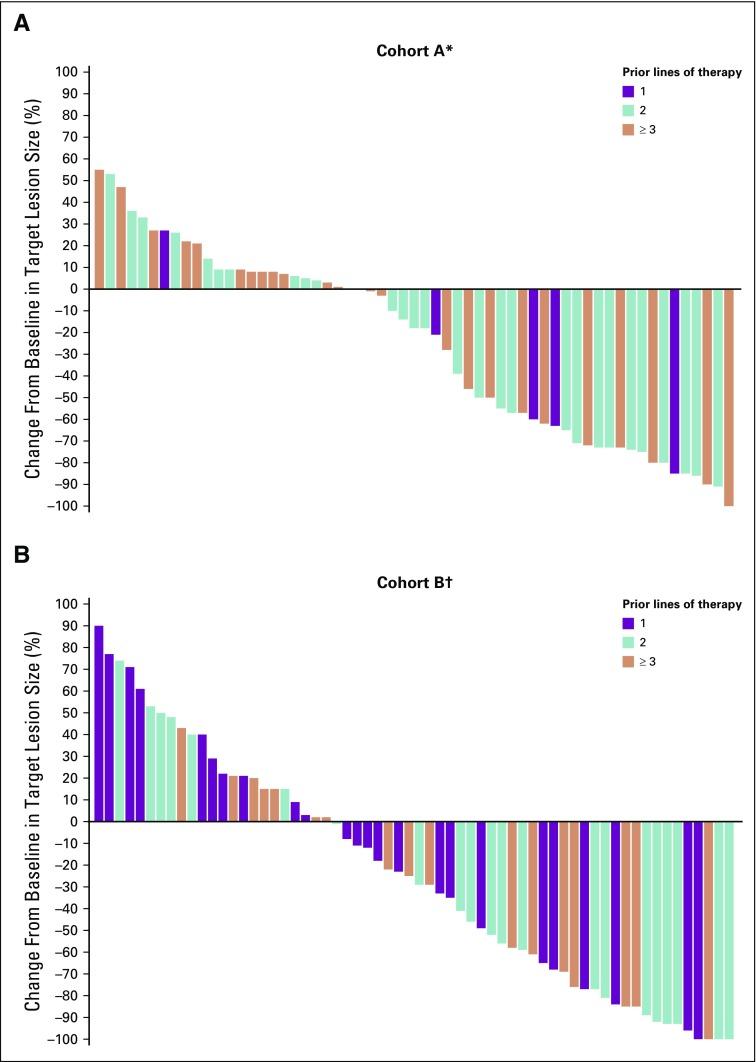
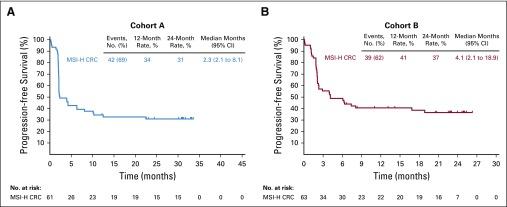
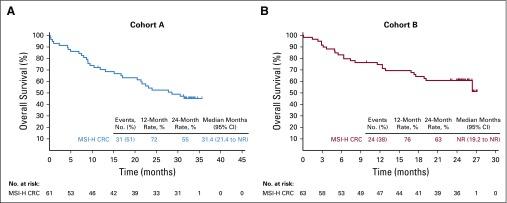
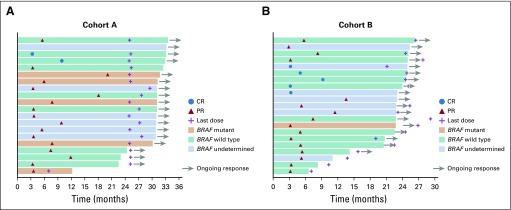
A total of 124 patients with MSI-H/dMMR CRC (61 in cohort A, 63 in cohort B) enrolled. At data cutoff, median follow-up was 31.3 months (range, 0.2-35.6 months) for cohort A and 24.2 months (range, 0.1-27.1 months) for cohort B. Objective response rate was 33% (95% CI, 21% to 46%) and 33% (95% CI, 22% to 46%), respectively, with median duration of response not reached in either cohort. Median PFS was 2.3 months (95% CI, 2.1 to 8.1 months) and 4.1 months (95% CI, 2.1 to 18.9 months). Median overall survival was 31.4 months (95% CI, 21.4 months to not reached) and not reached (95% CI, 19.2 months to not reached). Treatment-related grade 3-4 adverse events occurred in 10 patients (16%) in cohort A and 8 (13%) in cohort B, with the most common occurring in ≥ 2 patients being pancreatitis, fatigue, increased alanine aminotransferase, and increased lipase (2 patients each; 3%) in cohort A.
CONCLUSION
Pembrolizumab is effective with a manageable safety profile in patients with MSI-H/dMMR CRC.
目的
KEYNOTE-164(NCT02460198)评估了帕博利珠单抗在先前治疗的转移性微卫星不稳定高/错配修复缺陷(MSI-H/dMMR)结直肠癌(CRC)患者中的抗肿瘤活性。
方法
这是一项在全球范围内开展的 128 个中心参与的 II 期开放标签研究。入组患者年龄≥18 岁,且既往接受过≥2 线标准治疗,包括氟嘧啶类药物、奥沙利铂和伊立替康,或联合或不联合抗血管内皮生长因子/表皮生长因子受体单克隆抗体(队列 A),或接受过≥1 线治疗(队列 B),转移性 MSI-H/dMMR CRC。MSI-H/dMMR 状态由当地评估。患者接受帕博利珠单抗 200mg,每 3 周 1 次,最长治疗 2 年,直至疾病进展、无法耐受毒性或停药。主要终点为独立中心评估的 RECIST 版本 1.1 的客观缓解率。次要终点包括缓解持续时间、无进展生存期(PFS)、总生存期、安全性和耐受性。
结果
共纳入 124 例 MSI-H/dMMR CRC 患者(队列 A 61 例,队列 B 63 例)。数据截止时,队列 A 的中位随访时间为 31.3 个月(范围:0.2-35.6 个月),队列 B 为 24.2 个月(范围:0.1-27.1 个月)。队列 A 和队列 B 的客观缓解率分别为 33%(95%CI:21%-46%)和 33%(95%CI:22%-46%),缓解持续时间均未达到中位值。队列 A 和队列 B 的中位 PFS 分别为 2.3 个月(95%CI:2.1-8.1 个月)和 4.1 个月(95%CI:2.1-18.9 个月)。中位总生存期分别为 31.4 个月(95%CI:21.4 个月至未达到)和未达到(95%CI:19.2 个月至未达到)。队列 A 和队列 B 各有 10 例(16%)和 8 例(13%)患者发生治疗相关的 3-4 级不良事件,最常见的事件包括胰腺炎、乏力、丙氨酸氨基转移酶升高和脂肪酶升高(各 2 例;3%)。
结论
帕博利珠单抗在 MSI-H/dMMR CRC 患者中具有良好的抗肿瘤活性和可管理的安全性。

 Zotero 插件