
美国老年人群中不同种族和族裔的健康状况负担:伤残调整生命年
The burden of health conditions across race and ethnicity for aging Americans: Disability-adjusted life years.
作者信息
McGrath Ryan P, Snih Soham Al, Markides Kyriakos S, Faul Jessica D, Vincent Brenda M, Hall Orman T, Peterson Mark D
机构信息
Department of Health, Nutrition, and Exercise Sciences, North Dakota State University, Fargo, ND.
Division of Rehabilitation Sciences.
出版信息
Medicine (Baltimore). 2019 Nov;98(46):e17964. doi: 10.1097/MD.0000000000017964.
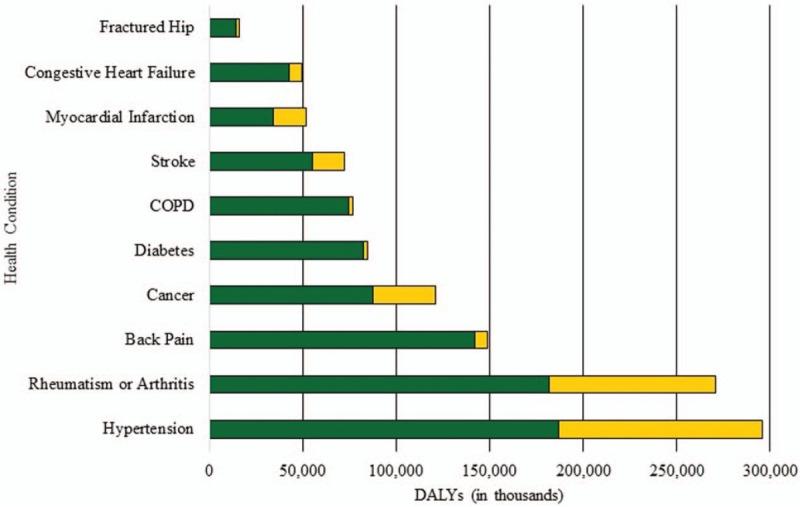
Despite evidence suggesting race and ethnicity are important factors in responses to environmental exposures, drug therapies, and disease risk, few studies focus on the health needs of racially- and ethnically-diverse aging adults.The objective of this study was to determine the burden of 10 health conditions across race and ethnicity for a nationally-representative sample of aging Americans.Data from the 1998 to 2014 waves of the Health and Retirement Study, an ongoing longitudinal-panel study, were analyzed.Those aged over 50 years who identified as Black, Hispanic, or White were included. There were 5510 Blacks, 3423 Hispanics, and 21,168 Whites in the study.At each wave, participants reported if they had cancer, chronic obstructive pulmonary disease, congestive heart failure, diabetes, back pain, hypertension, a fractured hip, myocardial infarction, rheumatism or arthritis, and a stroke. Disability-adjusted life years (DALYs) were calculated for each health condition by race and ethnicity. Ranked DALYs determined how race and ethnicity was differentially impacted by the burden of each health condition. Sample weights were utilized to make DALY estimates nationally-representative.Weighted DALY estimates (in thousands) ranged from 1405 to 55,631 for Blacks, 931 to 28,442 for Hispanics, and 15,313 to 295,623 for Whites. Although the health conditions affected each race and ethnicity differently, hypertension had the largest number of DALYs, and hip fractures had the fewest across race and ethnicity. In total, there were an estimated 198,621, 101,462, and 1,187,725 DALYs for older Black, Hispanic, and White aging adults.Our findings indicate that race and ethnicity may be influential on health and disease for aging adults in the United States. Monitoring DALYs may help guide the flow of health-related expenditures, improve the impact of health interventions, advance inclusive health care for diverse aging adult populations, and prepare healthcare providers for serving the health needs of aging adults.
尽管有证据表明种族和族裔是影响对环境暴露、药物治疗和疾病风险反应的重要因素,但很少有研究关注不同种族和族裔的老年成年人的健康需求。本研究的目的是确定美国具有全国代表性的老年样本中10种健康状况在不同种族和族裔中的负担情况。对健康与退休研究(一项正在进行的纵向面板研究)1998年至2014年各轮的数据进行了分析。纳入了年龄超过50岁且自认为是黑人、西班牙裔或白人的参与者。研究中有5510名黑人、3423名西班牙裔和21168名白人。在每一轮中,参与者报告他们是否患有癌症、慢性阻塞性肺疾病、充血性心力衰竭、糖尿病、背痛、高血压、髋部骨折、心肌梗死、风湿或关节炎以及中风。按种族和族裔计算了每种健康状况的伤残调整生命年(DALYs)。排名后的DALYs确定了种族和族裔如何受到每种健康状况负担的不同影响。使用样本权重使DALY估计具有全国代表性。黑人的加权DALY估计值(以千为单位)在1405至55631之间,西班牙裔在931至28442之间,白人在15313至295623之间。尽管这些健康状况对每个种族和族裔的影响不同,但高血压的DALYs数量最多,髋部骨折在所有种族和族裔中最少。总体而言,老年黑人、西班牙裔和白人的DALYs估计分别为198621、101462和1187725。我们的研究结果表明,种族和族裔可能对美国老年成年人的健康和疾病有影响。监测DALYs可能有助于指导与健康相关的支出流向,提高健康干预的效果,推进针对不同老年人群体的包容性医疗保健,并使医疗保健提供者为满足老年成年人的健康需求做好准备。


 Zotero 插件