
2 型糖尿病中间临床结局的临床和患者差异:一项多层次分析。
Clinic and patient variation in intermediate clinical outcomes for type 2 diabetes: a multilevel analysis.
机构信息
Institute for Clinical Research, National Institutes of Health, Ministry of Health Malaysia, No.1, Jalan Setia Murni U13/52, Setia Alam, Selangor, Malaysia.
Julius Center for Health Sciences and Primary Care, University Medical Center Utrecht, Utrecht, the Netherlands.
出版信息
BMC Fam Pract. 2019 Nov 15;20(1):158. doi: 10.1186/s12875-019-1045-1.
BACKGROUND
Variation at different levels of diabetes care has not yet been quantified for low- and middle-income countries. Understanding this variation and its magnitude is important to guide policy makers in designing effective interventions. This study aims to quantify the variation in the control of glycated haemoglobin (HbA1c), systolic blood pressure (SBP) and low-density lipoprotein cholesterol (LDL-C) for type 2 diabetes (T2D) patients at the clinic and patient level and determine patient and clinic factors associated with control of these outcomes in T2D.
METHODS
This is a cross-sectional study within the baseline data from the impact evaluation of the Enhanced Primary Health Care (EnPHC) intervention on 40 public clinics in Malaysia. Patients aged 30 and above, diagnosed with T2D, had a clinic visit for T2D between 01 Nov 2016 and 30 April 2017 and had at least one HbA1c, SBP and LDL-C measurement within 1 year from the date of visit were included for analysis. Multilevel linear regression adjusting for patient and clinic characteristics was used to quantify variation at the clinic and patient levels for each outcome.
RESULTS
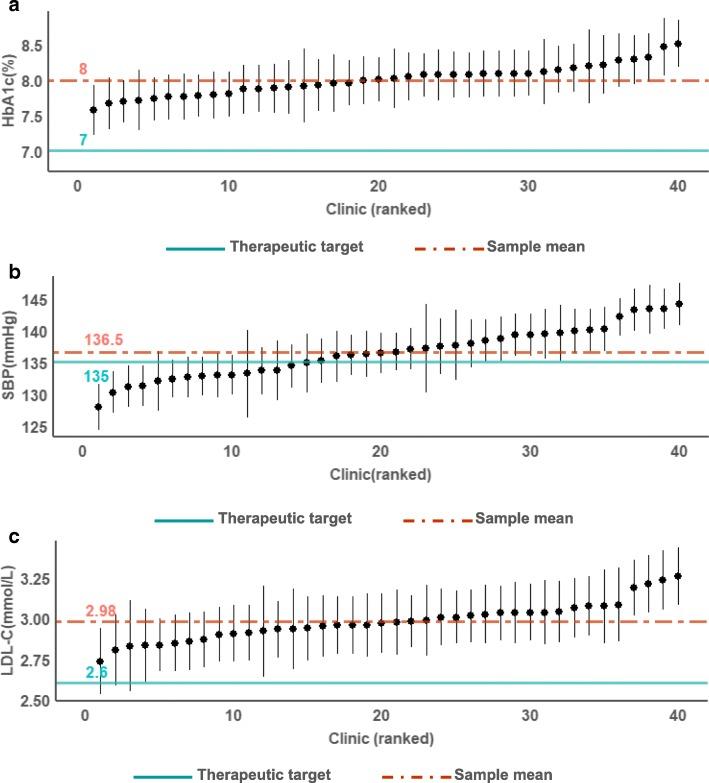
Variation in intermediate clinical outcomes in T2D lies predominantly (93% and above) at the patient level. The strongest predictors for poor disease control in T2D were the proxy measures for disease severity including duration of diabetes, presence of microvascular complications, being on insulin therapy and number of antihypertensives. Among the three outcomes, HbA1c and LDL-C results provide greatest opportunity for improvement.
CONCLUSION
Clinic variation in HbA1c, SBP and LDL-C accounts for a small percentage from total variation. Findings from this study suggest that standardised interventions need to be applied across all clinics, with a focus on customizing therapy based on individual patient characteristics.
背景
不同层次的糖尿病护理的差异在中低收入国家尚未被量化。了解这种差异及其程度对于指导决策者设计有效的干预措施非常重要。本研究旨在量化 2 型糖尿病(T2D)患者在诊所和患者层面上糖化血红蛋白(HbA1c)、收缩压(SBP)和低密度脂蛋白胆固醇(LDL-C)控制的差异,并确定与 T2D 患者这些结果控制相关的患者和诊所因素。
方法
这是马来西亚强化初级卫生保健(EnPHC)干预影响评估基线数据中的一项横断面研究。年龄在 30 岁及以上、被诊断为 T2D、在 2016 年 11 月 1 日至 2017 年 4 月 30 日期间有一次 T2D 就诊、且在就诊日期后 1 年内至少有一次 HbA1c、SBP 和 LDL-C 测量值的患者被纳入分析。使用调整了患者和诊所特征的多水平线性回归来量化每个结局在诊所和患者层面的差异。
结果
T2D 患者中间临床结局的差异主要(93%及以上)存在于患者层面。T2D 控制不良的最强预测因素是疾病严重程度的代理指标,包括糖尿病病程、微血管并发症存在、接受胰岛素治疗和抗高血压药物数量。在这三个结局中,HbA1c 和 LDL-C 结果提供了最大的改善机会。
结论
HbA1c、SBP 和 LDL-C 的诊所差异仅占总差异的一小部分。本研究的结果表明,需要在所有诊所应用标准化干预措施,重点根据患者个体特征定制治疗方案。
 Zotero 插件