
下一代测序的靶向广泛基因检测为肾脏病患者的诊断和治疗提供了信息。
Targeted broad-based genetic testing by next-generation sequencing informs diagnosis and facilitates management in patients with kidney diseases.
机构信息
Iowa Institute of Human Genetics, University of Iowa, Iowa City, IA, USA.
Physiology, Medical College of Wisconsin, Iowa City, IA, USA.
出版信息
Nephrol Dial Transplant. 2021 Jan 25;36(2):295-305. doi: 10.1093/ndt/gfz173.
BACKGROUND
The clinical diagnosis of genetic renal diseases may be limited by the overlapping spectrum of manifestations between diseases or by the advancement of disease where clues to the original process are absent. The objective of this study was to determine whether genetic testing informs diagnosis and facilitates management of kidney disease patients.
METHODS
We developed a comprehensive genetic testing panel (KidneySeq) to evaluate patients with various phenotypes including cystic diseases, congenital anomalies of the kidney and urinary tract (CAKUT), tubulointerstitial diseases, transport disorders and glomerular diseases. We evaluated this panel in 127 consecutive patients ranging in age from newborns to 81 years who had samples sent in for genetic testing.
RESULTS
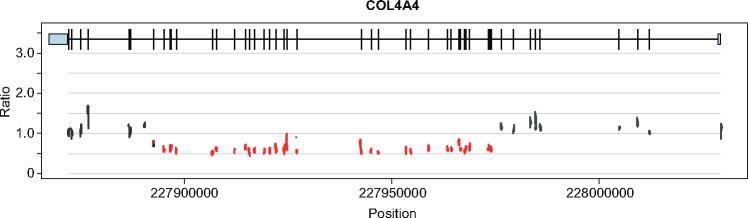
The performance of the sequencing pipeline for single-nucleotide variants was validated using CEPH (Centre de'Etude du Polymorphism) controls and for indels using Genome-in-a-Bottle. To test the reliability of the copy number variant (CNV) analysis, positive samples were re-sequenced and analyzed. For patient samples, a multidisciplinary review board interpreted genetic results in the context of clinical data. A genetic diagnosis was made in 54 (43%) patients and ranged from 54% for CAKUT, 53% for ciliopathies/tubulointerstitial diseases, 45% for transport disorders to 33% for glomerulopathies. Pathogenic and likely pathogenic variants included 46% missense, 11% nonsense, 6% splice site variants, 23% insertion-deletions and 14% CNVs. In 13 cases, the genetic result changed the clinical diagnosis.
CONCLUSION
Broad genetic testing should be considered in the evaluation of renal patients as it complements other tests and provides insight into the underlying disease and its management.
背景
遗传肾脏疾病的临床诊断可能受到疾病表现重叠或疾病进展的限制,在这些情况下,原始过程的线索可能不存在。本研究的目的是确定基因检测是否能为肾脏疾病患者的诊断和治疗提供信息。
方法
我们开发了一个全面的基因检测面板(KidneySeq),用于评估具有各种表型的患者,包括囊性疾病、先天性肾和尿路异常(CAKUT)、肾小管间质性疾病、转运障碍和肾小球疾病。我们在年龄从新生儿到 81 岁的 127 名连续患者中评估了该面板,这些患者的样本被送进行基因检测。
结果
使用 CEPH(Centre de'Etude du Polymorphism)对照验证了单核苷酸变异的测序管道的性能,使用 Genome-in-a-Bottle 验证了插入缺失的性能。为了测试拷贝数变异(CNV)分析的可靠性,对阳性样本进行了重新测序和分析。对于患者样本,一个多学科审查委员会根据临床数据解释遗传结果。在 54 名(43%)患者中做出了基因诊断,范围从 CAKUT 的 54%、纤毛病变/肾小管间质性疾病的 53%、转运障碍的 45%到肾小球病变的 33%。致病性和可能致病性变体包括 46%的错义、11%的无义、6%的剪接位点变体、23%的插入缺失和 14%的 CNVs。在 13 例中,遗传结果改变了临床诊断。
结论
在评估肾脏患者时,应考虑广泛的基因检测,因为它可以补充其他检查,并深入了解潜在疾病及其治疗。

 Zotero 插件