
基于 iPSCs 的神经 3D 系统:疾病建模和药物发现的多维方法。
iPSCs-Based Neural 3D Systems: A Multidimensional Approach for Disease Modeling and Drug Discovery.
机构信息
Dino Ferrari Centre, Neuroscience Section, Department of Pathophysiology and Transplantation (DEPT), University of Milan, Neurology Unit, IRCCS Foundation Ca' Granda Ospedale Maggiore Policlinico, 20122 Milan, Italy.
出版信息
Cells. 2019 Nov 14;8(11):1438. doi: 10.3390/cells8111438.
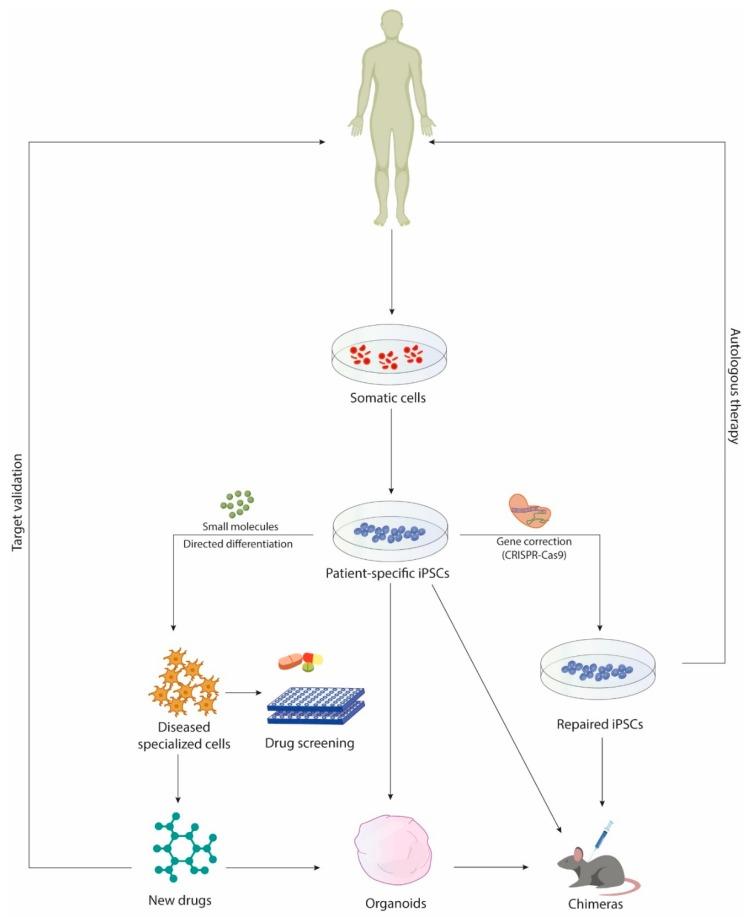
Induced pluripotent stem cells (iPSCs)-based two-dimensional (2D) protocols have offered invaluable insights into the pathophysiology of neurological diseases. However, these systems are unable to reproduce complex cytoarchitectural features, cell-cell and tissue-tissue interactions like their in vivo counterpart. Three-dimensional (3D)-based culture protocols, though in their infancy, have offered new insights into modeling human diseases. Human neural organoids try to recapitulate the cellular diversity of complex tissues and can be generated from iPSCs to model the pathophysiology of a wide spectrum of pathologies. The engraftment of iPSCs into mice models and the improvement of differentiation protocols towards 3D cultures has enabled the generation of more complex multicellular systems. Consequently, models of neuropsychiatric disorders, infectious diseases, brain cancer and cerebral hypoxic injury can now be investigated from new perspectives. In this review, we consider the advancements made in modeling neuropsychiatric and neurological diseases with iPSC-derived organoids and their potential use to develop new drugs.
基于诱导多能干细胞 (iPSC) 的二维 (2D) 方案为神经疾病的病理生理学提供了宝贵的见解。然而,这些系统无法复制复杂的细胞结构特征、细胞间和组织间的相互作用,无法与体内系统相媲美。基于三维 (3D) 的培养方案虽然处于起步阶段,但为人类疾病建模提供了新的见解。人类神经类器官试图重现复杂组织的细胞多样性,可从 iPSC 中生成,以模拟广泛病理生理过程的病理生理学。iPSC 移植到小鼠模型中,以及对 3D 培养物的分化方案的改进,使得更复杂的多细胞系统得以生成。因此,现在可以从新的角度研究神经精神疾病、传染病、脑癌和脑缺氧损伤的模型。在这篇综述中,我们考虑了使用 iPSC 衍生的类器官对神经精神疾病和神经疾病进行建模的进展,以及它们在开发新药方面的潜在用途。

 Zotero 插件