
丹酚酸 B 通过增强 AKT 信号通路抑制手足口病肠道病毒 71 复制。
Salvianolic Acid B Inhibits Hand-Foot-Mouth Disease Enterovirus 71 Replication through Enhancement of AKT Signaling Pathway.
机构信息
Department of Biomedical Science, Jungwon University, Goesan-gun, Chungbuk 28024, Republic of Korea.
Department of Chemistry and Nanoscience, Ewha Womans University, Seoul 120-750, Republic of Korea.
出版信息
J Microbiol Biotechnol. 2020 Jan 28;30(1):38-43. doi: 10.4014/jmb.1907.07079.
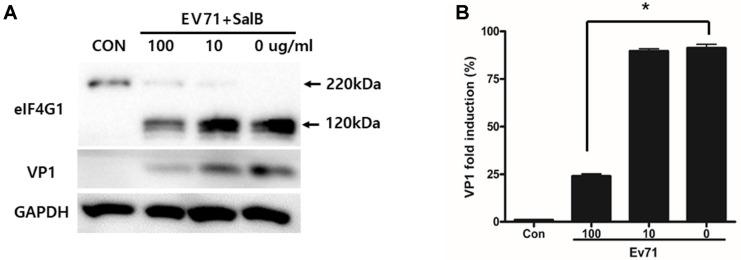
Hand, foot, and mouth disease (HFMD) is caused by enterovirus 71 (EV71) in infants and children under six years of age. HFMD is characterized by fever, mouth ulcers, and vesicular rashes on the palms and feet. EV71 also causes severe neurological manifestations, such as brainstem encephalitis and aseptic meningitis. Recently, frequent outbreaks of EV71 have occurred in the Asia-Pacific region, but currently, no effective antiviral drugs have been developed to treat the disease. In this study, we investigated the antiviral effect of salvianolic acid B (SalB) on EV71. SalB is a major component of the root and has been shown to be an effective treatment for subarachnoid hemorrhages and myocardial infarctions. HeLa cells were cultured in 12-well plates and treated with SalB (100 or 10 µg/ml) and 10 PFU/ml of EV71. SalB treatment (100 µg/ml) significantly decreased the cleavage of the eukaryotic eIF4G1 protein and reduced the expression of the EV71 capsid protein VP1. In addition, SalB treatment showed a dramatic decrease in viral infection, measured by immunofluorescence staining. The Akt signaling pathway, a key component of cell survival and proliferation, was significantly increased in EV71-infected HeLa cells treated with 100 µg/ml SalB. RT-PCR results showed that the mRNA for anti-apoptotic protein Bcl-2 and the cell cycle regulator Cyclin-D1 were significantly increased by SalB treatment. These results indicate that SalB activates Akt/PKB signaling and inhibits apoptosis in infected HeLa cells. Taken together, these results suggest that SalB could be used to develop a new therapeutic drug for EV71-induced HFMD.
手足口病(HFMD)是由肠道病毒 71 型(EV71)引起的,主要发生于 6 岁以下婴幼儿。HFMD 的特征是发热、口腔溃疡,手掌和脚底出现水疱性皮疹。EV71 还会引起严重的神经表现,如脑干脑炎和无菌性脑膜炎。最近,亚太地区频繁爆发 EV71,但目前尚无有效的抗病毒药物来治疗该疾病。本研究探讨了丹酚酸 B(SalB)对 EV71 的抗病毒作用。SalB 是丹参的主要成分之一,已被证明对蛛网膜下腔出血和心肌梗死有效。将 HeLa 细胞培养在 12 孔板中,用 SalB(100 或 10 μg/ml)和 10 PFU/ml 的 EV71 处理。SalB 处理(100 μg/ml)显著降低了真核细胞起始因子 4G1 蛋白的裂解,并降低了 EV71 衣壳蛋白 VP1 的表达。此外,SalB 处理还通过免疫荧光染色显示出病毒感染的急剧减少。在用 100 μg/ml SalB 处理的感染 EV71 的 HeLa 细胞中,Akt 信号通路,细胞存活和增殖的关键组成部分,显著增加。RT-PCR 结果表明,SalB 处理显著增加了抗凋亡蛋白 Bcl-2 和细胞周期调节剂 Cyclin-D1 的 mRNA。这些结果表明,SalB 激活了感染的 HeLa 细胞中的 Akt/PKB 信号通路并抑制了细胞凋亡。总之,这些结果表明 SalB 可用于开发治疗 EV71 引起的 HFMD 的新治疗药物。



 Zotero 插件