
尼泊尔鲁潘德希地区社区成员对抗生素使用的知识、态度和实践。
Knowledge, attitudes and practices relating to antibiotic use among community members of the Rupandehi District in Nepal.
机构信息
School of Public Health, Faculty of Health Sciences, Curtin University, Kent Street, Bentley, Perth, Western Australia, 6102, Australia.
School of Public Health, The University of Queensland, Herston Rd, Herston, Qld, 4006, Australia.
出版信息
BMC Public Health. 2019 Nov 26;19(1):1558. doi: 10.1186/s12889-019-7924-5.
BACKGROUND
The development of antibiotic resistance is one of the biggest threats to global public health. Inappropriate use of antibiotics is recognised as a leading cause of antibiotic resistance. The aim of this study was to explore the knowledge, attitudes and practices (KAP) towards antibiotic use among adults in Nepal.
METHODS
A quantitative survey was conducted with 220 community members of the Rupandehi district of Nepal, with cluster sampling techniques applied to select households. Interviews were carried out face-to-face using a structured questionnaire. Responses were presented using descriptive analysis, with chi-squared tests and regression analysis applied to identify factors associated with KAP about antibiotic use and the Spearman's rank order correlation coefficient calculated to examine the relationship between responses to the KAP questions.
RESULTS
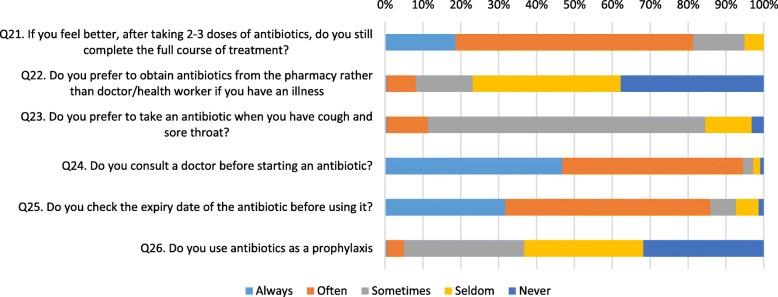
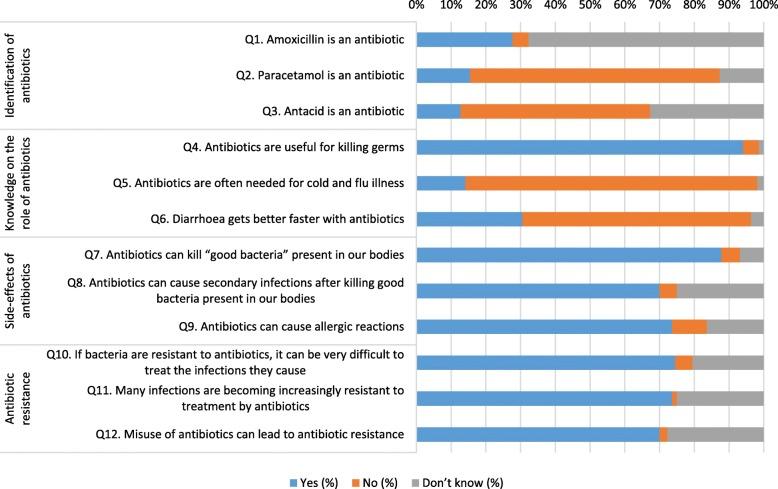
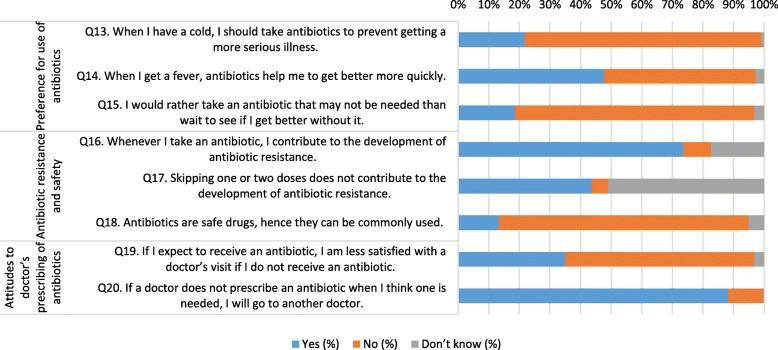
The sample comprised more females (54%) than males, the average age of respondents was 38.5 years and almost 60% of respondents lived in rural areas. Respondents had relatively good knowledge about aspects of antibiotic use other than identifying antibiotics. The concept of antibiotic resistance was well known but imperfectly understood. Half of respondents (50.9%) were unsure whether skipping doses would contribute to the development of antibiotic resistance, 88.2% indicated they would go to another doctor if not prescribed an antibiotic when they thought one was needed and nearly half (47.7%) believed antibiotics helped them get better more quickly if they had a fever. Most respondents reported correct practices accessing and using antibiotics, however, 84.6% at least sometimes preferred an antibiotic when they have a cough and sore throat. Logistic regression showed respondents with higher levels of education tended to have better knowledge, more appropriate attitudes and better practices about antibiotic use. Rural respondents were less likely to have better knowledge about antibiotic use, while females were more likely to report better practices.
CONCLUSION
The study provides baseline evidence about the knowledge, attitudes and practices regarding antibiotic use among the population of the Rupandehl district. Its findings will be useful in designing effective and targeted interventions to decrease misconceptions about antibiotic use and to increase awareness about the risks of inappropriate use of antibiotics in the community.
背景
抗生素耐药性的发展是全球公共卫生面临的最大威胁之一。抗生素的不当使用被认为是抗生素耐药性的主要原因。本研究旨在探讨尼泊尔成年人对抗生素使用的知识、态度和实践(KAP)。
方法
采用定量调查方法,对尼泊尔鲁潘德希地区的 220 名社区成员进行了调查,采用聚类抽样技术选择家庭。采用面对面的结构化问卷进行访谈。使用描述性分析呈现结果,应用卡方检验和回归分析确定与抗生素使用 KAP 相关的因素,并计算斯皮尔曼等级相关系数来检验 KAP 问题回答之间的关系。
结果
样本中女性(54%)多于男性,受访者平均年龄为 38.5 岁,近 60%的受访者居住在农村地区。受访者对除识别抗生素以外的抗生素使用方面有较好的了解。对抗生素耐药性的概念了解较好但理解不完美。一半的受访者(50.9%)不确定不按时服药是否会导致抗生素耐药性的发展,88.2%的受访者表示,如果他们认为需要抗生素而医生没有开,他们会去看另一位医生,近一半(47.7%)的受访者认为,如果发烧,抗生素可以帮助他们更快地康复。大多数受访者报告说,他们在获取和使用抗生素方面的做法是正确的,但 84.6%的受访者在咳嗽和喉咙痛时至少有时会选择抗生素。逻辑回归显示,受教育程度较高的受访者往往对抗生素使用的知识更丰富,态度更恰当,做法更好。农村地区的受访者对抗生素使用的了解程度较低,而女性则更有可能报告更好的做法。
结论
本研究为鲁潘德希地区人群对抗生素使用的知识、态度和实践提供了基线证据。研究结果将有助于设计有效的、有针对性的干预措施,减少对抗生素使用的误解,提高社区对抗生素不当使用的风险意识。
 Zotero 插件