
中国65岁及以上老年人的残疾转变与健康期望寿命:一项全国性纵向研究
Disability Transitions and Health Expectancies among Elderly People Aged 65 Years and Over in China: A Nationwide Longitudinal Study.
作者信息
Hou Chengbei, Ma Yuan, Yang Xinghua, Tao Lixin, Zheng Deqiang, Liu Xiangtong, Wang Xiaonan, Li Xia, Wang Wei, Fang Xianghua, Guo Xiuhua
机构信息
1School of Public Health, Capital Medical University, Beijing, China.
2Beijing Municipal Key Laboratory of Clinical Epidemiology, School of Public Health, Capital Medical University, Beijing, China.
出版信息
Aging Dis. 2019 Dec 1;10(6):1246-1257. doi: 10.14336/AD.2019.0121. eCollection 2019 Dec.
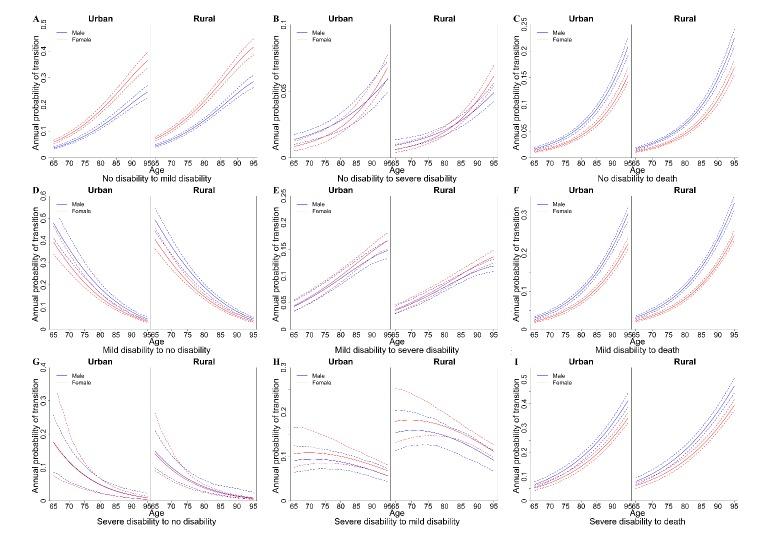
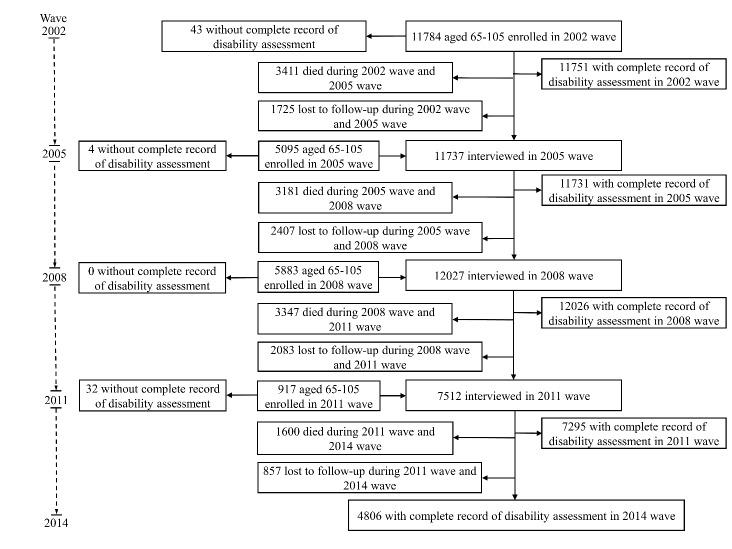
Disability has become a critical issue among elderly populations, yet limited large-scale research related to this issue has been conducted in China, an aging society. This study explored sex and urban-rural differences in disability transitions and life expectancies among older adults in China. Data were collected from the Chinese Longitudinal Health Longevity Survey (CLHLS), which enrolled people aged 65 and older and was conducted in randomly selected counties and cities across 22 provinces in China. Disability was diagnosed based on basic activities of daily living (BADLs) and instrumental activities of daily living (IADLs). Several individual characteristics were assessed, including sociodemographic factors (age, sex and region, etc.) and health behaviors (currently smoking, currently drinking, etc.). Multistate models were applied to analyze the transition rates among 4 states: no disability, mild disability, severe disability and death. The transition rates from disabled states to the no-disability state were found to decrease markedly with age. The rates of recovery from mild disability in rural areas were higher than those in urban areas. Rural elderly individuals lived shorter lives than their urban counterparts, but they tended to live with better functional status, spending a larger fraction of their remaining life with less severe disability. Based on these findings, devoting more attention and resources to rural areas may help less severely disabled people recuperate and prevent severe disability. The study provides insights into health plan strategies to help guide the allocation of limited resources.
残疾已成为老年人群中的一个关键问题,但在中国这个老龄化社会,针对这一问题的大规模研究却很有限。本研究探讨了中国老年人在残疾转变和预期寿命方面的性别及城乡差异。数据来自中国健康与养老追踪调查(CLHLS),该调查纳入了65岁及以上的人群,在中国22个省随机抽取的县和城市开展。残疾是根据日常生活基本活动(BADLs)和日常生活工具性活动(IADLs)来诊断的。评估了几个个体特征,包括社会人口学因素(年龄、性别和地区等)以及健康行为(目前吸烟、目前饮酒等)。应用多状态模型分析了无残疾、轻度残疾、重度残疾和死亡4种状态之间的转变率。发现从残疾状态转变为无残疾状态的比率会随着年龄的增长而显著下降。农村地区从轻度残疾恢复的比率高于城市地区。农村老年人的寿命比城市老年人短,但他们往往以更好的功能状态生活,在剩余生命中处于残疾程度较轻状态的时间占比更大。基于这些发现,将更多关注和资源投入农村地区可能有助于残疾程度较轻的人康复并预防重度残疾。该研究为健康计划策略提供了见解,以帮助指导有限资源的分配。
 Zotero 插件