
体重指数与严重肥胖患者内脏脂肪组织的表观遗传年龄加速相关。
Body mass index is associated with epigenetic age acceleration in the visceral adipose tissue of subjects with severe obesity.
机构信息
Institute of Nutrition and Functional Foods (INAF), Université Laval, Pavillon des Services (2729 K), 2440, boul. Hochelaga, Quebec, QC, G1V 0A6, Canada.
School of Nutrition, Université Laval, Quebec, QC, Canada.
出版信息
Clin Epigenetics. 2019 Dec 2;11(1):172. doi: 10.1186/s13148-019-0754-6.
BACKGROUND
There is solid evidence that obesity induces the acceleration of liver epigenetic aging. However, unlike easily accessible blood or subcutaneous adipose tissue, little is known about the impact of obesity on epigenetic aging of metabolically active visceral adipose tissue (VAT). Herein, we aimed to test whether obesity accelerates VAT epigenetic aging in subjects with severe obesity.
RESULTS
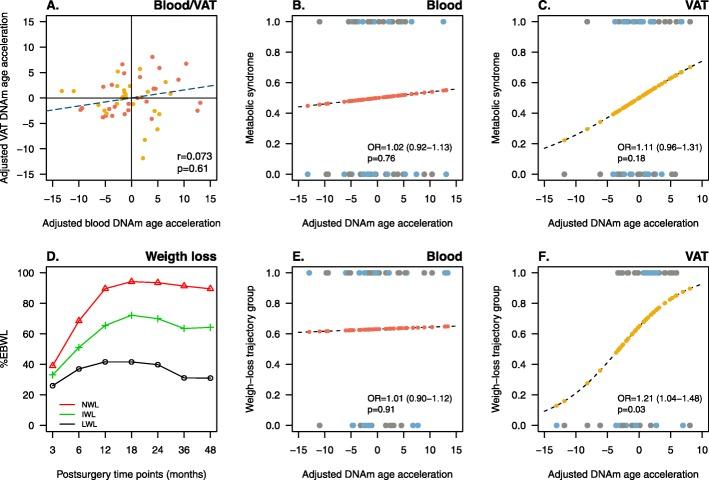
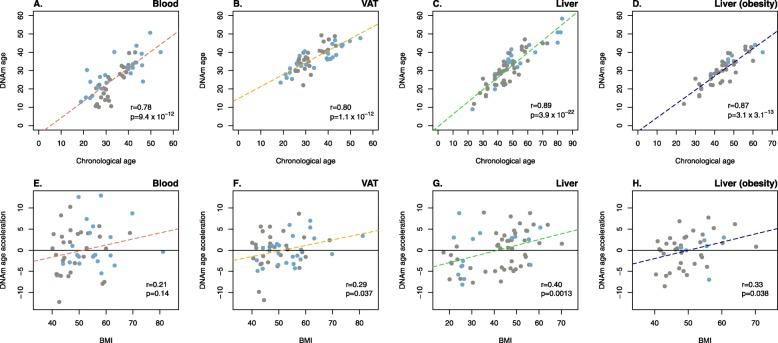
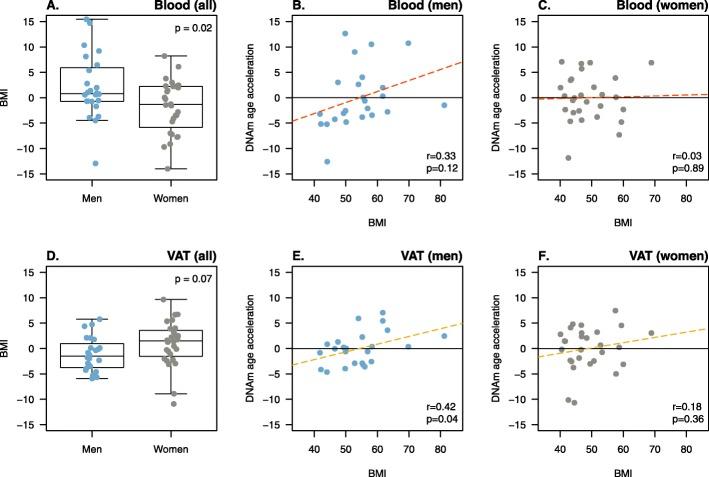
A significant and positive correlation between chronological age and epigenetic age, estimated with a reduced version of the Horvath's epigenetic clock, was found in both blood (r = 0.78, p = 9.4 × 10) and VAT (r = 0.80, p = 1.1 × 10). Epigenetic age acceleration, defined as the residual resulting from regressing epigenetic age on chronological age, was significantly correlated with body mass index (BMI) in VAT (r = 0.29, p = 0.037). Multivariate linear regression analysis showed that, after adjusting for chronological age, sex and metabolic syndrome status, BMI remained significantly associated with epigenetic age acceleration in VAT (beta = 0.15, p = 0.035), equivalent to 2.3 years for each 10 BMI units. Binomial logistic regression showed that BMI-adjusted epigenetic age acceleration in VAT was significantly associated with a higher loss of excess body weight following biliopancreatic diversion with duodenal switch surgery (odds ratio = 1.21; 95% CI = 1.04-1.48; p = 0.03).
CONCLUSIONS
Epigenetic age acceleration increases with BMI in VAT, but not in blood, as previously reported in liver. These results suggest that obesity is associated with epigenetic age acceleration of metabolically active tissues. Further studies that deepen the physiological relevance of VAT epigenetic aging will help to better understand the onset of metabolic syndrome and weight loss dynamics following bariatric surgery.
背景
有确凿证据表明肥胖会加速肝脏表观遗传衰老。然而,与易于获取的血液或皮下脂肪组织不同,人们对肥胖对代谢活跃的内脏脂肪组织(VAT)的表观遗传衰老的影响知之甚少。在此,我们旨在测试肥胖是否会加速严重肥胖患者的 VAT 表观遗传衰老。
结果
在血液(r = 0.78,p = 9.4×10)和 VAT(r = 0.80,p = 1.1×10)中,均发现生物钟年龄与用 Horvath 表观遗传时钟的简化版本估算的表观遗传年龄之间存在显著正相关。表观遗传年龄加速,定义为将表观遗传年龄回归到生物钟年龄后的剩余值,与 VAT 中的体重指数(BMI)显著相关(r = 0.29,p = 0.037)。多元线性回归分析显示,在校正生物钟年龄、性别和代谢综合征状态后,BMI 与 VAT 中的表观遗传年龄加速仍显著相关(β=0.15,p = 0.035),相当于 BMI 每增加 10 个单位,表观遗传年龄加速 2.3 年。二项逻辑回归显示,VAT 中经 BMI 调整的表观遗传年龄加速与胆胰分流加十二指肠转流术后多余体重的显著减轻显著相关(比值比=1.21;95%可信区间=1.04-1.48;p = 0.03)。
结论
与之前在肝脏中报道的情况一样,VAT 中的 BMI 与表观遗传年龄加速呈正相关,但血液中则不然。这些结果表明,肥胖与代谢活跃组织的表观遗传年龄加速有关。进一步的研究加深了 VAT 表观遗传衰老的生理相关性,将有助于更好地理解代谢综合征的发生和减重手术后的体重减轻动态。
 Zotero 插件