
推断哺乳动物树:用于生态学、进化和保护问题的物种级系统发育集合。
Inferring the mammal tree: Species-level sets of phylogenies for questions in ecology, evolution, and conservation.
机构信息
Department of Ecology & Evolutionary Biology, Yale University, New Haven, Connecticut, United States of America.
Center for Biodiversity & Global Change, Yale University, New Haven, Connecticut, United States of America.
出版信息
PLoS Biol. 2019 Dec 4;17(12):e3000494. doi: 10.1371/journal.pbio.3000494. eCollection 2019 Dec.
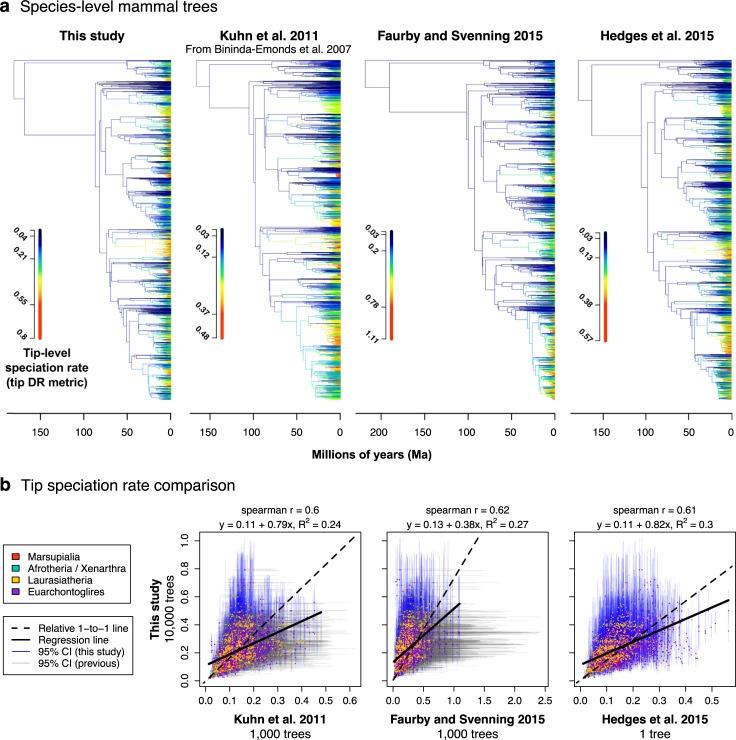
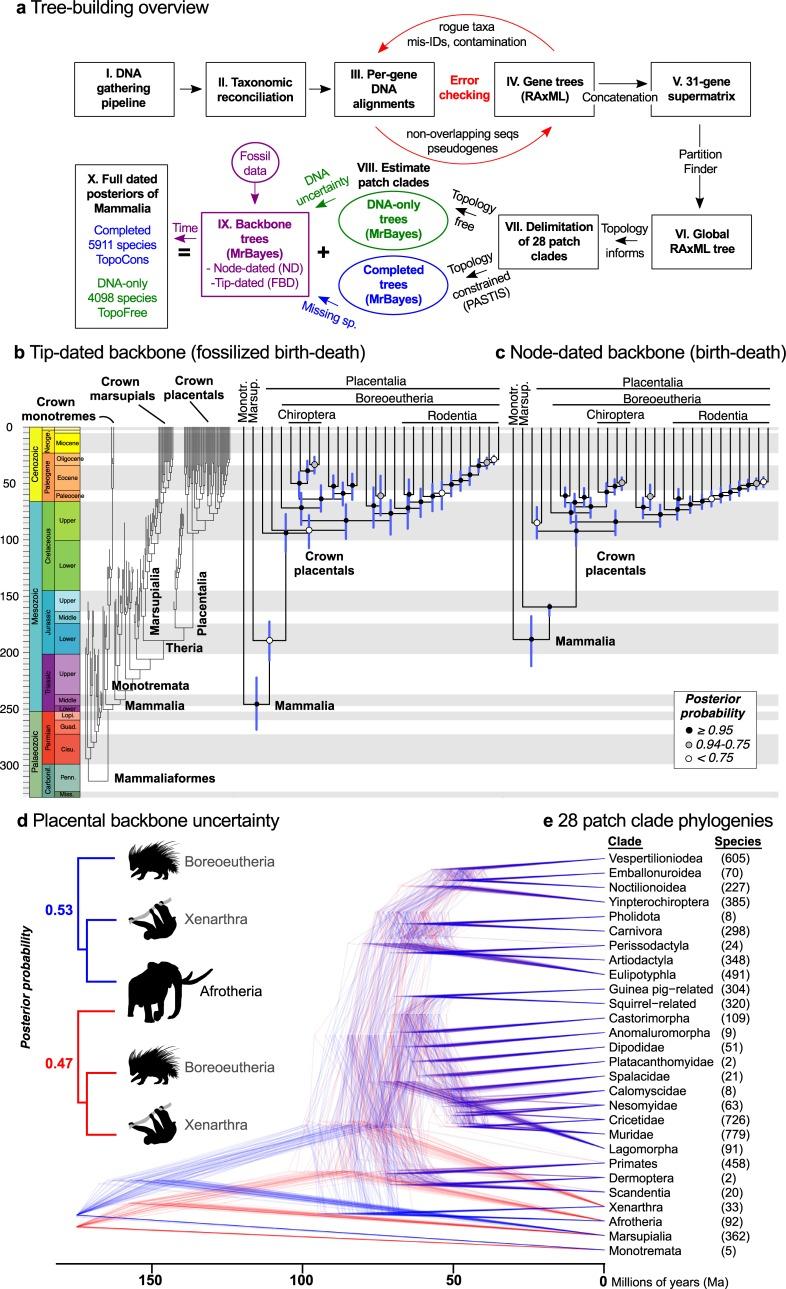
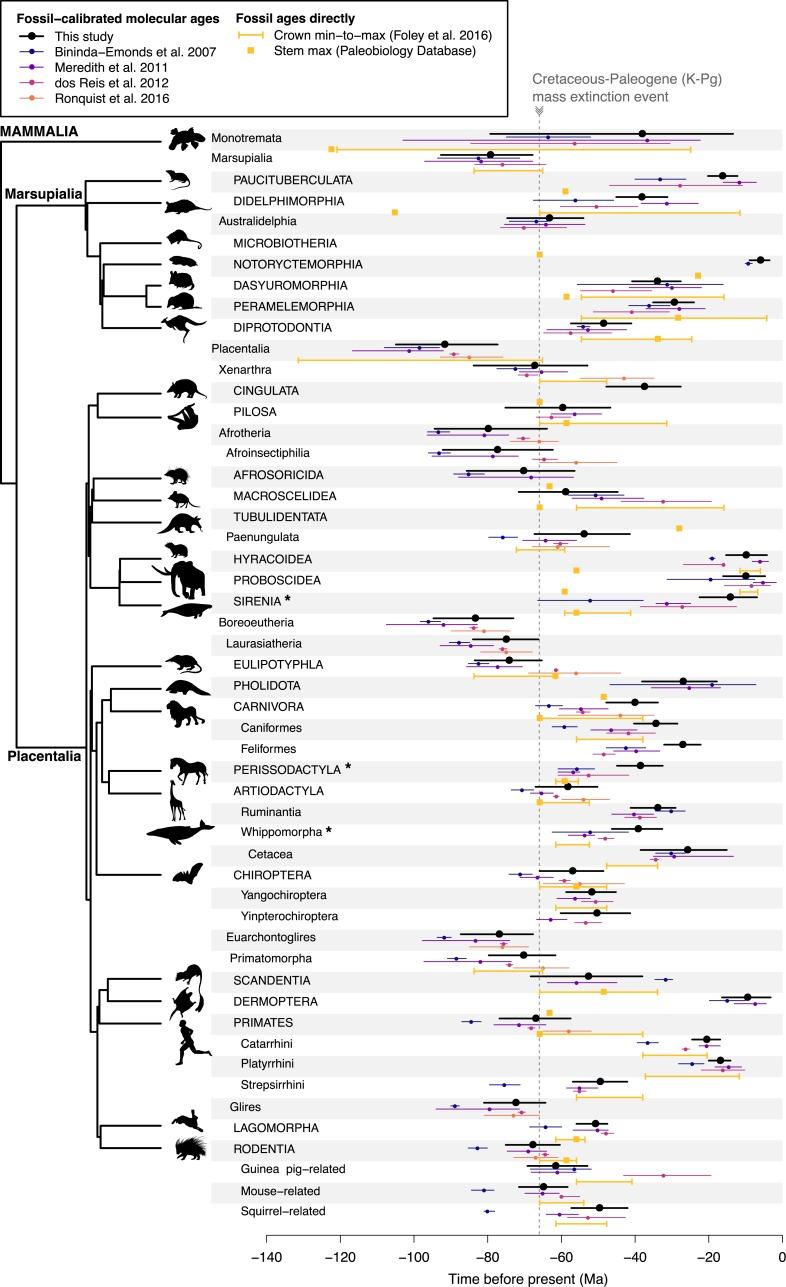
Big, time-scaled phylogenies are fundamental to connecting evolutionary processes to modern biodiversity patterns. Yet inferring reliable phylogenetic trees for thousands of species involves numerous trade-offs that have limited their utility to comparative biologists. To establish a robust evolutionary timescale for all approximately 6,000 living species of mammals, we developed credible sets of trees that capture root-to-tip uncertainty in topology and divergence times. Our "backbone-and-patch" approach to tree building applies a newly assembled 31-gene supermatrix to two levels of Bayesian inference: (1) backbone relationships and ages among major lineages, using fossil node or tip dating, and (2) species-level "patch" phylogenies with nonoverlapping in-groups that each correspond to one representative lineage in the backbone. Species unsampled for DNA are either excluded ("DNA-only" trees) or imputed within taxonomic constraints using branch lengths drawn from local birth-death models ("completed" trees). Joining time-scaled patches to backbones results in species-level trees of extant Mammalia with all branches estimated under the same modeling framework, thereby facilitating rate comparisons among lineages as disparate as marsupials and placentals. We compare our phylogenetic trees to previous estimates of mammal-wide phylogeny and divergence times, finding that (1) node ages are broadly concordant among studies, and (2) recent (tip-level) rates of speciation are estimated more accurately in our study than in previous "supertree" approaches, in which unresolved nodes led to branch-length artifacts. Credible sets of mammalian phylogenetic history are now available for download at http://vertlife.org/phylosubsets, enabling investigations of long-standing questions in comparative biology.
大尺度的系统发育树对于将进化过程与现代生物多样性模式联系起来至关重要。然而,为数千个物种推断可靠的系统发育树涉及到许多权衡,这限制了它们在比较生物学家中的应用。为了为所有大约 6000 种现存哺乳动物建立一个稳健的进化时间尺度,我们开发了可信的树集合,以捕获拓扑和分歧时间的根到尖端不确定性。我们的树构建“骨干和补丁”方法适用于两个层次的贝叶斯推断:(1)使用化石节点或尖端测年,在主要谱系之间建立骨干关系和年龄;(2)使用非重叠的内群建立物种水平的“补丁”系统发育,每个内群对应于骨干中的一个代表谱系。没有 DNA 采样的物种要么被排除(“仅 DNA”树),要么在分类学限制内使用从本地出生-死亡模型中抽取的分支长度进行推断(“完成”树)。将时间尺度补丁与骨干结合起来,生成具有所有分支在同一建模框架下估计的现存哺乳动物的种系发生树,从而促进了不同谱系(如有袋类和胎盘类)之间的速率比较。我们将我们的系统发育树与以前对哺乳动物广泛的系统发育和分歧时间的估计进行了比较,发现:(1)节点年龄在研究中广泛一致;(2)与以前的“超树”方法相比,我们的研究更准确地估计了最近(尖端水平)的物种形成率,在这些方法中,未解决的节点导致了分支长度的假象。现在可以在 http://vertlife.org/phylosubsets 下载可信的哺乳动物系统发育历史集合,从而能够研究比较生物学中的长期问题。



 Zotero 插件