
BH3 模拟物的并排比较确定 MCL-1 为 AML 的关键治疗靶点。
Side-by-side comparison of BH3-mimetics identifies MCL-1 as a key therapeutic target in AML.
机构信息
Institute for Experimental Cancer Research in Pediatrics, Goethe-University Frankfurt, Frankfurt, Germany.
German Cancer Consortium (DKTK), Partner Site Frankfurt, Frankfurt, Germany.
出版信息
Cell Death Dis. 2019 Dec 4;10(12):917. doi: 10.1038/s41419-019-2156-2.
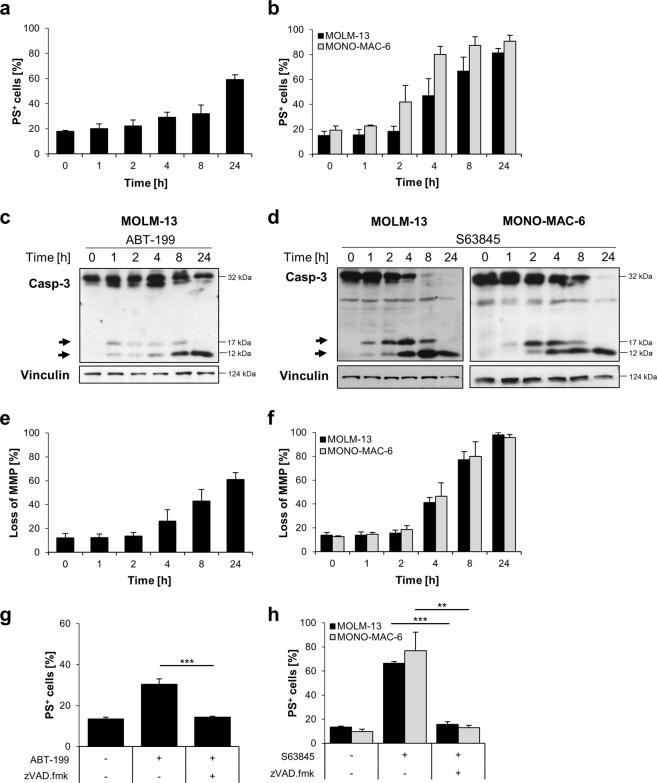
Despite advances in the treatment of acute myeloid leukemia (AML), prognosis of AML patients is still dismal and better treatment options are required. B-cell Lymphoma 2 (BCL-2) homology domain 3 (BH3)-mimetics are emerging as a novel class of apoptosis-inducing agents that are currently being tested for the treatment of different hematological malignancies including AML. Particularly, the selective BCL-2 inhibitor ABT-199/Venetoclax is demonstrating clinical responses and has recently been approved in combination for the treatment of AML. Compounds targeting the related protein MCL-1 have recently entered clinical trials, highlighting the urgency to compare the different BH3-mimetics and identify the most promising antiapoptotic target in AML. We performed a side-by-side comparison of different highly selective and potent BH3-mimetics targeting BCL-2 (ABT-199), MCL-1 (S63845) or BCL-x (A1331852) in a panel of AML cell lines and primary patient cells. Gene knockdown using siRNAs was utilized to investigate the functional relevance of BCL-2 proteins. Western blotting and immunoprecipitations were used to explore the influence of BH3-mimetics on interactions between pro- and antiapoptotic BCL-2 proteins. A1331852 induced apoptosis only in selected cases, indicating that BCL-x is not a very promising therapeutic target in AML. However, S63845 displayed higher potency than ABT-199, with more cell lines and primary cells responding to S63845 than to ABT-199. MCL-1 dependency in AML cells was confirmed by siRNA-mediated knockdown of MCL-1, which was sufficient to induce apoptosis. S63845-induced cell death was accompanied by a displacement of the BH3-only protein BIM as well as BAK, resulting in BAK-dependent apoptosis. In contrast, ABT-199-induced cell death was mediated by BAX rather than BAK, indicating distinct non-redundant molecular functions of BCL-2 and MCL-1 in AML. Our study reveals that MCL-1 may be a more prevalent therapeutic target than BCL-2 in AML and identifies BIM and BAK as important mediators of S63845-induced apoptosis in AML.
尽管急性髓系白血病 (AML) 的治疗取得了进展,但 AML 患者的预后仍然不佳,需要更好的治疗选择。B 细胞淋巴瘤 2 (BCL-2) 同源结构域 3 (BH3)-模拟物作为一类新型的凋亡诱导剂正在出现,目前正在测试用于治疗不同的血液恶性肿瘤,包括 AML。特别是,选择性 BCL-2 抑制剂 ABT-199/Venetoclax 正在显示临床反应,最近已被批准联合用于治疗 AML。针对相关蛋白 MCL-1 的化合物最近已进入临床试验,这凸显了比较不同 BH3 模拟物并确定 AML 中最有前途的抗凋亡靶点的紧迫性。我们在一组 AML 细胞系和原代患者细胞中对不同的高度选择性和有效的针对 BCL-2 (ABT-199)、MCL-1 (S63845) 或 BCL-x (A1331852) 的 BH3 模拟物进行了并排比较。使用 siRNA 进行基因敲低用于研究 BCL-2 蛋白的功能相关性。Western 印迹和免疫沉淀用于研究 BH3 模拟物对促凋亡和抗凋亡 BCL-2 蛋白之间相互作用的影响。A1331852 仅在某些情况下诱导凋亡,表明 BCL-x 不是 AML 中非常有前途的治疗靶点。然而,S63845 比 ABT-199 显示出更高的效力,与 ABT-199 相比,更多的细胞系和原代细胞对 S63845 有反应。通过 siRNA 介导的 MCL-1 敲低证实了 AML 细胞中对 MCL-1 的依赖性,这足以诱导凋亡。S63845 诱导的细胞死亡伴随着 BH3 仅有蛋白 BIM 以及 BAK 的位移,导致 BAK 依赖性凋亡。相比之下,ABT-199 诱导的细胞死亡是由 BAX 介导的,而不是 BAK,这表明在 AML 中 BCL-2 和 MCL-1 具有不同的非冗余分子功能。我们的研究表明,MCL-1 可能是 AML 中比 BCL-2 更普遍的治疗靶点,并确定 BIM 和 BAK 是 S63845 诱导 AML 中凋亡的重要介质。




 Zotero 插件