
宏基因组下一代测序在危重症患者支气管肺泡灌洗诊断中的应用。
Application of metagenomic next-generation sequencing for bronchoalveolar lavage diagnostics in critically ill patients.
机构信息
Department of Respiratory and Critical Care Medicine, Beijing Chao-Yang Hospital, Capital Medical University, Beijing Institute of Respiratory Medicine, No. 8 Gongtinan Road, Beijing, 100020, China.
出版信息
Eur J Clin Microbiol Infect Dis. 2020 Feb;39(2):369-374. doi: 10.1007/s10096-019-03734-5. Epub 2019 Dec 7.
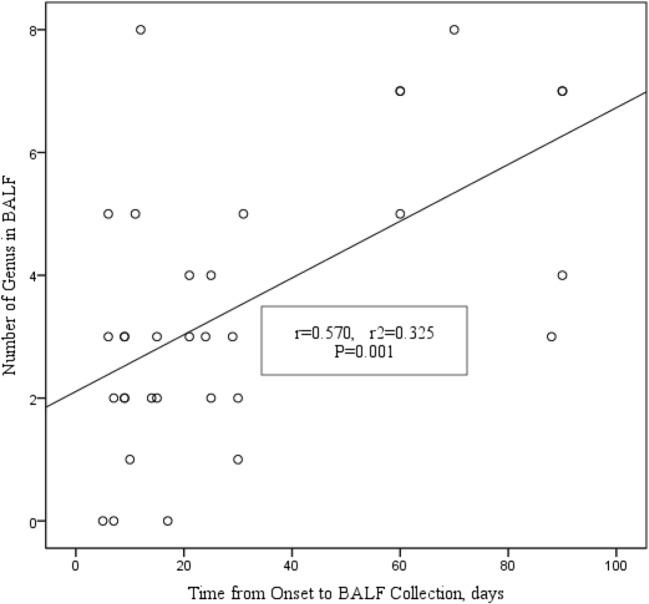
The purpose of this study was to assess the value of metagenomic next-generation sequencing (mNGS) of bronchoalveolar lavage fluid (BALF) for the diagnosis of severe respiratory diseases based on interpretation of sequencing results. BALF samples were harvested and used for mNGS as well as microbiological detection. Infectious bacteria or fungi were defined according to relative abundance and number of unique reads. We performed mNGS on 35 BALF samples from 32 patients. The positive rate reached 100% in the mNGS analysis of nine immunocompromised patients. Compared with the culture method, mNGS had a diagnostic sensitivity of 88.89% and a specificity of 74.07% with an agreement rate of 77.78% between these two methods. Compared with the smear method and PCR, mNGS had a diagnostic sensitivity of 77.78% and a specificity of 70.00%. In 13 cases, detection results were positive by mNGS but negative by culture/smear and PCR. The mNGS findings in 11/32 (34.4%) cases led to changes in treatment strategies. Linear regression analysis showed that diversity was significantly correlated with interval between disease onset and sampling. Dynamic changes in reads could indirectly reflect therapeutic effectiveness. BALF mNGS improves sensitivity of pathogen detection and provides guidance in clinical practice. Potential pathogens can be identified based on relative abundance and number of unique reads.
本研究旨在评估基于测序结果解读的支气管肺泡灌洗液(BALF)宏基因组下一代测序(mNGS)在严重呼吸道疾病诊断中的价值。采集 BALF 样本进行 mNGS 和微生物检测。根据相对丰度和独特读数数量来定义感染性细菌或真菌。我们对 32 名患者的 35 个 BALF 样本进行了 mNGS 分析。9 名免疫功能低下患者的 mNGS 分析阳性率达到 100%。与培养方法相比,mNGS 的诊断灵敏度为 88.89%,特异性为 74.07%,两种方法的一致性率为 77.78%。与涂片法和 PCR 相比,mNGS 的诊断灵敏度为 77.78%,特异性为 70.00%。13 例 mNGS 检测结果阳性,但培养/涂片和 PCR 阴性。11/32(34.4%)例 mNGS 结果导致治疗策略发生变化。线性回归分析显示,多样性与发病与采样间隔之间存在显著相关性。读数的动态变化可以间接反映治疗效果。BALF mNGS 提高了病原体检测的灵敏度,并为临床实践提供了指导。可以根据相对丰度和独特读数数量来识别潜在病原体。
 Zotero 插件