
基于两种邀请方式的人乳头瘤病毒(HPV)自我采样与常规护理比较:在未筛查和筛查不足的毛利人、太平洋岛民和亚裔妇女中的研究方案:一项随机对照社区试验,旨在检验自我采样对宫颈癌筛查参与度的影响。
Comparison of two invitation-based methods for human papillomavirus (HPV) self-sampling with usual care among un- and under-screened Māori, Pacific and Asian women: study protocol for a randomised controlled community trial to examine the effect of self-sampling on participation in cervical-cancer screening.
机构信息
Centre for Public Health Research, College of Health, Massey University, PO Box 756, Wellington, 6140, New Zealand.
Waitematā District Health Board (DHB) and Auckland DHB, Private Bag 93-503, Takapuna, Auckland, 0740, New Zealand.
出版信息
BMC Cancer. 2019 Dec 9;19(1):1198. doi: 10.1186/s12885-019-6401-y.
BACKGROUND
Māori, Pacific and Asian women in New Zealand have lower cervical-cancer screening rates than European women, and there are persistent inequities in cervical cancer outcomes for Māori and Pacific women. Innovative ways to address access barriers are required. New Zealand is transitioning to screening with human papillomavirus (HPV) DNA testing, which could allow women themselves, rather than a clinician, to take the sample. Internationally, self-sampling has been found to increase screening participation rates. The aim of this open-label community-based randomised controlled trial is to investigate whether self-sampling increases screening participation among un- and under-screened Māori, Pacific and Asian women in New Zealand.
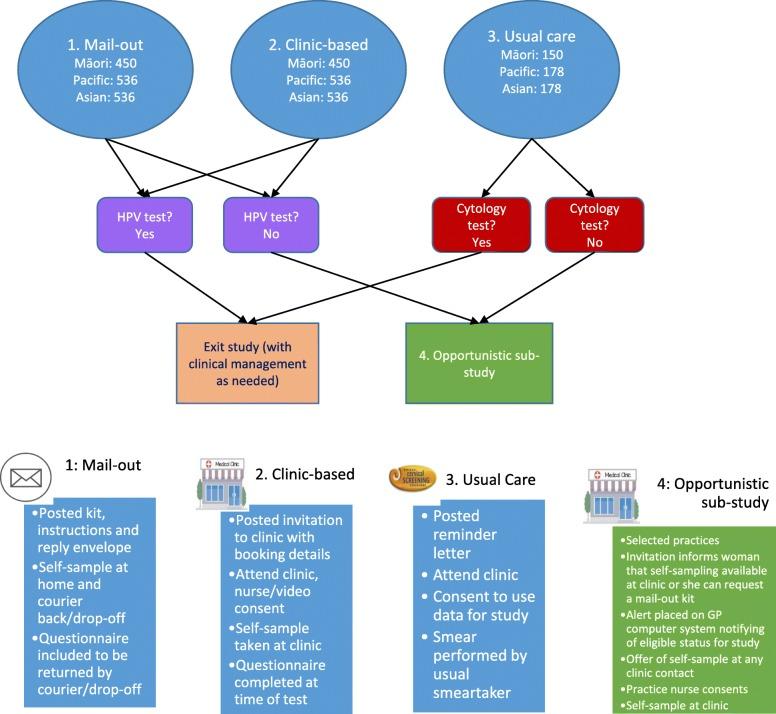
METHODS/DESIGN: We aim to invite at least 3550 un- or under-screened (≥5 years overdue) Māori, Pacific and Asian women (1050, 1250, 1250 respectively), aged 30-69 years, for screening. The three study arms are: usual care in which women are invited to attend a clinic for a standard clinician-collected cytology test; clinic-based self-sampling in which women are invited to take a self-sample at their usual general practice; and mail-out self-sampling in which women are mailed a kit and invited to take a self-sample at home. Women will be randomised 3:3:1 to the clinic and mail-out self-sampling groups, and usual care. There is also a nested sub-study in which non-responding women in all allocation groups, when they subsequently present to the clinic for other reasons, are offered clinic or home-kit self-sampling. The primary outcome will be the proportion of women who participate (by taking a self-sample or cytology test).
DISCUSSION
This trial is the first to evaluate the effectiveness of mailed self-sampling in New Zealand and will be one of the first internationally to evaluate the effectiveness of opportunistic in-clinic invitations for self-sampling. The trial will provide robust evidence on the impact on participation proportions from different invitation approaches for HPV self-sampling in New Zealand un- and under-screened Māori, Pacific and Asian women.
TRIAL REGISTRATION
ANZCTR Identifier: ACTRN12618000367246 (date registered 12/3/2018) https://www.anzctr.org.au/Trial/Registration/TrialReview.aspx?id=371741&isReview=true; UTN: U1111-1189-0531.
背景
新西兰的毛利人、太平洋岛民和亚裔女性宫颈癌筛查率低于欧洲女性,毛利人和太平洋岛民的宫颈癌结果仍存在持续的不平等。需要创新的方法来解决获取障碍。新西兰正在过渡到使用人乳头瘤病毒 (HPV) DNA 检测进行筛查,这可以让女性自己而不是临床医生来取样。在国际上,自我取样已被发现可以提高筛查参与率。本开放性社区随机对照试验旨在研究自我取样是否会增加新西兰未筛查和筛查不足的毛利人、太平洋岛民和亚裔女性的筛查参与率。
方法/设计:我们旨在邀请至少 3550 名未筛查(≥5 年未筛查)的毛利人、太平洋岛民和亚裔女性(分别为 1050、1250、1250 名),年龄在 30-69 岁,进行筛查。三个研究组是:常规护理组,邀请女性到诊所进行标准的临床医生收集的细胞学检测;诊所基于自我采样组,邀请女性在其常规的一般实践中进行自我采样;邮件发送自我采样组,向女性邮寄套件并邀请其在家中进行自我采样。女性将按照 3:3:1 的比例随机分配到诊所和邮件发送自我采样组和常规护理组。还有一个嵌套子研究,在所有分配组中,当非应答女性随后因其他原因到诊所就诊时,将为她们提供诊所或家庭试剂盒自我采样。主要结局将是参与(通过自我采样或细胞学检测)的女性比例。
讨论
这项试验是评估新西兰邮寄自我采样有效性的第一项试验,也是评估新西兰未筛查和筛查不足的毛利人、太平洋岛民和亚裔女性中机会性诊所邀请自我采样有效性的首批国际试验之一。该试验将为新西兰未筛查和筛查不足的毛利人、太平洋岛民和亚裔女性提供有关不同 HPV 自我采样邀请方法对参与率影响的有力证据。
试验注册
ANZCTR 标识符:ACTRN12618000367246(注册日期 2018 年 12 月 3 日)https://www.anzctr.org.au/Trial/Registration/TrialReview.aspx?id=371741&isReview=true;UTN:U1111-1189-0531。
 Zotero 插件