
厄多司坦对中度气流受限的慢性阻塞性肺疾病(COPD)患者COPD急性加重的影响。
Effect of Erdosteine on COPD Exacerbations in COPD Patients with Moderate Airflow Limitation.
作者信息
Calverley Peter Ma, Page Clive, Dal Negro Roberto W, Fontana Giovanni, Cazzola Mario, Cicero Arrigo F, Pozzi Edoardo, Wedzicha Jadwiga A
机构信息
Department of Medicine, Clinical Sciences Centre, University Hospital Aintree, Liverpool, UK.
Faculty of Life Sciences and Medicine, King's College, London, UK.
出版信息
Int J Chron Obstruct Pulmon Dis. 2019 Dec 2;14:2733-2744. doi: 10.2147/COPD.S221852. eCollection 2019.
BACKGROUND
The RESTORE study, a multi-national randomized, placebo-controlled study, showed that erdosteine - a muco-active antioxidant that modulates bacterial adhesiveness - reduced the rate and duration of exacerbations in moderate and severe COPD with a history of exacerbations. How much benefit patients with less severe disease experience when taking this drug remains unclear.
METHODS
This post hoc analysis of the 254 RESTORE participants with spirometrically-defined moderate COPD (post-bronchodilator forced expiratory volume in 1 second [FEV] 50‒79% predicted) examined exacerbation rate and duration, time to first exacerbation, and exacerbation-free time. Data were analyzed using descriptive statistics and comparisons between treatment groups used Wilcoxon rank-sum tests, Mann-Whitney -tests, or log rank tests.
RESULTS
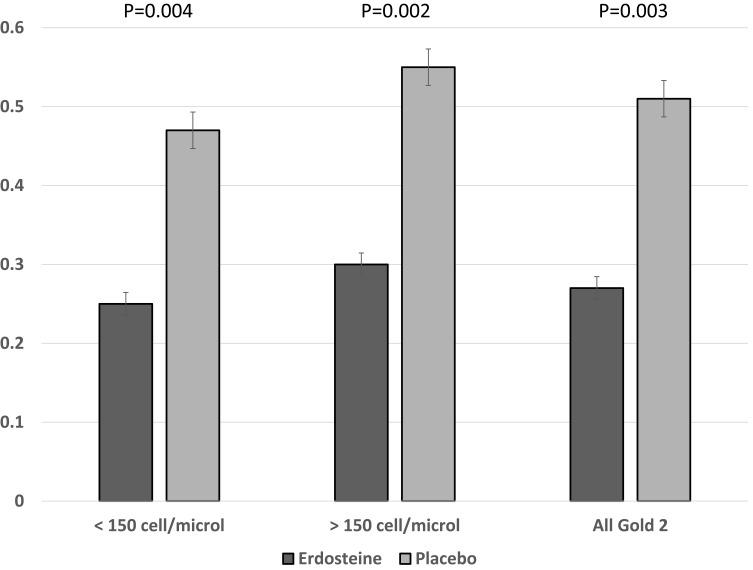
Patients with moderate COPD received erdosteine 300 mg twice daily (n=126) or placebo (n=128) added to usual COPD therapy for 12 months. During this time, there were 53 exacerbations in the erdosteine group and 74 in the placebo group, with 42.1% and 57.8% of patients, respectively, experiencing an exacerbation. There was a 47% reduction in the mean exacerbation rate with erdosteine compared to placebo (0.27 vs 0.51 exacerbations per-patient per-year, respectively, =0.003), and a 58.3% reduction in the mild exacerbation rate (0.23 vs 0.53 mild exacerbations per-patient per-year, =0.001). Mean duration of exacerbations was 26% shorter in erdosteine-treated patients (9.1 vs 12.3 days for placebo, =0.022), with significant reductions in the duration of mild and moderate-to-severe exacerbations. Mean time to first exacerbation was prolonged by 7.7% (182 days for erdosteine vs 169 days for placebo, <0.001) and the mean exacerbation-free time was increased by 51 days (279 days for erdosteine vs 228 days for placebo; <0.001).
CONCLUSION
These results indicate that adding erdosteine to usual COPD maintenance therapy reduces the number of mild, and duration of all, exacerbations in patients with moderate COPD and a history of exacerbations.
背景
RESTORE研究是一项多国随机、安慰剂对照研究,结果显示厄多司坦(一种可调节细菌黏附性的黏液活性抗氧化剂)可降低有加重病史的中重度慢性阻塞性肺疾病(COPD)患者的加重率及加重持续时间。病情较轻的患者服用此药能获得多少益处尚不清楚。
方法
本研究对RESTORE研究中254名经肺量计测定为中度COPD(支气管扩张剂后1秒用力呼气容积[FEV₁]为预测值的50%-79%)的参与者进行事后分析,考察加重率、加重持续时间、首次加重时间及无加重时间。采用描述性统计分析数据,治疗组间比较采用Wilcoxon秩和检验、Mann-Whitney检验或对数秩检验。
结果
中度COPD患者在接受常规COPD治疗的基础上,每日两次服用300mg厄多司坦(n = 126)或安慰剂(n = 128),为期12个月。在此期间,厄多司坦组发生53次加重,安慰剂组发生74次加重,分别有42.1%和57.8%的患者出现加重。与安慰剂相比,厄多司坦使平均加重率降低47%(分别为每人每年0.27次加重和0.51次加重,P = 0.003),轻度加重率降低58.3%(分别为每人每年0.23次轻度加重和0.53次轻度加重,P = 0.001)。厄多司坦治疗的患者加重的平均持续时间缩短26%(安慰剂组为12.3天,厄多司坦组为9.1天,P = 0.022),轻度和中重度加重的持续时间均显著缩短。首次加重的平均时间延长7.7%(厄多司坦组为182天,安慰剂组为169天,P < 0.001),无加重的平均时间增加51天(厄多司坦组为279天,安慰剂组为228天;P < 0.001)。
结论
这些结果表明,在常规COPD维持治疗中加用厄多司坦可减少中度COPD且有加重病史患者的轻度加重次数及所有加重的持续时间。


 Zotero 插件