
一种新型的USH1B小鼠模型揭示了听觉和视觉系统的单倍剂量不足。
A Novel Mouse Model of USH1B Reveals Auditory and Visual System Haploinsufficiencies.
作者信息
Calabro Kaitlyn R, Boye Sanford L, Choudhury Shreyasi, Fajardo Diego, Peterson James J, Li Wei, Crosson Sean M, Kim Mi-Jung, Ding Dalian, Salvi Richard, Someya Shinichi, Boye Shannon E
机构信息
Department of Ophthalmology, University of Florida, Gainesville, FL, United States.
Department of Pediatrics, University of Florida, Gainesville, FL, United States.
出版信息
Front Neurosci. 2019 Nov 22;13:1255. doi: 10.3389/fnins.2019.01255. eCollection 2019.
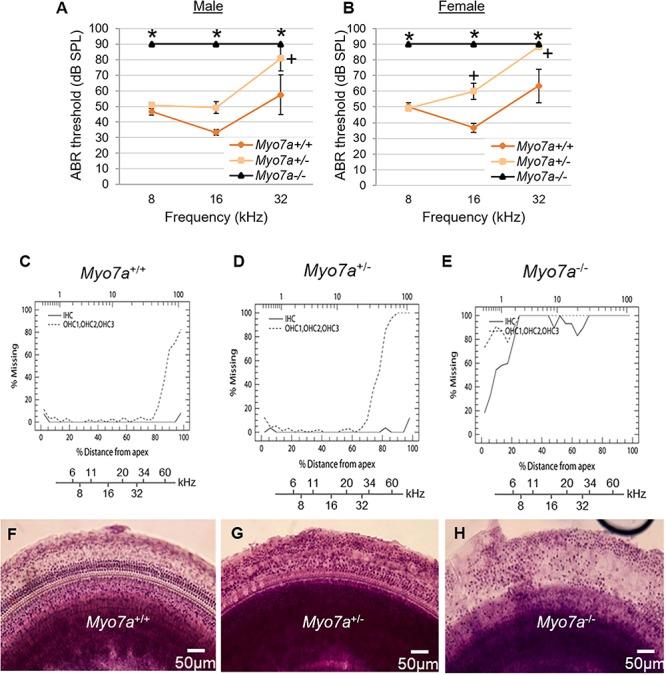
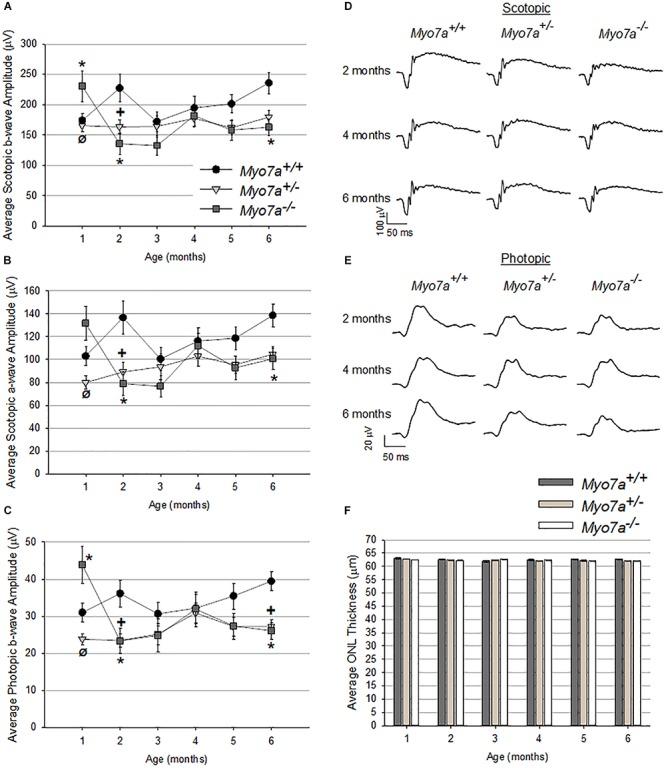
Usher's syndrome is the most common combined blindness-deafness disorder with USH1B, caused by mutations in , resulting in the most severe phenotype. The existence of numerous, naturally occurring mice harboring variable mutations on different genetic backgrounds has complicated the characterization of MYO7A knockout (KO) and heterozygote mice. We generated a novel MYO7A KO mouse ( ) that is easily genotyped, maintained, and confirmed to be null for MYO7A in both the eye and inner ear. Like USH1B patients, mice are profoundly deaf, and display near complete loss of inner and outer cochlear hair cells (HCs). No gross structural changes were observed in vestibular HCs. mice exhibited modest declines in retinal function but, unlike patients, no loss of retinal structure. We attribute the latter to differential expression of MYO7A in mouse vs. primate retina. Interestingly, heterozygous mice had reduced numbers of cochlear HCs and concomitant reductions in auditory function relative to controls. Notably, this is the first report that loss of a single allele significantly alters auditory structure and function and suggests that audiological characterization of USH1B carriers is warranted. Maintenance of vestibular HCs in mice suggests that gene replacement could be used to correct the vestibular dysfunction in USH1B patients. While mice do not exhibit sufficiently robust retinal phenotypes to be used as a therapeutic outcome measure, they can be used to assess expression of vectored on a null background and generate valuable pre-clinical data toward the treatment of USH1B.
尤塞氏综合征是最常见的合并失明和失聪的疾病,其中USH1B型由 中的突变引起,导致最严重的表型。在不同遗传背景下存在大量携带可变 突变的天然小鼠,这使得MYO7A基因敲除(KO)小鼠和杂合子小鼠的特征描述变得复杂。我们培育了一种新型的MYO7A基因敲除小鼠( ),其易于进行基因分型、饲养,并且在眼睛和内耳中均被证实为MYO7A基因缺失。与USH1B患者一样, 小鼠严重失聪,并且耳蜗内、外毛细胞(HCs)几乎完全丧失。在前庭毛细胞中未观察到明显的结构变化。 小鼠的视网膜功能出现适度下降,但与患者不同的是,视网膜结构没有丧失。我们将后者归因于MYO7A在小鼠和灵长类动物视网膜中的差异表达。有趣的是,相对于 对照,杂合的 小鼠的耳蜗毛细胞数量减少,听觉功能也随之降低。值得注意的是,这是第一份关于单个 等位基因缺失会显著改变听觉结构和功能的报告,表明对USH1B携带者进行听力学特征分析是有必要的。 小鼠前庭毛细胞的保留表明基因替代可用于纠正USH1B患者的前庭功能障碍。虽然 小鼠没有表现出足够强大的视网膜表型以用作治疗效果的衡量指标,但它们可用于评估在基因缺失背景下载体 的表达,并为USH1B的治疗生成有价值的临床前数据。




 Zotero 插件