
从化学结构信息中开发一种用于预测人类肾脏排泄和清除率的计算预测系统,该系统将血浆中非结合分数作为描述符。
Development of an in silico prediction system of human renal excretion and clearance from chemical structure information incorporating fraction unbound in plasma as a descriptor.
机构信息
Laboratory of Bioinformatics, AI Center for Health and Biomedical Research, National Institute of Biomedical Innovation Health and Nutrition, Osaka, Japan.
Discovery Technology Laboratories, Mitsubishi Tanabe Pharma Corporation, Saitama, Japan.
出版信息
Sci Rep. 2019 Dec 11;9(1):18782. doi: 10.1038/s41598-019-55325-1.
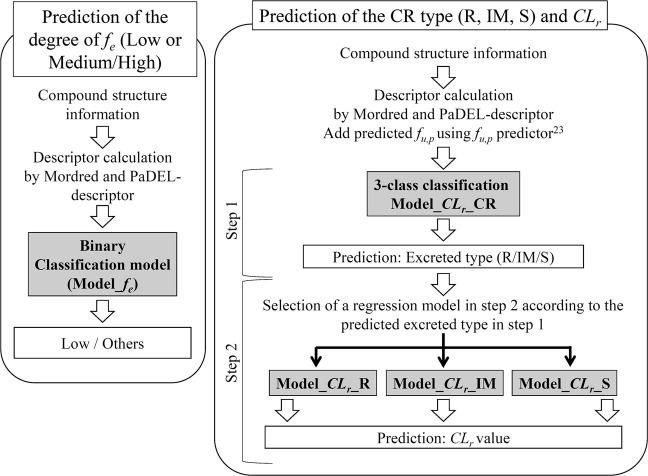
Prediction of pharmacokinetic profiles of new chemical entities is essential in drug development to minimize the risks of potential withdrawals. The excretion of unchanged compounds by the kidney constitutes a major route in drug elimination and plays an important role in pharmacokinetics. Herein, we created in silico prediction models of the fraction of drug excreted unchanged in the urine (f) and renal clearance (CL), with datasets of 411 and 401 compounds using freely available software; notably, all models require chemical structure information alone. The binary classification model for f demonstrated a balanced accuracy of 0.74. The two-step prediction system for CL was generated using a combination of the classification model to predict excretion-type compounds and regression models to predict the CL value for each excretion type. The accuracies of the regression models increased upon adding a descriptor, which was the observed and predicted fraction unbound in plasma (f); 78.6% of the samples in the higher range of renal clearance fell within 2-fold error with predicted f value. Our prediction system for renal excretion is freely available to the public and can be used as a practical tool for prioritization and optimization of compound synthesis in the early stage of drug discovery.
预测新化学实体的药代动力学特征对于药物开发至关重要,可以最大程度地降低潜在撤药的风险。肾脏对原型化合物的排泄是药物消除的主要途径,在药代动力学中起着重要作用。在此,我们使用免费软件,基于 411 种和 401 种化合物的数据集,建立了尿中药物原形排泄分数(f)和肾清除率(CL)的计算预测模型;值得注意的是,所有模型仅需要化学结构信息。f 的二分类预测模型的平衡准确率为 0.74。采用分类模型预测排泄型化合物和回归模型预测每种排泄类型的 CL 值相结合的两步预测系统来生成 CL 的两步预测系统。加入观察到的和预测的血浆中未结合分数(f)的描述符后,回归模型的准确性提高了;在较高的肾清除率范围内,78.6%的样本的预测 f 值的 2 倍误差内。我们的肾排泄预测系统可供公众免费使用,可作为药物发现早期化合物合成的优先级和优化的实用工具。


 Zotero 插件