
形态学不是角鮨属的可靠分类学工具:分子数据和实验感染表明,长角鮨和横带角鮨是同物异名。
Morphology is not a reliable taxonomic tool for the genus Lernaea: molecular data and experimental infection reveal that L. cyprinacea and L. cruciata are conspecific.
机构信息
Key Laboratory of Aquaculture Disease Control, Ministry of Agriculture, and State Key Laboratory of Freshwater Ecology and Biotechnology, Institute of Hydrobiology, Chinese Academy of Sciences, Wuhan, 430072, People's Republic of China.
Wuhan Institute of Biomedical Sciences, School of Medicine, Jianghan University, Wuhan, 430056, People's Republic of China.
出版信息
Parasit Vectors. 2019 Dec 11;12(1):579. doi: 10.1186/s13071-019-3831-y.
BACKGROUND
Species belonging to the genus Lernaea are cosmopolitan parasites that can infect many different freshwater fish hosts. Due to a high degree of morphological intraspecific variability and high levels of interspecific similarities, their classification is extremely difficult and controversial. Although the suitability of the shape of cephalic horns has been questioned decades ago by some experimental infection studies, this character still plays the central role in the identification of Lernaea spp.
METHODS
We used the nominal species Lernaea cyprinacea and Lernaea cruciata to test the hypothesis that the shape of the anchor can exhibit host-induced morphological variability, and that the two taxa may be synonymous.
RESULTS
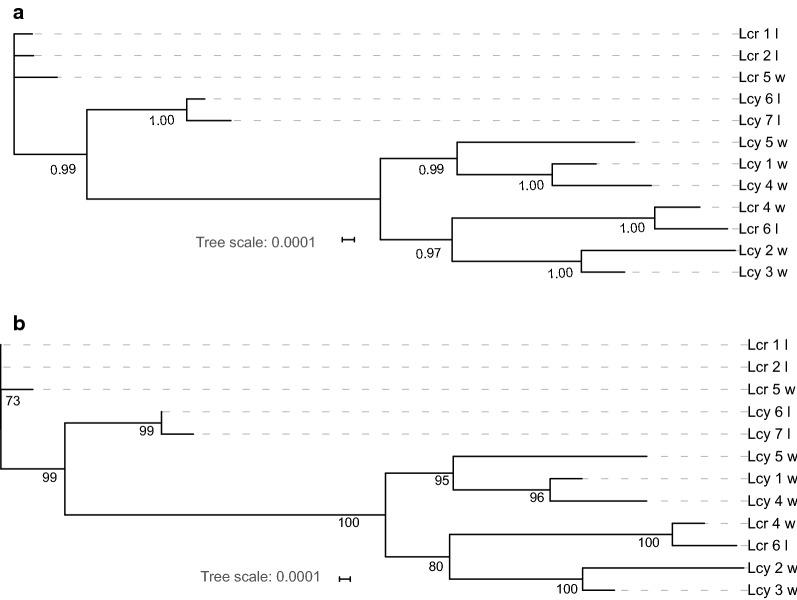
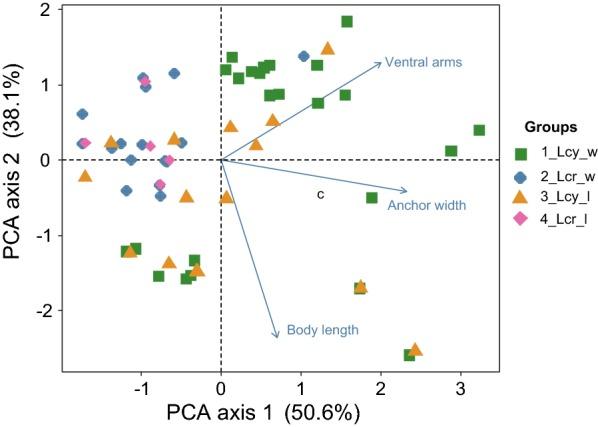
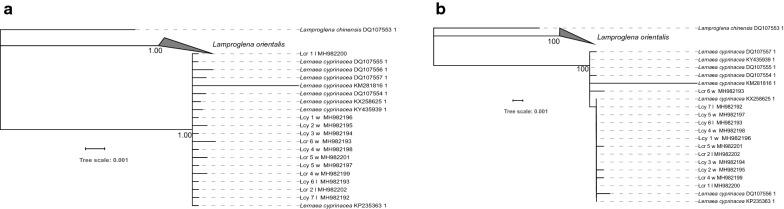
We examined 517 wild or farmed specimens of five host fish species (four cyprinids and a mosquitofish), and found that all 16 parasite specimens collected from mosquitofish could be morphologically identified as L. cruciata, whereas the remaining 25 parasite specimens were all identified as L. cyprinacea. We experimentally infected goldfish and mosquitofish specimens with offspring (copepodids) of a single L. cyprinacea specimen: the adult parasites from goldfish were morphologically identified as L. cyprinacea, and those from mosquitofish as L. cruciata. We then used molecular data to corroborate that all these specimens are conspecific.
CONCLUSIONS
Our results suggest that L. cyprinacea and L. cruciata may be synonyms, misidentified as different species as a result of host-induced morphological variation. Given the current shortage of molecular data for the genus Lernaea, in order to resolve the taxonomy of this genus (determine the exact number of species), future studies should aim to sequence as much molecular data as possible, and conduct further experimental infections.
背景
属种 Lernaea 是世界性的寄生虫,可感染许多不同的淡水鱼类宿主。由于种内形态变异程度高,种间相似度高,因此其分类极具难度且颇具争议。尽管几十年来一些实验感染研究已经对头部角的形状是否适合提出了质疑,但这个特征在 Lernaea spp 的鉴定中仍起着核心作用。
方法
我们使用名义种 Lernaea cyprinacea 和 Lernaea cruciata 来检验以下假设:锚的形状可能表现出宿主诱导的形态变异性,并且这两个分类单元可能是同义词。
结果
我们检查了 5 种宿主鱼类(4 种鲤科鱼类和 1 种食蚊鱼)的 517 个野生或养殖标本,发现从食蚊鱼采集的 16 个寄生虫标本都可以形态学上鉴定为 L. cruciata,而其余 25 个寄生虫标本均鉴定为 L. cyprinacea。我们用从单个 L. cyprinacea 标本的幼虫(桡足幼体)感染金鱼和食蚊鱼标本的实验表明:从金鱼感染的成年寄生虫被形态学鉴定为 L. cyprinacea,而从食蚊鱼感染的成年寄生虫被鉴定为 L. cruciata。然后我们使用分子数据证实所有这些标本都是同种的。
结论
我们的结果表明,L. cyprinacea 和 L. cruciata 可能是同义词,由于宿主诱导的形态变化而被错误地鉴定为不同的物种。鉴于目前 Lernaea 属的分子数据短缺,为了解决该属的分类学问题(确定确切的物种数量),未来的研究应该旨在尽可能多地测序分子数据,并进行进一步的实验感染。




 Zotero 插件