
阿托伐醌通过上调整合应激通路和抑制氧化磷酸化来抑制 AML。
Atovaquone is active against AML by upregulating the integrated stress pathway and suppressing oxidative phosphorylation.
机构信息
Division of Pediatric Hematology/Oncology, Department of Pediatrics, Baylor College of Medicine, Houston, TX.
Department of Medical Oncology, Dana-Farber Cancer Institute, Boston, MA.
出版信息
Blood Adv. 2019 Dec 23;3(24):4215-4227. doi: 10.1182/bloodadvances.2019000499.
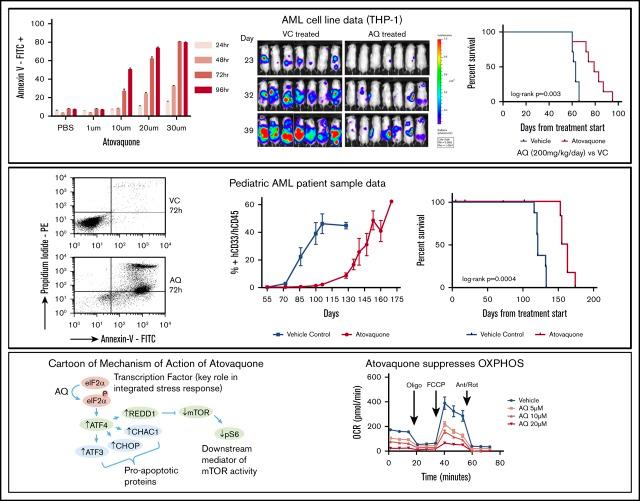
Atovaquone, a US Food and Drug Administration-approved antiparasitic drug previously shown to reduce interleukin-6/STAT3 signaling in myeloma cells, is well tolerated, and plasma concentrations of 40 to 80 µM have been achieved with pediatric and adult dosing. We conducted preclinical testing of atovaquone with acute myeloid leukemia (AML) cell lines and pediatric patient samples. Atovaquone induced apoptosis with an EC50 <30 µM for most AML lines and primary pediatric AML specimens. In NSG mice xenografted with luciferase-expressing THP-1 cells and in those receiving a patient-derived xenograft, atovaquone-treated mice demonstrated decreased disease burden and prolonged survival. To gain a better understanding of the mechanism of atovaquone, we performed an integrated analysis of gene expression changes occurring in cancer cell lines after atovaquone exposure. Atovaquone promoted phosphorylation of eIF2α, a key component of the integrated stress response and master regulator of protein translation. Increased levels of phosphorylated eIF2α led to greater abundance of the transcription factor ATF4 and its target genes, including proapoptotic CHOP and CHAC1. Furthermore, atovaquone upregulated REDD1, an ATF4 target gene and negative regulator of the mechanistic target of rapamycin (mTOR), and caused REDD1-mediated inhibition of mTOR activity with similar efficacy as rapamycin. Additionally, atovaquone suppressed the oxygen consumption rate of AML cells, which has specific implications for chemotherapy-resistant AML blasts that rely on oxidative phosphorylation for survival. Our results provide insight into the complex biological effects of atovaquone, highlighting its potential as an anticancer therapy with novel and diverse mechanisms of action, and support further clinical evaluation of atovaquone for pediatric and adult AML.
阿托伐醌,一种美国食品和药物管理局批准的抗寄生虫药物,先前已被证明可减少骨髓瘤细胞中的白细胞介素 6/STAT3 信号,具有良好的耐受性,儿科和成人剂量可达到 40 至 80µM 的血浆浓度。我们对急性髓细胞白血病(AML)细胞系和儿科患者样本进行了阿托伐醌的临床前测试。阿托伐醌诱导大多数 AML 系和原发性儿科 AML 标本的细胞凋亡,EC50<30µM。在表达荧光素酶的 THP-1 细胞的 NSG 小鼠异种移植和接受患者来源的异种移植的小鼠中,接受阿托伐醌治疗的小鼠显示疾病负担减轻和存活时间延长。为了更好地了解阿托伐醌的作用机制,我们对阿托伐醌暴露后癌细胞系中发生的基因表达变化进行了综合分析。阿托伐醌促进了 eIF2α 的磷酸化,eIF2α 是整合应激反应的关键组成部分,也是蛋白质翻译的主要调节剂。磷酸化 eIF2α 水平的增加导致转录因子 ATF4 及其靶基因,包括促凋亡的 CHOP 和 CHAC1 的丰度增加。此外,阿托伐醌上调了 REDD1,这是 ATF4 的靶基因和雷帕霉素(mTOR)的机制靶标(mTOR)的负调节剂,并通过 REDD1 介导的 mTOR 活性抑制,与雷帕霉素具有相似的功效。此外,阿托伐醌抑制了 AML 细胞的耗氧量,这对依赖氧化磷酸化生存的化疗耐药 AML blasts 具有特殊意义。我们的研究结果深入了解了阿托伐醌的复杂生物学作用,突出了其作为一种具有新型和多样化作用机制的抗癌疗法的潜力,并支持进一步评估阿托伐醌用于儿科和成人 AML 的临床应用。
 Zotero 插件