
2019 年更新版:《2018 年美国糖尿病协会(ADA)与欧洲糖尿病研究协会(EASD)关于 2 型糖尿病患者高血糖管理的共识报告》。
2019 Update to: Management of Hyperglycemia in Type 2 Diabetes, 2018. A Consensus Report by the American Diabetes Association (ADA) and the European Association for the Study of Diabetes (EASD).
机构信息
Department of Medicine, University of North Carolina School of Medicine, Chapel Hill, NC
Department of Medicine and Diabetes Unit, Massachusetts General Hospital, Boston, MA.
出版信息
Diabetes Care. 2020 Feb;43(2):487-493. doi: 10.2337/dci19-0066. Epub 2019 Dec 19.
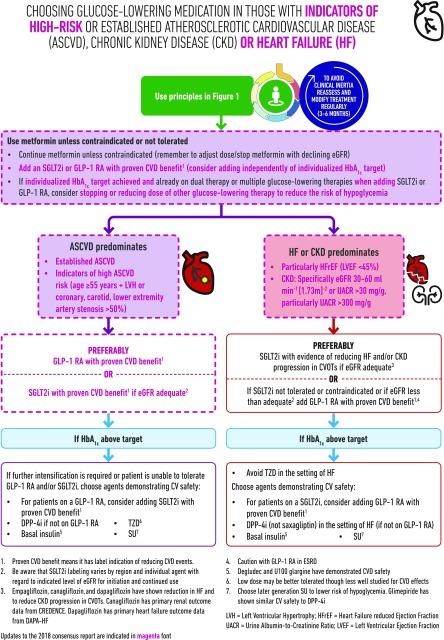
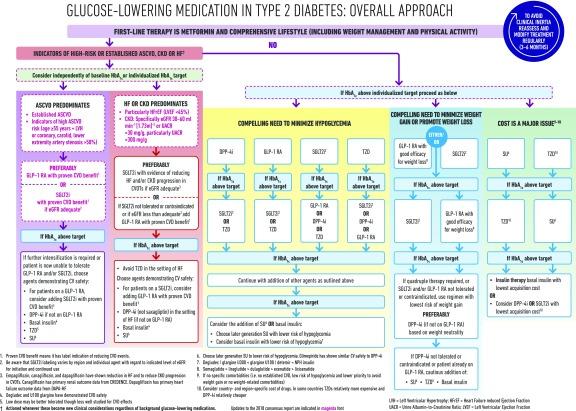
The American Diabetes Association and the European Association for the Study of Diabetes have briefly updated their 2018 recommendations on management of hyperglycemia, based on important research findings from large cardiovascular outcomes trials published in 2019. Important changes include: ) the decision to treat high-risk individuals with a glucagon-like peptide 1 (GLP-1) receptor agonist or sodium-glucose cotransporter 2 (SGLT2) inhibitor to reduce major adverse cardiovascular events (MACE), hospitalization for heart failure (hHF), cardiovascular death, or chronic kidney disease (CKD) progression should be considered independently of baseline HbA or individualized HbA target; ) GLP-1 receptor agonists can also be considered in patients with type 2 diabetes without established cardiovascular disease (CVD) but with the presence of specific indicators of high risk; and ) SGLT2 inhibitors are recommended in patients with type 2 diabetes and heart failure, particularly those with heart failure with reduced ejection fraction, to reduce hHF, MACE, and CVD death, as well as in patients with type 2 diabetes with CKD (estimated glomerular filtration rate 30 to ≤60 mL min [1.73 m] or urinary albumin-to-creatinine ratio >30 mg/g, particularly >300 mg/g) to prevent the progression of CKD, hHF, MACE, and cardiovascular death.
美国糖尿病协会和欧洲糖尿病研究协会根据 2019 年大型心血管结局试验的重要研究结果,简要更新了 2018 年关于高血糖管理的建议。重要的变化包括:(i) 决定使用胰高血糖素样肽 1 (GLP-1) 受体激动剂或钠-葡萄糖共转运蛋白 2 (SGLT2) 抑制剂治疗高危个体,以降低主要不良心血管事件 (MACE)、心力衰竭住院 (hHF)、心血管死亡或慢性肾脏病 (CKD) 进展,而不考虑基线 HbA 或个体化 HbA 目标;(ii) GLP-1 受体激动剂也可考虑用于无明确心血管疾病 (CVD) 但存在高风险特定指标的 2 型糖尿病患者;以及 (iii) SGLT2 抑制剂推荐用于 2 型糖尿病伴心力衰竭患者,特别是射血分数降低的心力衰竭患者,以降低 hHF、MACE 和 CVD 死亡,以及 2 型糖尿病伴 CKD(估计肾小球滤过率 30 至 ≤60 mL min [1.73 m] 或尿白蛋白与肌酐比值 >30 mg/g,特别是 >300 mg/g)患者,以预防 CKD、hHF、MACE 和心血管死亡的进展。
 Zotero 插件