
多囊卵巢综合征(PCOS)女性后代的心脏代谢健康与健康对照组比较:系统评价和个体参与者数据荟萃分析。
Cardiometabolic health in offspring of women with PCOS compared to healthy controls: a systematic review and individual participant data meta-analysis.
机构信息
Department of Reproductive Medicine, Obstetrics and Gynecology, University Medical Center Utrecht, Utrecht University, Utrecht, The Netherlands.
Endocrinology and Metabolism, University of Chile, Santiago, Chile.
出版信息
Hum Reprod Update. 2020 Jan 1;26(1):103-117. doi: 10.1093/humupd/dmz036.
BACKGROUND
Women diagnosed with polycystic ovary syndrome (PCOS) suffer from an unfavorable cardiometabolic risk profile, which is already established by child-bearing age.
OBJECTIVE AND RATIONALE
The aim of this systematic review along with an individual participant data meta-analysis is to evaluate whether cardiometabolic features in the offspring (females and males aged 1-18 years) of women with PCOS (OPCOS) are less favorable compared to the offspring of healthy controls.
SEARCH METHODS
PubMed, Embase and gray literature databases were searched by three authors independently (M.N.G., M.A.W and J.C.) (last updated on 1 February 2018). Relevant key terms such as 'offspring' and 'PCOS' were combined. Outcomes were age-specific standardized scores of various cardiometabolic parameters: BMI, blood pressure, glucose, insulin, lipid profile and the sum scores of various cardiometabolic features (metabolic sum score). Linear mixed models were used for analyses with standardized beta (β) as outcome.
OUTCOMES
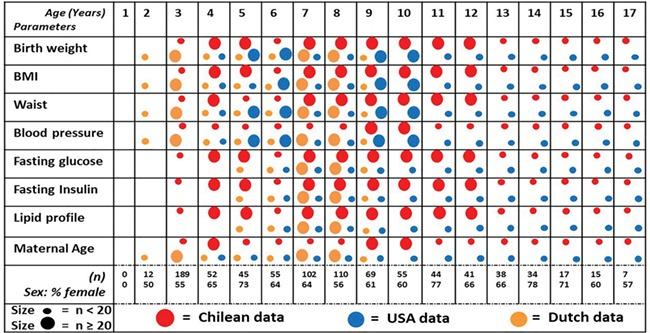
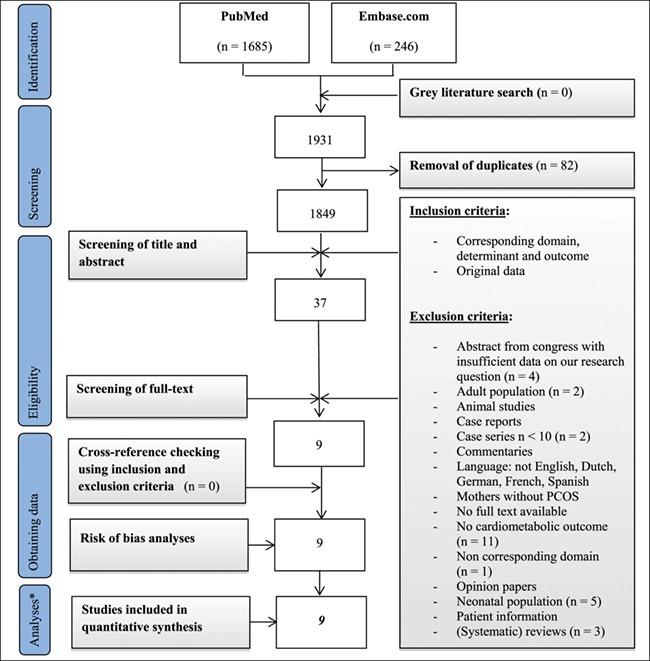
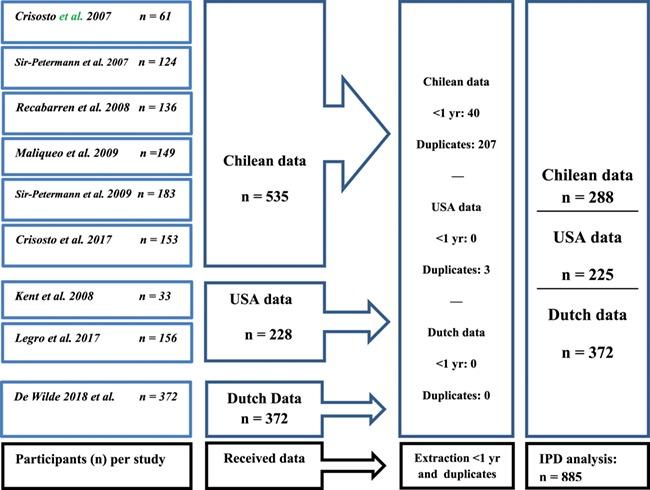
Nine relevant observational studies could be identified, which jointly included 1367 children: OPCOS and controls, originating from the Netherlands, Chile and the USA. After excluding neonates, duplicate records and follow-up screenings, a total of 885 subjects remained. In adjusted analyses, we observed that OPCOS (n = 298) exhibited increased plasma levels of fasting insulin (β = 0.21(95%CI: 0.01-0.41), P = 0.05), insulin-resistance (β = 0.21(95%CI: 0.01-0.42), P = 0.04), triglycerides (β = 0.19(95%CI: 0.02-0.36), P = 0.03) and high-density lipoprotein (HDL)-cholesterol concentrations (β = 0.31(95%CI: 0.08-0.54), P < 0.01), but a reduced birthweight (β = -116(95%CI: -195 to 38), P < 0.01) compared to controls (n = 587). After correction for multiple testing, however, differences in insulin and triglycerides lost their statistical significance. Interaction tests for sex revealed differences between males and females when comparing OPCOS versus controls. A higher 2-hour fasting insulin was observed among female OPCOS versus female controls (estimated difference for females (βf) = 0.45(95%CI: 0.07 to 0.83)) compared to the estimated difference between males ((βm) = -0.20(95%CI: -0.58 to 0.19)), with interaction-test: P = 0.03. Low-density lipoprotein-cholesterol differences in OPCOS versus controls were lower among females (βf = -0.39(95%CI: -0.62 to 0.16)), but comparable between male OPCOS and male controls (βm = 0.27(95%CI: -0.03 to 0.57)), with interaction-test: P < 0.01. Total cholesterol differences in OPCOS versus controls were also lower in females compared to the difference in male OPCOS and male controls (βf = -0.31(95%CI: -0.57 to 0.06), βm = 0.28(95%CI: -0.01 to 0.56), interaction-test: P = 0.01). The difference in HDL-cholesterol among female OPCOS versus controls (βf = 0.53(95%CI: 0.18-0.88)) was larger compared to the estimated mean difference among OPCOS males and the male controls (βm = 0.13(95%CI: -0.05-0.31), interaction-test: P < 0.01). Interaction test in metabolic sum score revealed a significant difference between females (OPCOS versus controls) and males (OPCOS versus controls); however, sub analyses performed in both sexes separately did not reveal a difference among females (OPCOS versus controls: βf = -0.14(95%CI: -1.05 to 0.77)) or males (OPCOS versus controls: βm = 0.85(95%CI: -0.10 to 1.79)), with P-value < 0.01.
WIDER IMPLICATIONS
We observed subtle signs of altered cardiometabolic health in OPCOS. Therefore, the unfavorable cardiovascular profile of women with PCOS at childbearing age may-next to a genetic predisposition-influence the health of their offspring. Sensitivity analyses revealed that these differences were predominantly observed among female offspring aged between 1 and 18 years. Moreover, studies with minimal risk of bias should elucidate the influence of a PCOS diagnosis in mothers on both sexes during fetal development and subsequently during childhood.
背景
患有多囊卵巢综合征 (PCOS) 的女性患者存在不利的心血管代谢风险状况,这种情况在生育年龄前就已经存在。
目的
本系统综述和个体参与者数据荟萃分析旨在评估患有 PCOS(OPCOS)的女性的后代(1-18 岁的女性和男性)的心血管代谢特征是否不如健康对照组的后代有利。
检索方法
由三位作者(M.N.G.、M.A.W. 和 J.C.)分别对 PubMed、Embase 和灰色文献数据库进行了检索(最后更新日期为 2018 年 2 月 1 日)。使用了诸如“后代”和“PCOS”等相关的关键词进行组合检索。结局为各种心血管代谢参数的年龄特异性标准化评分:BMI、血压、血糖、胰岛素、血脂谱和各种心血管代谢特征的总和评分(代谢总和评分)。采用标准化β(β)作为结果的线性混合模型进行分析。
结果
共确定了 9 项相关的观察性研究,其中共同纳入了 1367 名儿童:OPCOS 和对照组,分别来自荷兰、智利和美国。排除新生儿、重复记录和随访筛查后,共纳入 885 名受试者。在调整分析中,我们观察到 OPCOS(n=298)的空腹胰岛素水平升高(β=0.21(95%CI:0.01-0.41),P=0.05)、胰岛素抵抗(β=0.21(95%CI:0.01-0.42),P=0.04)、甘油三酯(β=0.19(95%CI:0.02-0.36),P=0.03)和高密度脂蛋白(HDL)-胆固醇浓度升高(β=0.31(95%CI:0.08-0.54),P<0.01),但出生体重降低(β=-116(95%CI:-195 至 38),P<0.01)与对照组相比。然而,在进行多次检验校正后,胰岛素和甘油三酯的差异失去了统计学意义。对性别进行交互检验显示,OPCOS 与对照组相比,男性和女性之间存在差异。与对照组相比,女性 OPCOS 的 2 小时空腹胰岛素更高(女性估计差异(βf)=0.45(95%CI:0.07-0.83)),而男性 OPCOS 的估计差异(βm)=-0.20(95%CI:-0.58 至 0.19)),交互检验:P=0.03。OPCOS 与对照组之间的低密度脂蛋白胆固醇差异在女性中较低(βf=-0.39(95%CI:-0.62 至 0.16)),但在男性 OPCOS 和男性对照组之间相似(βm=0.27(95%CI:-0.03 至 0.57)),交互检验:P<0.01。OPCOS 与对照组之间的总胆固醇差异在女性中也低于男性 OPCOS 和男性对照组之间的差异(βf=-0.31(95%CI:-0.57 至 0.06),βm=0.28(95%CI:-0.01 至 0.56)),交互检验:P=0.01)。与对照组相比,女性 OPCOS 的高密度脂蛋白胆固醇差异更大(βf=0.53(95%CI:0.18-0.88)),而男性 OPCOS 和男性对照组的估计平均差异较小(βm=0.13(95%CI:-0.05-0.31)),交互检验:P<0.01。代谢总和评分的交互检验显示,女性(OPCOS 与对照组)和男性(OPCOS 与对照组)之间存在显著差异;然而,在男性和女性中分别进行的亚组分析显示,女性(OPCOS 与对照组:βf=-0.14(95%CI:-1.05 至 0.77))或男性(OPCOS 与对照组:βm=0.85(95%CI:-0.10 至 1.79))之间没有差异,P 值均<0.01。
意义
我们观察到 OPCOS 存在心血管代谢健康状况轻微改变的迹象。因此,患有 PCOS 的女性在生育年龄时不利的心血管状况-除了遗传易感性外-可能会影响其后代的健康。敏感性分析表明,这些差异主要出现在 1 至 18 岁的女性后代中。此外,具有最小偏倚风险的研究应阐明母亲的 PCOS 诊断对胎儿发育期间以及随后儿童期的男女两性的影响。
 Zotero 插件