
分根系统中根区的异质性盐分减轻了高粱的盐害。
Heterogeneous root zone salinity mitigates salt injury to Sorghum bicolor (L.) Moench in a split-root system.
机构信息
Agronomy College, Shenyang Agricultural University, Shenyang, Liaoning, China.
Crop Research Institute, Shandong Academy of Agricultural Sciences, Jinan, Shandong, China.
出版信息
PLoS One. 2019 Dec 30;14(12):e0227020. doi: 10.1371/journal.pone.0227020. eCollection 2019.
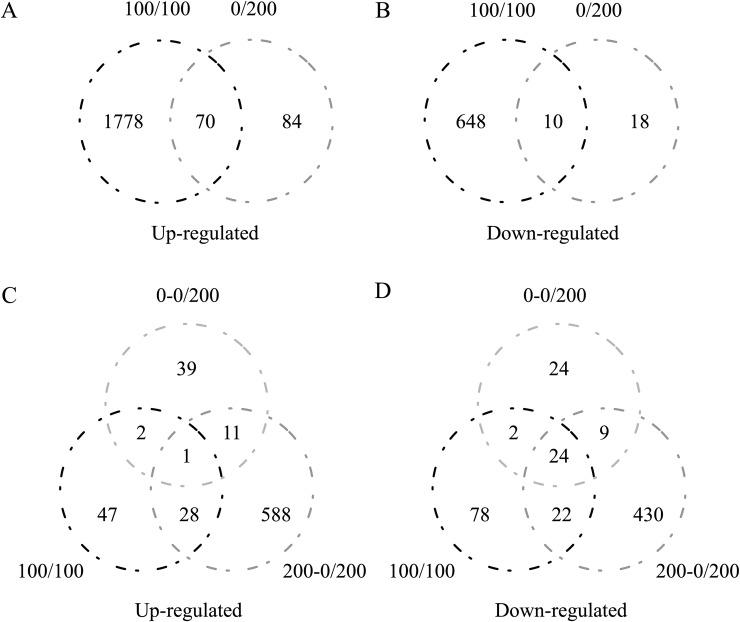
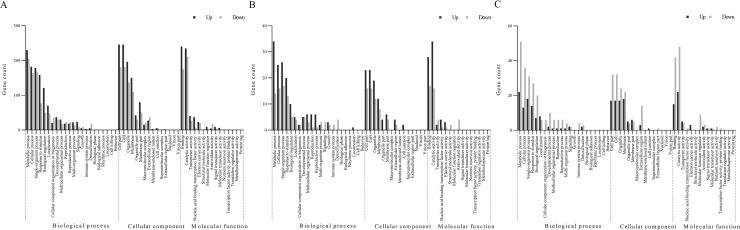
The heterogeneous distribution of soil salinity across the rhizosphere can moderate salt injury and improve sorghum growth. However, the essential molecular mechanisms used by sorghum to adapt to such environmental conditions remain uncharacterized. The present study evaluated physiological parameters such as the photosynthetic rate, antioxidative enzyme activities, leaf Na+ and K+ contents, and osmolyte contents and investigated gene expression patterns via RNA sequencing (RNA-seq) analysis under various conditions of nonuniformly distributed salt. Totals of 5691 and 2047 differentially expressed genes (DEGs) in the leaves and roots, respectively, were identified by RNA-seq under nonuniform (NaCl-free and 200 mmol·L-1 NaCl) and uniform (100 mmol·L-1 and 100 mmol·L-1 NaCl) salinity conditions. The expression of genes related to photosynthesis, Na+ compartmentalization, phytohormone metabolism, antioxidative enzymes, and transcription factors (TFs) was enhanced in leaves under nonuniform salinity stress compared with uniform salinity stress. Similarly, the expression of the majority of aquaporins and essential mineral transporters was upregulated in the NaCl-free root side in the nonuniform salinity treatment, whereas abscisic acid (ABA)-related and salt stress-responsive TF transcripts were more abundant in the high-saline root side in the nonuniform salinity treatment. In contrast, the expression of the DEGs identified in the nonuniform salinity treatment remained virtually unaffected and was even downregulated in the uniform salinity treatment. The transcriptome findings might be supportive of the increased photosynthetic rate, reduced Na+ levels, increased antioxidative capability in the leaves and, consequently, the growth recovery of sorghum under nonuniform salinity stress as well as the inhibited sorghum growth under uniform salinity conditions. The increased expression of salt resistance genes activated in response to the nonuniform salinity distribution implied that the cross-talk between the nonsaline and high-saline sides of the roots exposed to nonuniform salt stress is potentially regulated.
土壤盐分在根际的非均匀分布会减轻盐害,促进高粱生长。然而,高粱适应这种环境条件的基本分子机制仍不清楚。本研究通过非均匀分布盐胁迫(无 NaCl 和 200mmol·L-1 NaCl)和均匀分布盐胁迫(100mmol·L-1 和 100mmol·L-1 NaCl)条件下的光合速率、抗氧化酶活性、叶片 Na+和 K+含量、渗透调节物质含量等生理参数的测定和 RNA 测序(RNA-seq)分析,研究了高粱在不同非均匀盐度条件下的基因表达模式。非均匀和均匀盐胁迫下,叶片和根系分别有 5691 和 2047 个差异表达基因(DEGs)。与均匀盐胁迫相比,非均匀盐胁迫下叶片中与光合作用、Na+区隔化、植物激素代谢、抗氧化酶和转录因子(TFs)相关的基因表达增强。同样,非均匀盐胁迫下 NaCl 处理侧根中大多数水通道蛋白和必需矿物质转运体的表达上调,而非均匀盐胁迫下高盐侧根中与脱落酸(ABA)相关和盐胁迫响应的 TF 转录本丰度更高。相反,非均匀盐处理中鉴定的 DEGs 的表达在均匀盐处理中几乎没有变化,甚至下调。转录组研究结果可能支持高粱在非均匀盐胁迫下光合速率提高、Na+水平降低、抗氧化能力增强,从而恢复生长,以及在均匀盐条件下生长受到抑制。非均匀盐分布激活的耐盐基因表达增加表明,根系非盐和高盐侧之间的相互作用可能受到调节。



 Zotero 插件