
大鼠肺、血和血清中整合转录组学、代谢组学和脂质组学分析评估激光打印机排放纳米颗粒吸入暴露诱导的疾病风险。
Integrated Transcriptomics, Metabolomics, and Lipidomics Profiling in Rat Lung, Blood, and Serum for Assessment of Laser Printer-Emitted Nanoparticle Inhalation Exposure-Induced Disease Risks.
机构信息
West Virginia University Cancer Institute/School of Public Health, West Virginia University, Morgantown, WV 26506, USA.
Lee Kong Chian School of Medicine, Nanyang Technological University, Singapore 308232, Singapore.
出版信息
Int J Mol Sci. 2019 Dec 16;20(24):6348. doi: 10.3390/ijms20246348.
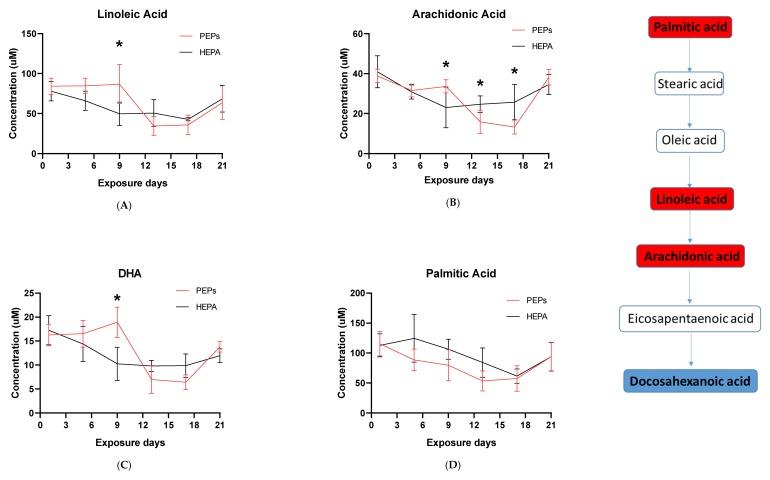
Laser printer-emitted nanoparticles (PEPs) generated from toners during printing represent one of the most common types of life cycle released particulate matter from nano-enabled products. Toxicological assessment of PEPs is therefore important for occupational and consumer health protection. Our group recently reported exposure to PEPs induces adverse cardiovascular responses including hypertension and arrythmia via monitoring left ventricular pressure and electrocardiogram in rats. This study employed genome-wide mRNA and miRNA profiling in rat lung and blood integrated with metabolomics and lipidomics profiling in rat serum to identify biomarkers for assessing PEPs-induced disease risks. Whole-body inhalation of PEPs perturbed transcriptional activities associated with cardiovascular dysfunction, metabolic syndrome, and neural disorders at every observed time point in both rat lung and blood during the 21 days of exposure. Furthermore, the systematic analysis revealed PEPs-induced transcriptomic changes linking to other disease risks in rats, including diabetes, congenital defects, auto-recessive disorders, physical deformation, and carcinogenesis. The results were also confirmed with global metabolomics profiling in rat serum. Among the validated metabolites and lipids, linoleic acid, arachidonic acid, docosahexanoic acid, and histidine showed significant variation in PEPs-exposed rat serum. Overall, the identified PEPs-induced dysregulated genes, molecular pathways and functions, and miRNA-mediated transcriptional activities provide important insights into the disease mechanisms. The discovered important mRNAs, miRNAs, lipids and metabolites may serve as candidate biomarkers for future occupational and medical surveillance studies. To the best of our knowledge, this is the first study systematically integrating in vivo, transcriptomics, metabolomics, and lipidomics to assess PEPs inhalation exposure-induced disease risks using a rat model.
激光打印机在打印过程中从墨粉中释放出的纳米颗粒(PEPs)代表了纳米产品生命周期中释放的最常见的颗粒物质之一。因此,PEPs 的毒理学评估对于职业和消费者健康保护非常重要。我们小组最近的研究报告表明,通过监测大鼠的左心室压力和心电图,PEPs 的暴露会引起不良的心血管反应,包括高血压和心律失常。本研究采用大鼠肺和血液的全基因组 mRNA 和 miRNA 谱分析以及大鼠血清的代谢组学和脂质组学谱分析,以确定评估 PEP 诱导疾病风险的生物标志物。在暴露的 21 天内,大鼠的全身体内吸入 PEP 会扰乱与心血管功能障碍、代谢综合征和神经紊乱相关的转录活性,在每个观察时间点都能在大鼠的肺和血液中观察到。此外,系统分析揭示了 PEP 诱导的转录组变化与大鼠的其他疾病风险有关,包括糖尿病、先天缺陷、常染色体隐性疾病、身体畸形和致癌作用。这些结果在大鼠血清的全局代谢组学谱分析中也得到了证实。在验证的代谢物和脂质中,亚油酸、花生四烯酸、二十二碳六烯酸和组氨酸在 PEP 暴露的大鼠血清中显示出显著变化。总的来说,所确定的 PEP 诱导的失调基因、分子途径和功能以及 miRNA 介导的转录活性为疾病机制提供了重要的见解。发现的重要 mRNAs、miRNAs、脂质和代谢物可能作为未来职业和医学监测研究的候选生物标志物。据我们所知,这是第一项使用大鼠模型系统地整合体内、转录组学、代谢组学和脂质组学来评估 PEP 吸入暴露诱导疾病风险的研究。


 Zotero 插件