
维生素 D 预防学龄前儿童哮喘恶化(DIVA):一项多中心随机安慰剂对照三盲试验方案。
Vitamin D in the prevention of exacerbations of asthma in preschoolers (DIVA): protocol for a multicentre randomised placebo-controlled triple-blind trial.
机构信息
Priority Research Centre Grow Up Well, School of Medicine & Public Health, Faculty of Health, The University of Newcastle, Callaghan, New South Wales, Australia.
Department of Social & Preventive Medicine, University of Montreal, Montreal, Québec, Canada
出版信息
BMJ Open. 2019 Dec 30;9(12):e033075. doi: 10.1136/bmjopen-2019-033075.
INTRODUCTION
Preschoolers have the highest rate of emergency visits and hospitalisations for asthma exacerbations of all age groups, with most triggered by upper respiratory tract infections (URTIs) and occurring in the fall or winter. Vitamin D insufficiency is highly prevalent in Canadian preschoolers with recurrent asthma exacerbations, particularly in winter. It is associated with more URTIs and, in patients with asthma, more oral corticosteroid (OCS) use. Although evidence suggests that vitamin D supplements significantly decrease URTIs and asthma exacerbations requiring OCS, there is insufficient data in preschoolers. This study aims to determine the impact of vitamin D supplementation on exacerbations requiring OCS, in preschoolers with recurrent URTI-induced asthma exacerbations.
METHODS AND ANALYSIS
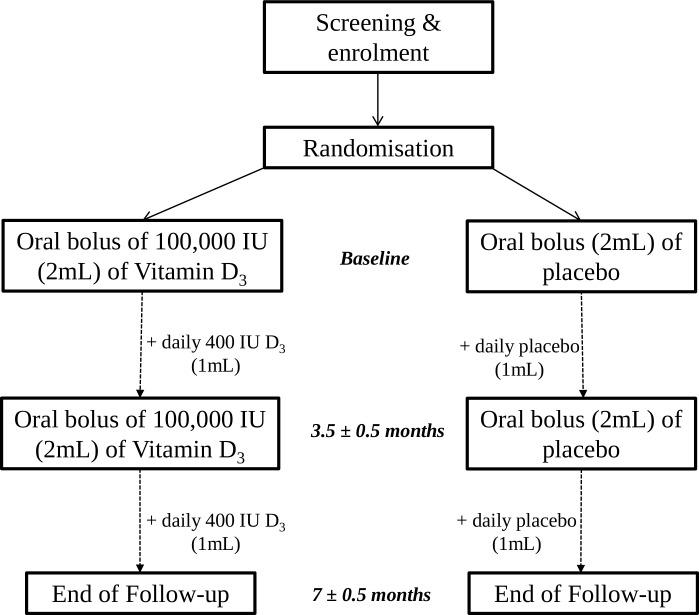
This is a phase III, randomised, triple-blind, placebo-controlled, parallel-group multicentre trial of vitamin D supplementation in children aged 1-5 years, with asthma triggered by URTIs and a recent history of frequent URTIs and OCS use. Children (n=865) will be recruited in the fall and early winter and followed for 7 months. They will be randomised to either the (1) intervention: two oral boluses of 100 000 international unit (IU) vitamin D (3.5 months apart) with 400 IU vitamin D daily; or (2) control: identical placebo boluses with daily placebo. The primary outcome is the number of exacerbations requiring OCS per child, documented by medical and pharmacy records. Secondary outcomes include number of laboratory-confirmed viral URTIs, exacerbation duration and severity, parent functional status, healthcare use, treatment deintensification, cost and safety.
ETHICS AND DISSEMINATION
This study has received ethical approval from all sites. Results will be disseminated via international conferences and manuscripts targeting paediatricians and respirologists, and to families of asthmatic children via our Quebec parents-partners outreach programme. If proven effective, findings may markedly influence the management of URTI-induced asthma in high-morbidity preschoolers and could be directly implemented into practice with an update to clinical guidelines.
TRIAL REGISTRATION NUMBER
NCT03365687.
简介
学龄前儿童是所有年龄段中哮喘急性发作急诊就诊和住院率最高的人群,大多数由上呼吸道感染(URTIs)引发,且发作时间多在秋季或冬季。在加拿大患有反复哮喘发作的学龄前儿童中,维生素 D 不足的情况非常普遍,尤其是在冬季。维生素 D 不足与更多的 URTIs 有关,而在患有哮喘的患者中,与更多的口服皮质类固醇(OCS)的使用有关。尽管有证据表明维生素 D 补充剂可显著减少 URTIs 和需要 OCS 的哮喘急性发作,但在学龄前儿童中数据不足。本研究旨在确定维生素 D 补充剂对因 URTI 引发哮喘急性发作且有近期频繁 URTI 和 OCS 使用史的学龄前儿童中需要 OCS 的急性发作的影响。
方法和分析
这是一项在因 URTI 引发哮喘急性发作且有近期频繁 URTI 和 OCS 使用史的 1-5 岁儿童中进行的维生素 D 补充的 III 期、随机、三盲、安慰剂对照、平行组、多中心试验。将在秋季和初冬招募儿童(n=865),并随访 7 个月。他们将被随机分配到(1)干预组:两次口服 100000 国际单位(IU)维生素 D (相隔 3.5 个月),每日口服 400 IU 维生素 D;或(2)对照组:给予相同的安慰剂丸和每日安慰剂。主要结局是每个儿童需要 OCS 的急性发作次数,通过医疗和药房记录来记录。次要结局包括实验室确诊的病毒性 URTIs 数量、急性发作持续时间和严重程度、父母的功能状态、医疗保健使用情况、治疗减量化、成本和安全性。
伦理和传播
本研究已获得所有参与地点的伦理批准。研究结果将通过国际会议和针对儿科医生和呼吸科医生的论文进行传播,并通过我们的魁北克父母合作伙伴外展计划向哮喘儿童的家庭传播。如果证明有效,研究结果可能会显著影响高发病率学龄前儿童因 URTI 引发的哮喘的管理,并可通过更新临床指南直接将其应用于实践。
试验注册号
NCT03365687。
 Zotero 插件