
新加坡基层医疗保健中伴前驱糖尿病患者的体力活动的相关因素、促进因素和阻碍因素:混合方法研究
Correlates, facilitators and barriers of physical activity among primary care patients with prediabetes in Singapore - a mixed methods approach.
机构信息
Saw Swee Hock School of Public Health, National University of Singapore and National University Health System, Tahir Foundation Building, 12 Science Drive 2, #10-01, Singapore, Singapore city, 117549, Singapore.
Health Promotion & Preventive Care, National Healthcare Group Polyclinics, 3 Fusionopolis Link, Nexus@one-north, South Tower, #05-10, Singapore, Singapore city, 138543, Singapore.
出版信息
BMC Public Health. 2020 Jan 2;20(1):1. doi: 10.1186/s12889-019-7969-5.
BACKGROUND
Primary care patients with prediabetes is a priority group in the clinical, organisational and policy contexts. Engaging in regular physical activity is crucial to prevent diabetes for this group. The objectives of the study were to assess factors associated with meeting the recommendation of at least 150 min of moderate/vigorous physical activity weekly, and to explore facilitators and barriers related to the behaviour among primary care patients with prediabetes in Singapore.
METHODS
This was a mixed methods study, consisting of a cross-sectional survey involving 433 participants from 8 polyclinics, and in-depth interviews with 48 of them. Adjusted prevalence ratios (aPR) were obtained by mixed effects Poisson regression model. The socio-ecological model (SEM) was applied, and thematic analysis performed.
RESULTS
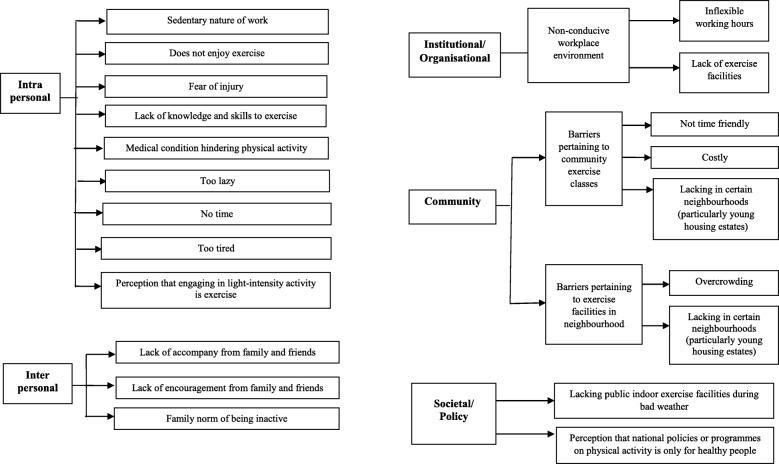
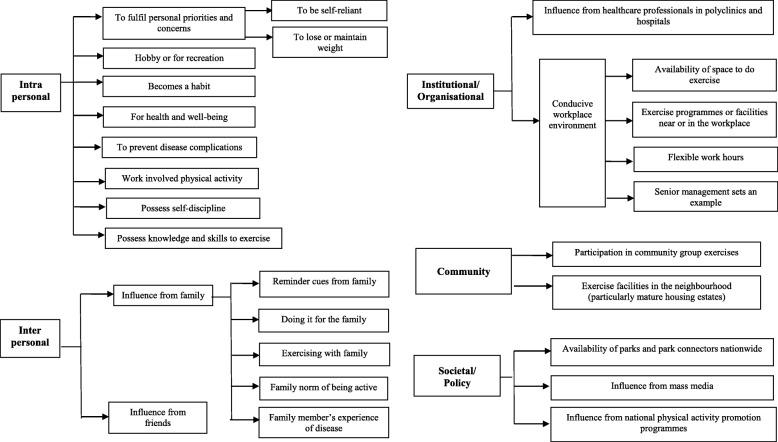
The prevalence of meeting the recommendation was 65.8%. This was positively associated with being male (aPR 1.21, 95%CI 1.09-1.34), living in 4-5 room public housing (aPR 1.19, 95%CI 1.07-1.31), living in executive flat/private housing (aPR 1.26, 95%CI 1.06-1.50), having family members/friends to exercise with (aPR 1.57, 95%CI 1.38-1.78); and negatively associated with a personal history of osteoarthritis (aPR 0.75, 95%CI 0.59-0.96), as well as time spent sitting or reclining daily (aPR 0.96, 95%CI 0.94-0.98). The recurrent themes for not meeting the recommendation included lacking companionship from family members/friends, medical conditions hindering physical activity (particularly osteoarthritis), lacking knowledge/skills to exercise properly, "no time" to exercise and barriers pertaining to exercise facilities in the neighbourhood. The recurrent themes for meeting the recommendation included family/peer influence, health/well-being concerns and education by healthcare professionals.
CONCLUSIONS
Much more remains to be done to promote physical activity among primary care patients with prediabetes in Singapore. Participants reported facilitators and barriers to physical activity at different levels of the SEM. Apart from the individual and interpersonal levels, practitioners and policy makers need to work together to address the organisational, community and policy barriers to physical activity.
背景
在临床、组织和政策背景下,患有前驱糖尿病的初级保健患者是一个优先群体。对于这一群体,定期进行身体活动对于预防糖尿病至关重要。本研究的目的是评估与满足每周至少进行 150 分钟中等/剧烈身体活动建议相关的因素,并探讨与新加坡患有前驱糖尿病的初级保健患者相关的行为的促进因素和障碍。
方法
这是一项混合方法研究,包括对来自 8 家诊所的 433 名参与者进行的横断面调查,以及对其中 48 名参与者进行的深入访谈。通过混合效应泊松回归模型获得调整后的患病率比 (aPR)。应用社会生态学模型 (SEM) 并进行主题分析。
结果
达到建议的患病率为 65.8%。这与男性(aPR 1.21,95%CI 1.09-1.34)、居住在 4-5 间房的公共住房(aPR 1.19,95%CI 1.07-1.31)、居住在行政公寓/私人住房(aPR 1.26,95%CI 1.06-1.50)、有一起锻炼的家庭成员/朋友(aPR 1.57,95%CI 1.38-1.78)呈正相关;与骨关节炎个人病史(aPR 0.75,95%CI 0.59-0.96)以及每天坐着或躺着的时间(aPR 0.96,95%CI 0.94-0.98)呈负相关。未达到建议的常见主题包括缺乏家庭成员/朋友的陪伴、身体活动的医疗条件(特别是骨关节炎)、缺乏适当锻炼的知识/技能、“没有时间”锻炼以及邻里锻炼设施方面的障碍。达到建议的常见主题包括家庭/同伴的影响、对健康/福祉的关注以及医疗保健专业人员的教育。
结论
新加坡仍有许多工作要做,以促进初级保健患者中的前驱糖尿病患者进行身体活动。参与者报告了社会生态学模型不同层次的身体活动促进因素和障碍。除了个人和人际层面外,从业者和政策制定者还需要共同努力,解决身体活动的组织、社区和政策障碍。
 Zotero 插件