
胆汁和尿液肽标志物谱:胆管癌分子途径和生物学过程的关键入口。
Bile and urine peptide marker profiles: access keys to molecular pathways and biological processes in cholangiocarcinoma.
机构信息
Department of Gastroenterology, Hepatology and Endocrinology, Hannover Medical School, Hannover, Germany.
Mosaiques diagnostics GmbH, Rotenburger Straße 20, 30659, Hannover, Germany.
出版信息
J Biomed Sci. 2020 Jan 3;27(1):13. doi: 10.1186/s12929-019-0599-5.
BACKGROUND
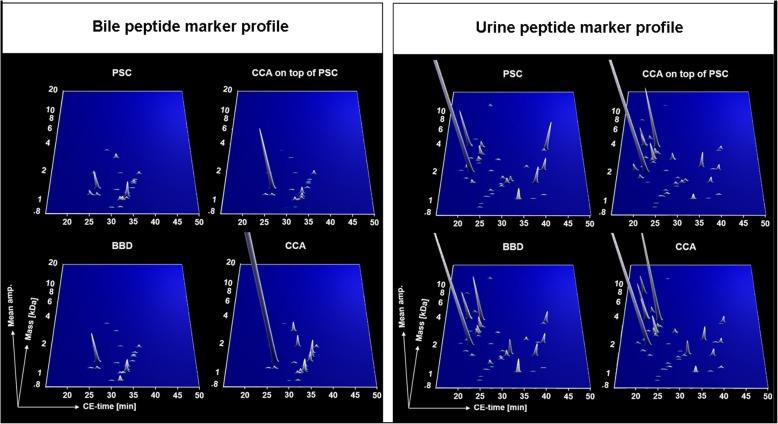
Detection of cholangiocarcinoma (CCA) remains a diagnostic challenge. We established diagnostic peptide biomarkers in bile and urine based on capillary electrophoresis coupled to mass spectrometry (CE-MS) to detect both local and systemic changes during CCA progression. In a prospective cohort study we recently demonstrated that combined bile and urine proteome analysis could further improve diagnostic accuracy of CCA diagnosis in patients with unknown biliary strictures. As a continuation of these investigations, the aim of the present study was to investigate the pathophysiological mechanisms behind the molecular determinants reflected by bile and urine peptide biomarkers.
METHODS
Protease mapping and gene ontology cluster analysis were performed for the previously defined CE-MS based biomarkers in bile and urine. For that purpose, bile and urine peptide profiles (from samples both collected at the date of endoscopy) were investigated from a representative cohort of patients with benign (n = 76) or CCA-associated (n = 52) biliary strictures (verified during clinical follow-up). This was supplemented with a literature search for the association of the individual biomarkers included in the proteomic patterns with CCA or cancer progression.
RESULTS
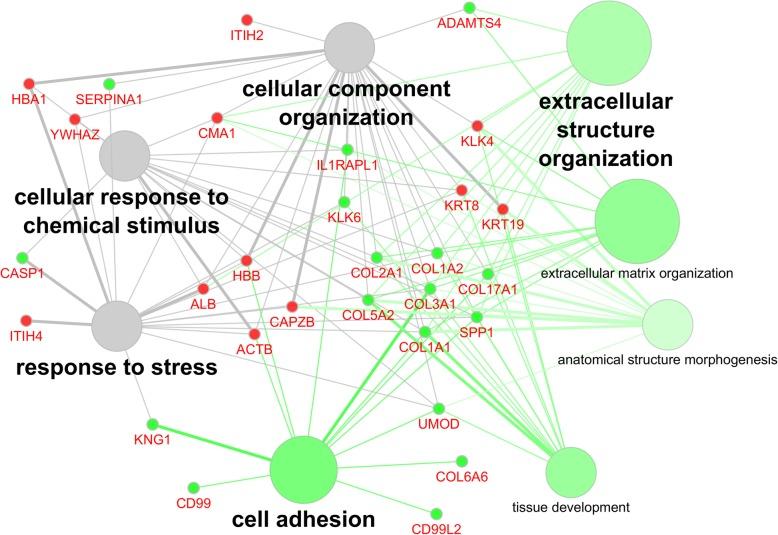
For most of the peptide markers, association to CCA has been described in literature. Protease mapping revealed ADAMTS4 activity in cleavage of both bile and urine CCA peptide biomarkers. Furthermore, increased chymase activity in bile points to mast cell activation at the tumor site. Gene ontology cluster analysis indicates cellular response to chemical stimuli and stress response as local and extracellular matrix reorganization by tissue destruction and repair as systemic events. The analysis further supports that the mapped proteases are drivers of local and systemic events.
CONCLUSIONS
The study supports connection of the CCA-associated peptide biomarkers to the molecular pathophysiology and indicates an involvement in epithelial-to-mesenchymal transition, generation of cancer-associated fibroblasts and activation of residual immune cells. Proteases, extracellular matrix components, inflammatory cytokines, proangiogenic, growth and vasoactive factors released from the tumor microenvironment are drivers of systemic early events during CCA progression.
背景
胆管癌(CCA)的检测仍然是一个诊断挑战。我们基于毛细管电泳-质谱联用(CE-MS)建立了胆汁和尿液中的诊断肽生物标志物,以检测 CCA 进展过程中的局部和全身变化。在最近的一项前瞻性队列研究中,我们证明了联合胆汁和尿液蛋白质组分析可以进一步提高对不明胆道狭窄患者 CCA 诊断的准确性。作为这些研究的延续,本研究的目的是探讨胆汁和尿液肽生物标志物所反映的分子决定因素背后的病理生理机制。
方法
对先前基于 CE-MS 的胆汁和尿液生物标志物进行蛋白酶图谱和基因本体聚类分析。为此,从具有良性(n=76)或 CCA 相关(n=52)胆道狭窄(在临床随访中证实)的代表性患者队列中分别研究了在进行内镜检查时采集的胆汁和尿液肽谱。此外,还对纳入蛋白质图谱的各个生物标志物与 CCA 或癌症进展的关联进行了文献检索。
结果
对于大多数肽标记物,与 CCA 的关联在文献中已有描述。蛋白酶图谱显示 ADAMTS4 在胆汁和尿液 CCA 肽生物标志物的切割中具有活性。此外,胆汁中糜蛋白酶活性的增加表明肿瘤部位的肥大细胞被激活。基因本体聚类分析表明,细胞对化学刺激的反应和应激反应以及组织破坏和修复导致的细胞外基质重排是局部和全身事件。该分析进一步支持所映射的蛋白酶是局部和全身事件的驱动因素。
结论
该研究支持将与 CCA 相关的肽生物标志物与分子病理生理学联系起来,并表明其参与了上皮-间充质转化、癌症相关成纤维细胞的产生以及残余免疫细胞的激活。从肿瘤微环境中释放的蛋白酶、细胞外基质成分、炎症细胞因子、促血管生成、生长和血管活性因子是 CCA 进展过程中系统性早期事件的驱动因素。
 Zotero 插件