
饮食性黄原胶改变抗生素对肠道微生物群的疗效并减轻定植。
Dietary Xanthan Gum Alters Antibiotic Efficacy against the Murine Gut Microbiota and Attenuates Colonization.
机构信息
Department of Microbiology and Immunology, University of Michigan, Ann Arbor, Michigan, USA.
Department of Internal Medicine, Division of Infectious Diseases, University of Michigan, Ann Arbor, Michigan, USA.
出版信息
mSphere. 2020 Jan 8;5(1):e00708-19. doi: 10.1128/mSphere.00708-19.
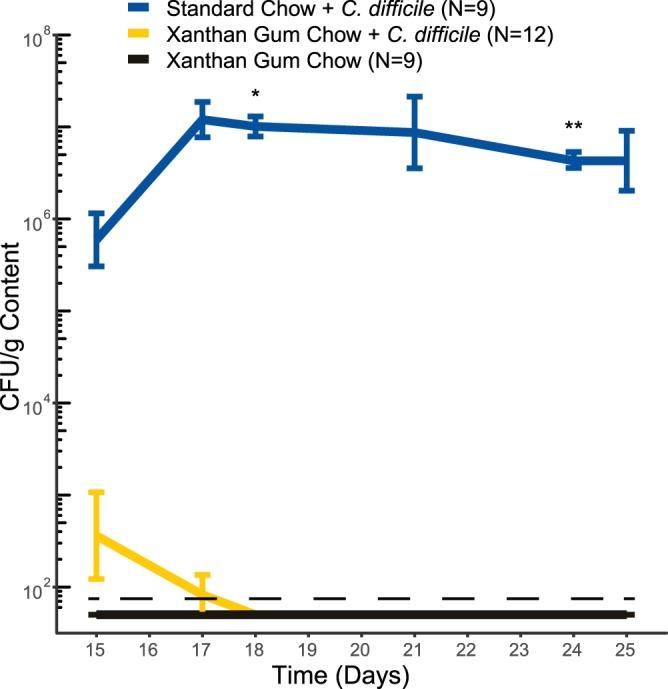
Dietary fiber provides a variety of microbiota-mediated benefits ranging from anti-inflammatory metabolites to pathogen colonization resistance. A healthy gut microbiota protects against colonization. Manipulation of these microbes through diet may increase colonization resistance to improve clinical outcomes. The primary objective of this study was to identify how the dietary fiber xanthan gum affects the microbiota and colonization. We added 5% xanthan gum to the diet of C57BL/6 mice and examined its effect on the microbiota through 16S rRNA gene amplicon sequencing and short-chain fatty acid analysis. Following either cefoperazone or an antibiotic cocktail administration, we challenged mice with and measured colonization by monitoring the CFU. Xanthan gum administration is associated with increases in fiber-degrading taxa and short-chain fatty acid concentrations. However, by maintaining both the diversity and absolute abundance of the microbiota during antibiotic treatment, the protective effects of xanthan gum administration on the microbiota were more prominent than the enrichment of these fiber-degrading taxa. As a result, mice that were on the xanthan gum diet experienced limited to no colonization. Xanthan gum administration alters mouse susceptibility to colonization by maintaining the microbiota during antibiotic treatment. While antibiotic-xanthan gum interactions are not well understood, xanthan gum has previously been used to bind drugs and alter their pharmacokinetics. Thus, xanthan gum may alter the activity of the oral antibiotics used to make the microbiota susceptible. Future research should further characterize how this and other common dietary fibers interact with drugs. A healthy gut bacterial community benefits the host by breaking down dietary nutrients and protecting against pathogens. capitalizes on the absence of this community to cause diarrhea and inflammation. Thus, a major clinical goal is to find ways to increase resistance to colonization by either supplementing with bacteria that promote resistance or a diet to enrich for those already present in the gut. In this study, we describe an interaction between xanthan gum, a human dietary additive, and the microbiota resulting in an altered gut environment that is protective against colonization.
膳食纤维提供了多种微生物群介导的益处,从抗炎代谢物到病原体定植抗性。健康的肠道微生物群可以防止定植。通过饮食对这些微生物进行操纵可能会增加定植抗性,以改善临床结果。本研究的主要目的是确定膳食纤维黄原胶如何影响微生物群和定植。我们在 C57BL/6 小鼠的饮食中添加 5%的黄原胶,并通过 16S rRNA 基因扩增子测序和短链脂肪酸分析来研究其对微生物群的影响。在用头孢哌酮或抗生素鸡尾酒处理后,我们用 挑战小鼠,并通过监测 CFU 来测量定植。黄原胶的给药与纤维降解分类群和短链脂肪酸浓度的增加有关。然而,通过在抗生素治疗期间维持微生物群的多样性和绝对丰度,黄原胶给药对微生物群的保护作用比这些纤维降解分类群的富集更为显著。结果,使用黄原胶饮食的小鼠经历了有限的或没有 的定植。黄原胶给药通过在抗生素治疗期间维持微生物群来改变小鼠对 的易感性。虽然抗生素-黄原胶相互作用尚未得到很好的理解,但黄原胶以前曾被用于结合药物并改变其药代动力学。因此,黄原胶可能会改变用于使微生物群易感的口服抗生素的活性。未来的研究应进一步描述这种和其他常见膳食纤维如何与药物相互作用。健康的肠道细菌群落通过分解膳食营养物质和保护宿主免受病原体侵害来使宿主受益。利用该群落的缺失来引起腹泻和炎症。因此,一个主要的临床目标是找到增加对 的定植抗性的方法,方法是补充促进抗性的细菌或通过饮食丰富肠道中已有的细菌。在这项研究中,我们描述了黄原胶(一种人类膳食添加剂)与微生物群之间的相互作用,导致肠道环境发生改变,从而对 定植具有保护作用。

 Zotero 插件