
类风湿关节炎中的氧化应激:新型生物标志物和附加治疗的未来展望。
Oxidative Stress in Rheumatoid Arthritis: What the Future Might Hold regarding Novel Biomarkers and Add-On Therapies.
机构信息
Laboratório de Reatividade Cardiovascular, Setor de Fisiologia, Núcleo de Síndrome Metabólica, Instituto de Ciências Biológicas e da Saúde, Universidade Federal de Alagoas, Maceió, Alagoas, Brazil.
Departamento de Fisiologia e Farmacologia, Centro de Biociências (CB), Universidade Federal de Pernambuco (UFPE), Recife, Pernambuco, Brazil.
出版信息
Oxid Med Cell Longev. 2019 Dec 14;2019:7536805. doi: 10.1155/2019/7536805. eCollection 2019.
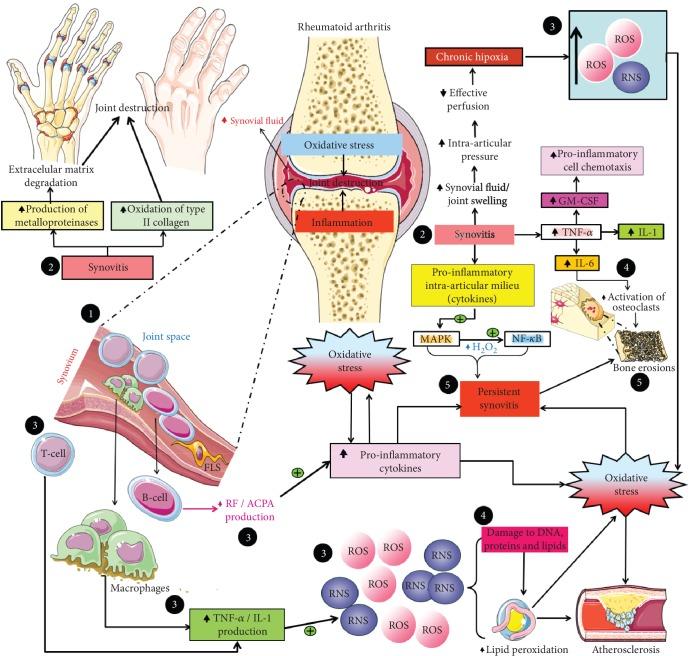
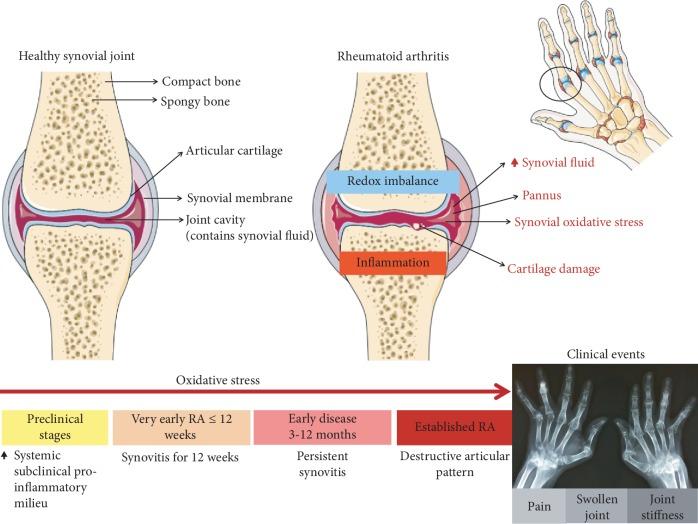
Numerous rheumatologic autoimmune diseases, among which rheumatoid arthritis, are chronic inflammatory diseases capable of inducing multiple cumulative articular and extra-articular damage, if not properly treated. Nevertheless, benign conditions may, similarly, exhibit arthritis as their major clinical finding, but with short-term duration instead, and evolve to spontaneous resolution in a few days to weeks, without permanent articular damage. Such distinction--represents one of the greatest challenges in clinical practice, once many metabolic, endocrine, neoplastic, granulomatous, infectious diseases and other autoimmune conditions may mimic rheumatoid arthritis. Indeed, the diagnosis of rheumatoid arthritis at early stages is a crucial step to a more effective mitigation of the disease-related damage. As a prototype of chronic inflammatory autoimmune disease, rheumatoid arthritis has been linked to oxidative stress, a condition in which the pool of reactive oxygen species increases over time, either by their augmented production, the reduction in antioxidant defenses, or the combination of both, ultimately implying compromise in the redox signaling. The exact mechanisms through which oxidative stress may contribute to the initiation and perpetuation of local (in the articular milieu) and systemic inflammation in rheumatoid arthritis, particularly at early stages, still remain to be determined. Furthermore, the role of antioxidants as therapeutic adjuvants in the control of disease activity seems to be overlooked, as a little number of short studies addressing this issue is currently found. Thus, the present review focuses on the binomial , bringing insights into their pathophysiological relationships, as well as the implications of potential diagnostic oxidative stress biomarkers and therapeutic interventions directed to the oxidative status in patients with rheumatoid arthritis.
许多风湿免疫性疾病,包括类风湿关节炎,都是慢性炎症性疾病,如果治疗不当,可导致多关节和关节外的进行性累积性损伤。然而,某些良性疾病也可能以关节炎为主要临床表现,但持续时间较短,通常在数天到数周内自行缓解,不会造成永久性关节损伤。这种鉴别是临床实践中最大的挑战之一,因为许多代谢性、内分泌性、肿瘤性、肉芽肿性、感染性疾病和其他自身免疫性疾病都可能类似于类风湿关节炎。事实上,在早期阶段诊断类风湿关节炎是减轻疾病相关损伤的关键步骤。作为慢性炎症性自身免疫性疾病的代表,类风湿关节炎与氧化应激有关,在这种情况下,活性氧的池会随着时间的推移而增加,这可能是由于其产生增加、抗氧化防御减少或两者的结合,最终导致氧化还原信号的损害。氧化应激如何导致类风湿关节炎局部(关节环境)和全身炎症的发生和持续,特别是在早期阶段,其确切机制仍有待确定。此外,抗氧化剂作为控制疾病活动的治疗辅助剂的作用似乎被忽视了,因为目前只有少数研究探讨了这个问题。因此,本综述重点关注氧化应激与类风湿关节炎的病理生理关系,以及潜在的诊断氧化应激生物标志物和针对类风湿关节炎患者氧化状态的治疗干预的意义。
 Zotero 插件