
基于生物分子和功能纳米材料的高灵敏度生物传感器:基于纳米材料类型的综述。
Highly Sensitive Biosensors Based on Biomolecules and Functional Nanomaterials Depending on the Types of Nanomaterials: A Perspective Review.
作者信息
Yoon Jinho, Shin Minkyu, Lee Taek, Choi Jeong-Woo
机构信息
Department of Chemical & Biomolecular Engineering, Sogang University, 35 Baekbeom-Ro, Mapo-Gu, Seoul 04107, Korea.
Department of Chemistry and Chemical Biology, Rutgers, The State University of New Jersey, Piscataway, NJ 08854, USA.
出版信息
Materials (Basel). 2020 Jan 9;13(2):299. doi: 10.3390/ma13020299.
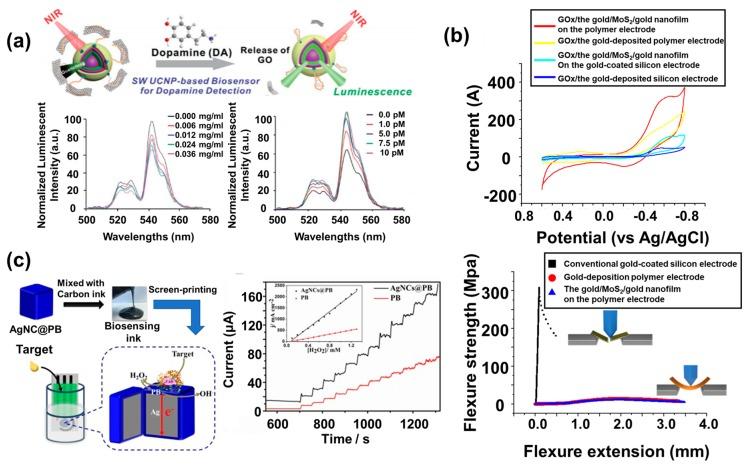
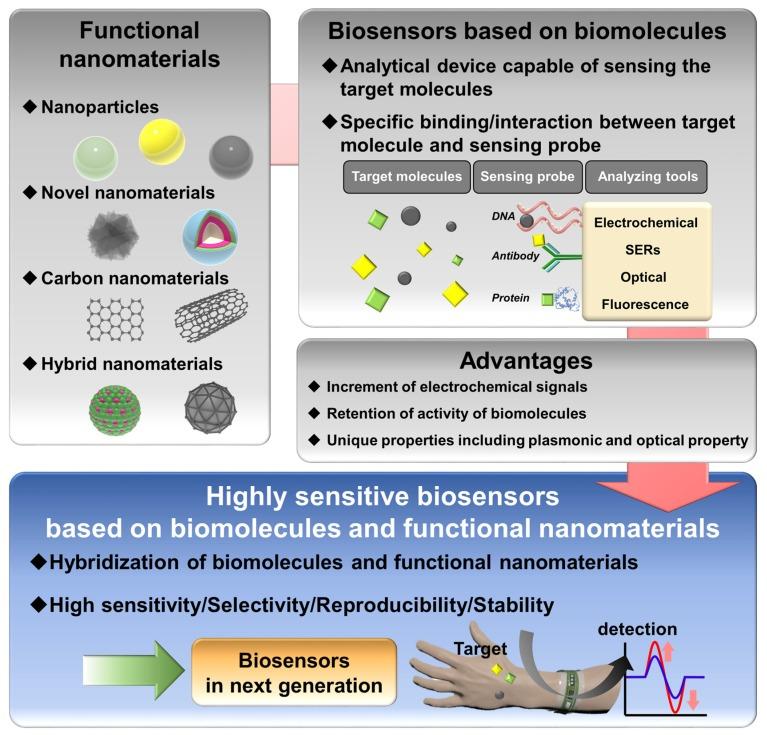
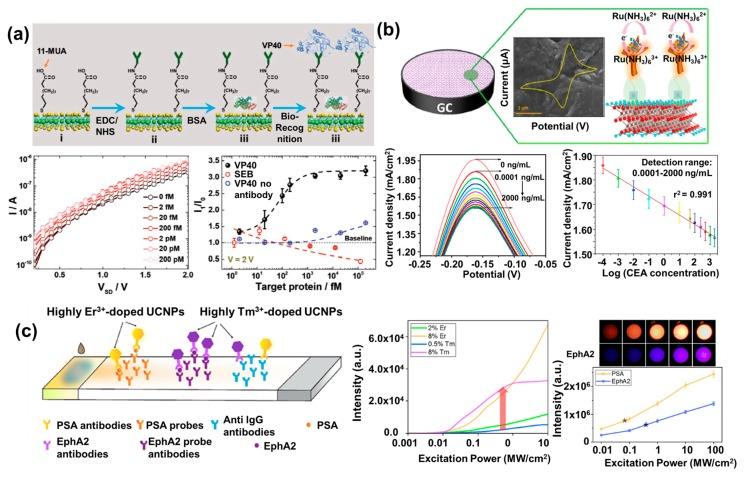
Biosensors are very important for detecting target molecules with high accuracy, selectivity, and signal-to-noise ratio. Biosensors developed using biomolecules such as enzymes or nucleic acids which were used as the probes for detecting the target molecules were studied widely due to their advantages. For example, enzymes can react with certain molecules rapidly and selectively, and nucleic acids can bind to their complementary sequences delicately in nanoscale. In addition, biomolecules can be immobilized and conjugated with other materials by surface modification through the recombination or introduction of chemical linkers. However, these biosensors have some essential limitations because of instability and low signal strength derived from the detector biomolecules. Functional nanomaterials offer a solution to overcome these limitations of biomolecules by hybridization with or replacing the biomolecules. Functional nanomaterials can give advantages for developing biosensors including the increment of electrochemical signals, retention of activity of biomolecules for a long-term period, and extension of investigating tools by using its unique plasmonic and optical properties. Up to now, various nanomaterials were synthesized and reported, from widely used gold nanoparticles to novel nanomaterials that are either carbon-based or transition-metal dichalcogenide (TMD)-based. These nanomaterials were utilized either by themselves or by hybridization with other nanomaterials to develop highly sensitive biosensors. In this review, highly sensitive biosensors developed from excellent novel nanomaterials are discussed through a selective overview of recently reported researches. We also suggest creative breakthroughs for the development of next-generation biosensors using the novel nanomaterials for detecting harmful target molecules with high sensitivity.
生物传感器对于高精度、高选择性和高信噪比地检测目标分子非常重要。利用生物分子(如酶或核酸)作为检测目标分子的探针开发的生物传感器,因其优点而受到广泛研究。例如,酶可以快速且选择性地与某些分子发生反应,核酸可以在纳米尺度上与它们的互补序列精确结合。此外,通过重组或引入化学连接体进行表面修饰,生物分子可以固定并与其他材料共轭。然而,由于检测生物分子的不稳定性和低信号强度,这些生物传感器存在一些本质上的局限性。功能性纳米材料通过与生物分子杂交或替代生物分子,为克服生物分子的这些局限性提供了解决方案。功能性纳米材料可为生物传感器的开发带来诸多优势,包括增强电化学信号、长期保持生物分子的活性,以及利用其独特的等离子体和光学特性扩展研究工具。到目前为止,已经合成并报道了各种纳米材料,从广泛使用的金纳米颗粒到基于碳或过渡金属二硫属化物(TMD)的新型纳米材料。这些纳米材料既可以单独使用,也可以与其他纳米材料杂交,以开发高灵敏度的生物传感器。在这篇综述中,通过对最近报道的研究进行选择性概述,讨论了由优秀的新型纳米材料开发的高灵敏度生物传感器。我们还为使用新型纳米材料开发下一代生物传感器以高灵敏度检测有害目标分子提出了创新性突破。


 Zotero 插件