
葡萄牙南部海甘蓝(十字花科)的酚类成分、毒性、酶抑制作用、计算机模拟研究及抗氧化特性
Phenolic Profile, Toxicity, Enzyme Inhibition, In Silico Studies, and Antioxidant Properties of Cakile maritima Scop. (Brassicaceae) from Southern Portugal.
作者信息
Placines Chloé, Castañeda-Loaiza Viana, João Rodrigues Maria, Pereira Catarina G, Stefanucci Azzurra, Mollica Adriano, Zengin Gokhan, Llorent-Martínez Eulogio J, Castilho Paula C, Custódio And Luísa
机构信息
Centre of Marine Sciences, Faculty of Sciences and Technology, University of Algarve, Ed. 7, Campus of Gambelas, 8005-139 Faro, Portugal.
Department of Pharmacy, University "G. d'Annunzio" of Chieti-Pescara, 66100 Chieti, Italy.
出版信息
Plants (Basel). 2020 Jan 22;9(2):142. doi: 10.3390/plants9020142.
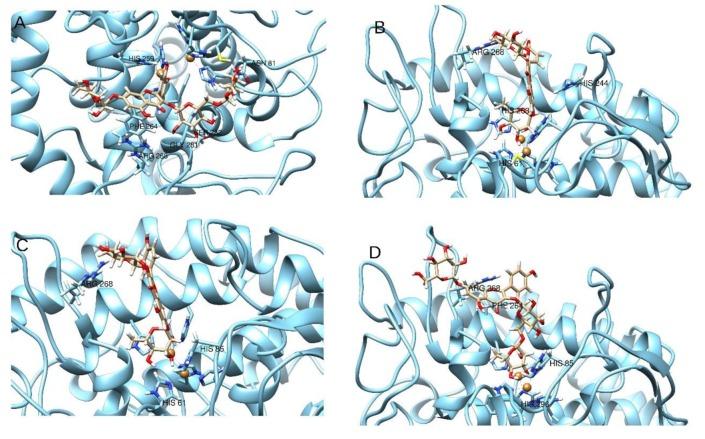
Cakile maritima Scop. (sea rocket) is an edible halophyte plant with several ethnomedicinal uses. This work reports the chemical profile and bioactivities of food grade extracts from sea rocket organs. Toxicity was determined on mammalian cells, and phenolic profiling and the quantitation of the main metabolites were made by high-performance liquid chromatography coupled to mass spectrometry (HPLC-MS). Enzymatic inhibition was determined towards acetyl- and butyrylcholinesterase (AChE, BuChE), α-glucosidase, α-amylase, and tyrosinase. Docking studies were performed to tyrosinase, on the major metabolites, and samples were tested for antioxidant properties. Extracts were not toxic, were constituted mainly by flavonoids, and some compounds (roseoside and oleuropein) are here described for the first time in the species. The aerial organs' ethanol extract had relevant activity towards 2,2-diphenyl-1-picrylhydrazyl [DPPH, half maximal inhibitory concentration (IC) = 0.59 mg/mL], and ferric-reducing activity power (FRAP, IC = 0.99 mg/mL). All samples were more active towards AChE than on BuChE. The ethanol fruits' extract inhibited α-glucosidase [2.19 mmol of equivalent of acarbose (ACAE)/g]. Samples were active against tyrosinase, especially the aerial organs' ethanol extracts [25.9 mg of equivalent of kojic acid (KAE)/g]. Quercetin and kaempferol glycosides fit well into the enzymatic pocket of tyrosinase. Our results suggest sea rocket as a candidate to be further explored as a source of bioactive products.
海甘蓝(Cakile maritima Scop.)是一种可食用的盐生植物,具有多种民族药用价值。这项工作报告了海甘蓝器官食品级提取物的化学特征和生物活性。在哺乳动物细胞上测定了毒性,并通过高效液相色谱-质谱联用(HPLC-MS)对酚类进行了分析和主要代谢物的定量。测定了对乙酰胆碱酯酶和丁酰胆碱酯酶(AChE、BuChE)、α-葡萄糖苷酶、α-淀粉酶和酪氨酸酶的酶抑制作用。对主要代谢物进行了酪氨酸酶对接研究,并测试了样品的抗氧化性能。提取物无毒,主要由黄酮类化合物组成,一些化合物(蔷薇糖苷和橄榄苦苷)在此物种中首次被描述。地上器官的乙醇提取物对2,2-二苯基-1-苦基肼[DPPH,半数最大抑制浓度(IC)=0.59mg/mL]和铁还原抗氧化能力(FRAP,IC=0.99mg/mL)具有相关活性。所有样品对AChE的活性均高于对BuChE的活性。乙醇果实提取物抑制α-葡萄糖苷酶[2.19mmol阿卡波糖当量(ACAE)/g]。样品对酪氨酸酶有活性,尤其是地上器官的乙醇提取物[25.9mg曲酸当量(KAE)/g]。槲皮素和山奈酚糖苷能很好地契合酪氨酸酶的酶口袋。我们的结果表明,海甘蓝作为生物活性产品的来源有待进一步探索。


 Zotero 插件