
用于预测头颈部鳞状细胞癌预后的免疫相关基因特征
Immune-related gene signature for predicting the prognosis of head and neck squamous cell carcinoma.
作者信息
She Yangyang, Kong Xiangbo, Ge Yaping, Yin Ping, Liu Zhiyong, Chen Jieyu, Gao Feng, Fang Silian
机构信息
1Department of Oral and Maxillofacial Surgery, The Sixth Affiliated Hospital of Sun Yat-sen University, No. 26 Yuancun Erheng Rd, Guangzhou, 510655 Guangdong China.
2Department of Stomatology, Sun Yat‑sen Memorial Hospital of Sun Yat-sen University, Guangzhou, Guangdong China.
出版信息
Cancer Cell Int. 2020 Jan 17;20:22. doi: 10.1186/s12935-020-1104-7. eCollection 2020.
BACKGROUND
Immune-related genes (IRGs) were linked to the prognosis of head and neck squamous cell carcinoma (HNSCC). This study aimed to identify the effects of an immune-related gene signature (IRGS) that can predict the of HNSCC prognosis.
METHODS
The expression data of 770 HNSCC patients from the TCGA database and the GEO database were used. To explore a predictive model, the Cox proportional hazards model was applied. The Kaplan-Meier survival analysis, as well as univariate and multivariate analyses were performed to evaluate the independent predictive value of IRGS. To explore biological functions of IRGS, enrichment analyses and pathway annotation for differentially expressed genes (DEGs) in different immune groups were applied, as well as the immune infiltration.
RESULTS
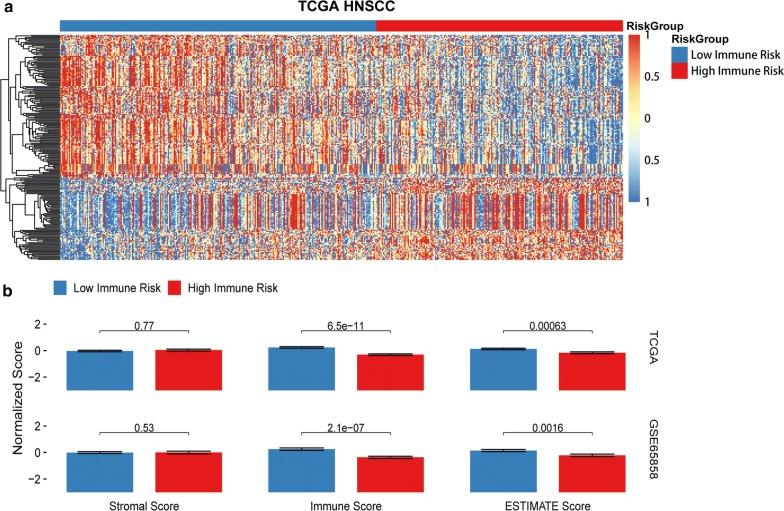
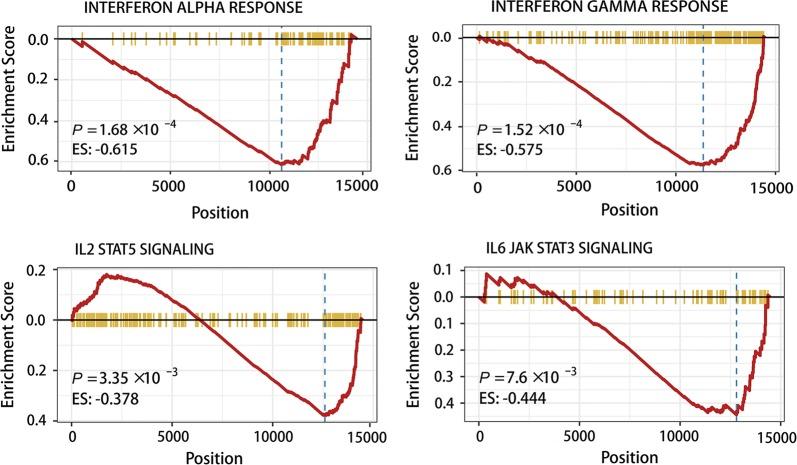
A prognostic signature comprising 27 IRGs was generated. IRGS significantly stratified HNSCC patients into high and low immune risk groups in regard to overall survival in the training cohort (HR = 3.69, 95% 2.73-4.98, < 0.001). Likewise, IRGS could be linked to the prognosis of HNSCC in patients of the validation cohort (HR = 1.84, 95% 1.21-2.81, < 0.01). Even after adjusting for TNM stage, IRGS was maintained as an independent predictor in the multivariate analysis (HR = 3.62, 95% 2.58-5.09, < 0.001), and in the validation cohort (HR = 1.73, 95% 1.12-2.67, = 0.014). The IFN-α response, the IFN-γ response, IL-2/STAT5 signaling, and IL-6/JAK/STAT3 signaling were all negatively correlated with the immune risk (< 0.01). Immune infiltration of the high-risk group was significantly lower than that of the low-risk group (< 0.01). Most notably, the infiltration of CD8 T cells, memory-activated CD4 T cells, and regulatory T cells was strongly upregulated in the low immune risk groups, while memory resting CD4 T cell infiltration was downregulated (< 0.01).
CONCLUSION
Our analysis provides a comprehensive prognosis of the immune microenvironments and outcomes for different individuals. Further studies are needed to evaluate the clinical application of this signature.
背景
免疫相关基因(IRGs)与头颈部鳞状细胞癌(HNSCC)的预后相关。本研究旨在确定一种可预测HNSCC预后的免疫相关基因特征(IRGS)的作用。
方法
使用来自TCGA数据库和GEO数据库的770例HNSCC患者的表达数据。为探索预测模型,应用Cox比例风险模型。进行Kaplan-Meier生存分析以及单变量和多变量分析,以评估IRGS的独立预测价值。为探索IRGS的生物学功能,对不同免疫组中差异表达基因(DEGs)进行富集分析和通路注释,以及免疫浸润分析。
结果
生成了一个包含27个IRGs的预后特征。在训练队列中,IRGS根据总生存期将HNSCC患者显著分为高免疫风险组和低免疫风险组(HR = 3.69,95% 2.73 - 4.98,< 0.001)。同样,在验证队列患者中,IRGS也与HNSCC的预后相关(HR = 1.84,95% 1.21 - 2.81,< 0.01)。即使在调整TNM分期后,在多变量分析中IRGS仍作为独立预测因子(HR = 3.62,95% 2.58 - 5.09,< 0.001),在验证队列中也是如此(HR = 1.73,95% 1.12 - 2.67,= 0.014)。IFN-α应答、IFN-γ应答、IL-2/STAT5信号通路和IL-6/JAK/STAT3信号通路均与免疫风险呈负相关(< 0.01)。高风险组的免疫浸润显著低于低风险组(< 0.01)。最值得注意的是,在低免疫风险组中,CD8 T细胞、记忆激活的CD4 T细胞和调节性T细胞的浸润强烈上调,而记忆静止CD4 T细胞浸润下调(< 0.01)。
结论
我们的分析为不同个体的免疫微环境和预后提供了全面的评估。需要进一步研究来评估该特征的临床应用。
 Zotero 插件