
驱动实体瘤血管生成拟态的调控网络。
Regulation Networks Driving Vasculogenic Mimicry in Solid Tumors.
作者信息
Hernández de la Cruz Olga N, López-González José Sullivan, García-Vázquez Raúl, Salinas-Vera Yarely M, Muñiz-Lino Marcos A, Aguilar-Cazares Dolores, López-Camarillo César, Carlos-Reyes Ángeles
机构信息
Posgrado en Ciencias Genómicas, Universidad Autónoma de la Ciudad de México, Mexico, Mexico.
Laboratorio de Cáncer de Pulmón, Instituto Nacional de Enfermedades Respiratorias "Ismael Cosío Villegas", Mexico, Mexico.
出版信息
Front Oncol. 2020 Jan 14;9:1419. doi: 10.3389/fonc.2019.01419. eCollection 2019.
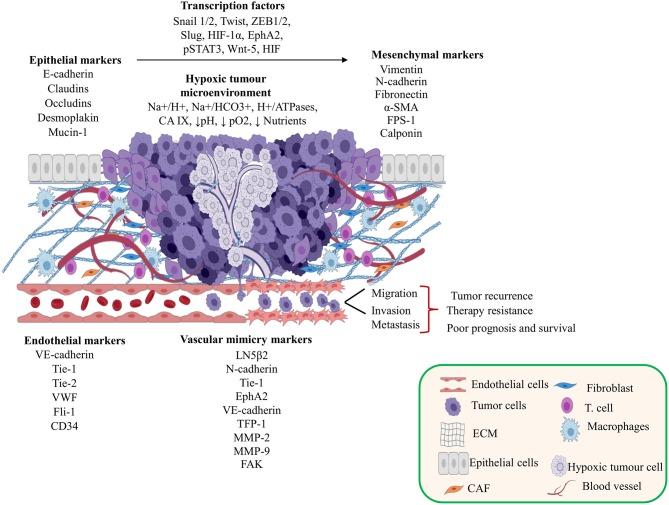
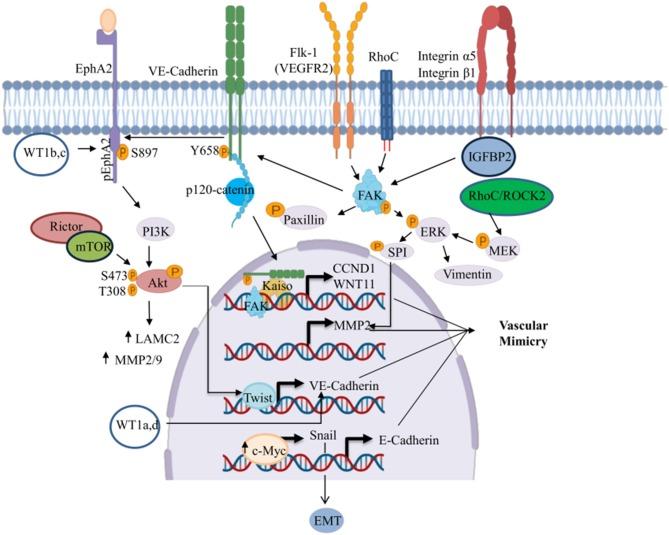
Vasculogenic mimicry (VM) is a mechanism whereby cancer cells form microvascular structures similar to three-dimensional channels to provide nutrients and oxygen to tumors. Unlike angiogenesis, VM is characterized by the development of new patterned three-dimensional vascular-like structures independent of endothelial cells. This phenomenon has been observed in many types of highly aggressive solid tumors. The presence of VM has also been associated with increased resistance to chemotherapy, low survival, and poor prognosis. MicroRNAs (miRNAs) and long non-coding RNAs (lncRNAs) are non-coding RNAs that regulate gene expression at the post-transcriptional level through different pathways. In recent years, these tiny RNAs have been shown to be expressed aberrantly in different human malignancies, thus contributing to the hallmarks of cancer. In this context, miRNAs and lncRNAs can be excellent biomarkers for diagnosis, prognosis, and the prediction of response to therapy. In this review, we discuss the role that the tumor microenvironment and the epithelial-mesenchymal transition have in VM. We include an overview of the mechanisms of VM with examples of diverse types of tumors. Finally, we describe the regulation networks of lncRNAs-miRNAs and their clinical impact with the VM. Knowing the key genes that regulate and promote the development of VM in tumors with invasive, aggressive, and therapy-resistant phenotypes will facilitate the discovery of novel biomarker therapeutics against cancer as well as tools in the diagnosis and prognosis of patients.
血管生成拟态(VM)是一种癌细胞形成类似于三维通道的微血管结构以向肿瘤提供营养和氧气的机制。与血管生成不同,VM的特征是独立于内皮细胞形成新的有图案的三维血管样结构。这种现象在许多类型的高侵袭性实体瘤中都有观察到。VM的存在还与化疗耐药性增加、低生存率和不良预后相关。微小RNA(miRNA)和长链非编码RNA(lncRNA)是非编码RNA,它们通过不同途径在转录后水平调节基因表达。近年来,这些微小RNA已被证明在不同的人类恶性肿瘤中异常表达,从而促成了癌症的特征。在这种情况下,miRNA和lncRNA可以成为诊断、预后和预测治疗反应的优秀生物标志物。在本综述中,我们讨论了肿瘤微环境和上皮-间质转化在VM中的作用。我们概述了VM的机制,并列举了不同类型肿瘤的例子。最后,我们描述了lncRNA-miRNA的调控网络及其对VM的临床影响。了解调控和促进具有侵袭性、攻击性和治疗抵抗性表型的肿瘤中VM发展的关键基因,将有助于发现针对癌症的新型生物标志物疗法以及患者诊断和预后的工具。


 Zotero 插件