
表面活性蛋白 A 作为特发性肺纤维化患者抗纤维化药物治疗结局的生物标志物。
Surfactant protein A as a biomarker of outcomes of anti-fibrotic drug therapy in patients with idiopathic pulmonary fibrosis.
机构信息
Department of Respiratory Medicine and Allergology, Sapporo Medical University School of Medicine, 1-37, South 1-West 16, Chuo-ku, Sapporo, Hokkaido, 060-8543, Japan.
出版信息
BMC Pulm Med. 2020 Jan 31;20(1):27. doi: 10.1186/s12890-020-1060-y.
BACKGROUND
Idiopathic pulmonary fibrosis (IPF) is a progressive and fibrosing lung disease with poor prognosis. Pirfenidone and nintedanib are anti-fibrotic drugs used for patients with IPF. These drugs reduce the rate of decline in forced vital capacity (FVC). Serum surfactant protein (SP)-A, SP-D, and Krebs von den Lungen-6 (KL-6) are monitoring and prognostic biomarkers in patients with IPF; however, their relationship with the therapeutic outcomes of anti-fibrotic drugs has not been investigated. We aim to clarify whether serum SP-A, SP-D, and KL-6 reflect therapeutic outcomes of pirfenidone and nintedanib administration in patients with IPF.
METHODS
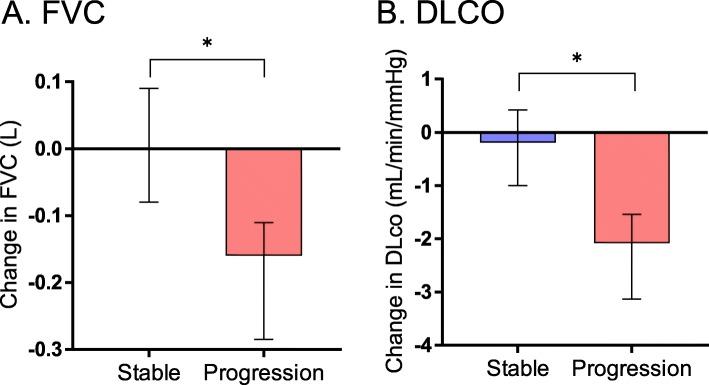
We retrospectively investigated patients with IPF who were initiated on pirfenidone or nintedanib administration between January 2014 and June 2018 at our hospital. Changes in clinical parameters and serum SP-A, SP-D, and KL-6 levels were evaluated. Patients with ≥10% decline in FVC or ≥ 15% decline in diffusing capacity of the lung for carbon monoxide (DLco) from baseline to 6 months were classified as progression group, while the other patients were classified as stable group.
RESULTS
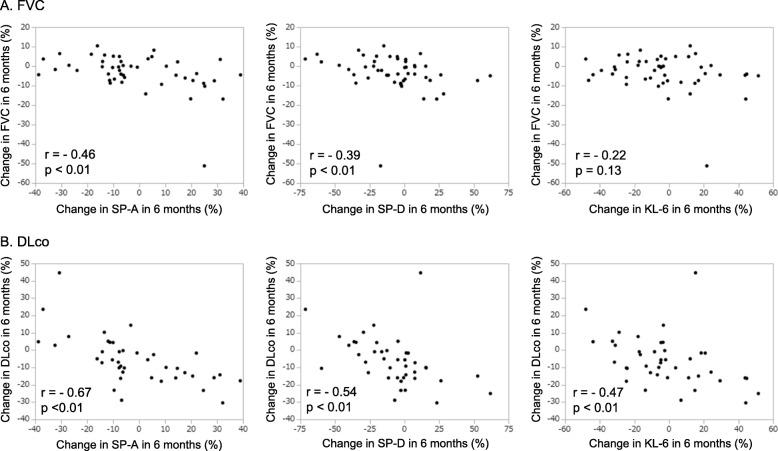
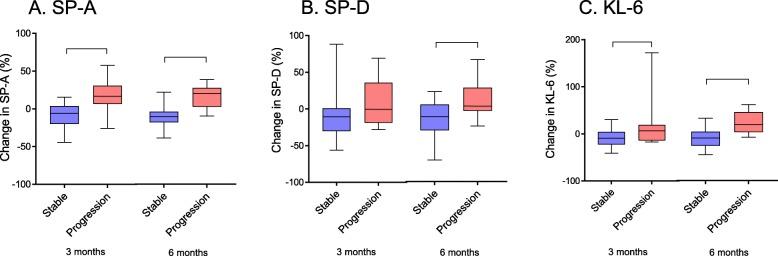
Forty-nine patients were included (pirfenidone, 23; nintedanib, 26). Stable group comprised 32 patients, while progression group comprised 17 patients. In the stable group, changes in SP-A and KL-6 from baseline to 3 and 6 months significantly decreased compared with the progression group (SP-A: 3 months - 6.0% vs 16.7%, 6 months - 10.2% vs 20.2%, KL-6: 3 months - 9.2% vs 6.7%, 6 months - 15.0% vs 12.1%, p < 0.05). Changes in SP-A and SP-D levels showed significant negative correlations with the change in %FVC (r = - 0.46 and r = - 0.39, p < 0.01, respectively) and %DLco (r = - 0.67 and r = - 0.54, p < 0.01, respectively). Similar results were also seen in subgroup analysis for both pirfenidone and nintedanib groups. On logistic regression analysis, decrease in SP-A from baseline to 3 months and 6 months was found to predict the outcomes at 6 months (odds ratios: 0.89 and 0.88, respectively).
CONCLUSIONS
Changes in serum SP-A reflected the outcomes of anti-fibrotic drug therapy. Serum SP-A has a potential as a biomarker of therapeutic outcomes of anti-fibrotic drugs.
背景
特发性肺纤维化(IPF)是一种进行性和纤维化的肺部疾病,预后不良。吡非尼酮和尼达尼布是用于 IPF 患者的抗纤维化药物。这些药物可降低用力肺活量(FVC)下降率。血清表面活性剂蛋白(SP)-A、SP-D 和 Krebs von den Lungen-6(KL-6)是 IPF 患者的监测和预后生物标志物;然而,它们与抗纤维化药物治疗效果的关系尚未得到研究。我们旨在阐明血清 SP-A、SP-D 和 KL-6 是否反映了 IPF 患者接受吡非尼酮和尼达尼布治疗的治疗效果。
方法
我们回顾性调查了 2014 年 1 月至 2018 年 6 月期间在我院接受吡非尼酮或尼达尼布治疗的 IPF 患者。评估了临床参数和血清 SP-A、SP-D 和 KL-6 水平的变化。FVC 下降≥10%或一氧化碳弥散量(DLco)下降≥15%的患者从基线到 6 个月被归类为进展组,其他患者被归类为稳定组。
结果
共纳入 49 例患者(吡非尼酮 23 例;尼达尼布 26 例)。稳定组包括 32 例患者,进展组包括 17 例患者。在稳定组中,与进展组相比,从基线到 3 个月和 6 个月时 SP-A 和 KL-6 的变化显著降低(SP-A:3 个月 -6.0%比 16.7%,6 个月 -10.2%比 20.2%,KL-6:3 个月 -9.2%比 6.7%,6 个月 -15.0%比 12.1%,p<0.05)。SP-A 和 SP-D 水平的变化与 %FVC(r=-0.46 和 r=-0.39,p<0.01)和 %DLco(r=-0.67 和 r=-0.54,p<0.01)的变化呈显著负相关。吡非尼酮和尼达尼布两组的亚组分析也得到了类似的结果。在逻辑回归分析中,从基线到 3 个月和 6 个月时 SP-A 的降低被发现可预测 6 个月时的结果(比值比:0.89 和 0.88)。
结论
血清 SP-A 的变化反映了抗纤维化药物治疗的结果。血清 SP-A 有可能成为抗纤维化药物治疗效果的生物标志物。

 Zotero 插件