
睡眠质量与精液参数及生殖激素之间的关联:一项在中国浙江的横断面研究。
Association Between Sleep Quality and Semen Parameters and Reproductive Hormones: A Cross-Sectional Study in Zhejiang, China.
作者信息
Du Cong-Qi, Yang Yong-Yi, Chen Jing, Feng Lei, Lin Wen-Qin
机构信息
Reproductive Medicine Center, The First Affiliated Hospital, College of Medicine, Zhejiang University, Hangzhou, People's Republic of China.
Department of Gynaecology, The First Affiliated Hospital, College of Medicine, Zhejiang University, Hangzhou, People's Republic of China.
出版信息
Nat Sci Sleep. 2020 Jan 9;12:11-18. doi: 10.2147/NSS.S235136. eCollection 2020.
BACKGROUND
The effects of sleep duration on semen quality have been documented in many epidemiological studies. However, the association between sleep quality and semen parameters and reproductive hormones is still unclear.
PATIENTS ENROLLMENT AND METHODS
We conducted a cross-sectional study among 970 outpatients from the Reproductive Medicine Center in Zhejiang, China between October 2017 and July 2019. All participants delivered a semen sample, underwent a physical examination, and answered a questionnaire to provide the following information: demographics, life habits, and sleep habits. Sleep quality was measured using the Pittsburgh Sleep Quality Index (PSQI). We first divided the patients into two groups according to sleep quality (good sleep: PQSI < 5 and poor sleep: PSQI ≥ 5). Then, we analyzed routine sperm parameters (semen volume, sperm total motility, progressive motility, sperm concentration, total sperm number, and normal sperm morphology) and reproductive hormones (follicle-stimulating hormone, luteinizing hormone, estrogen, testosterone, and prolactin) of each group. Finally, we used multivariate linear regression analysis and Spearman correlation coefficients to examine the relationship between sleep quality (discrete variable or dichotomous variable) and sperm parameters, reproductive hormones.
RESULTS
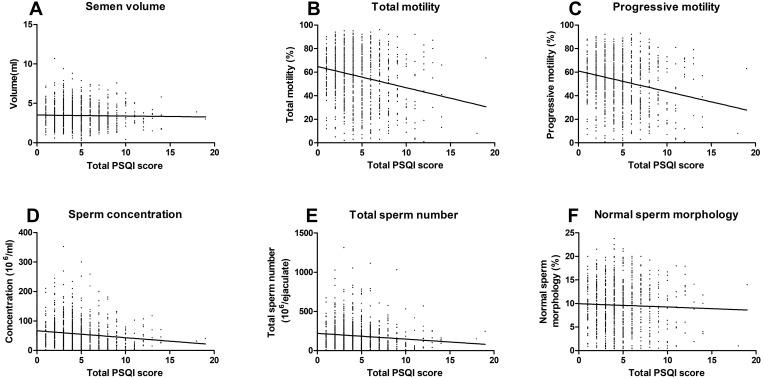
A negative correlation was found between the general PSQI scores and several semen parameters: total motility (r= -0.187979, 0.001), progressive motility (r= -0.192902, 0.001), concentration (r= -0.167063, 0.001), total sperm number (r= -0.160008, 0.001), and normal sperm morphology (r= -0.124511, 0.001). However, there was no significant correlation between the semen volume, all reproductive hormones and the general PSQI scores. After adjusting for confounders, men with poor sleep had lower total motility (β= -9.287; 95% CI, -12.050, -6.523), progressive motility (β= -8.853; 95% CI, -11.526, -6.180), concentration (log scale, β= -0.131; 95% CI, -0.181, -0.082), total sperm number (log scale, β= -0.137; 95% CI, -0.189, -0.084), and normal sperm morphology (β= -1.195; 95% CI, -1.844, -0.547), but semen volume and all reproductive hormones were not markedly altered.
CONCLUSION
Poor sleep quality might be related to impaired semen quality, but we found no evidence that poor sleep quality affects reproductive hormones.
背景
许多流行病学研究已记录了睡眠时间对精液质量的影响。然而,睡眠质量与精液参数及生殖激素之间的关联仍不明确。
患者招募与方法
2017年10月至2019年7月期间,我们在中国浙江生殖医学中心对970名门诊患者进行了一项横断面研究。所有参与者均提供了精液样本,接受了体格检查,并回答了一份问卷,以提供以下信息:人口统计学、生活习惯和睡眠习惯。使用匹兹堡睡眠质量指数(PSQI)测量睡眠质量。我们首先根据睡眠质量将患者分为两组(睡眠良好:PSQI<5;睡眠不佳:PSQI≥5)。然后,我们分析了每组的常规精子参数(精液量、精子总活力、前向运动力、精子浓度、精子总数和正常精子形态)和生殖激素(促卵泡生成素、促黄体生成素、雌激素、睾酮和催乳素)。最后,我们使用多元线性回归分析和Spearman相关系数来检验睡眠质量(离散变量或二分变量)与精子参数、生殖激素之间的关系。
结果
PSQI总评分与几个精液参数之间存在负相关:总活力(r=-0.187979,P=0.001)、前向运动力(r=-0.192902,P=0.001)、浓度(r=-0.167063,P=0.001)、精子总数(r=-0.160008,P=0.001)和正常精子形态(r=-0.124511,P=0.001)。然而,精液量、所有生殖激素与PSQI总评分之间无显著相关性。在调整混杂因素后,睡眠不佳的男性总活力较低(β=-9.287;95%CI,-12.050,-6.523)、前向运动力较低(β=-8.853;95%CI,-11.526,-6.180)、浓度(对数尺度,β=-0.131;95%CI,-0.181,-0.082)、精子总数(对数尺度,β=-0.137;95%CI,-0.189,-0.084)和正常精子形态较低(β=-1.195;95%CI,-1.844,-0.547),但精液量和所有生殖激素无明显变化。
结论
睡眠质量差可能与精液质量受损有关,但我们没有发现证据表明睡眠质量差会影响生殖激素。

 Zotero 插件