
抗菌药物降级作为重症监护中抗菌药物管理的一部分:没有简单的答案可以解决简单的问题——专家观点。
Antimicrobial de-escalation as part of antimicrobial stewardship in intensive care: no simple answers to simple questions-a viewpoint of experts.
机构信息
Department of Critical Care Medicine, Ghent University Hospital, C. Heymanslaan 10, 9000, Ghent, Belgium.
Department of Intensive Care, Radboudumc, Nijmegen, The Netherlands.
出版信息
Intensive Care Med. 2020 Feb;46(2):236-244. doi: 10.1007/s00134-019-05871-z. Epub 2020 Feb 5.
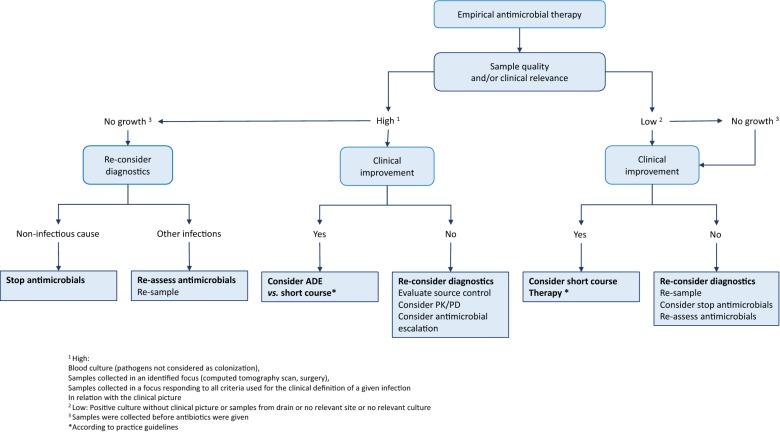
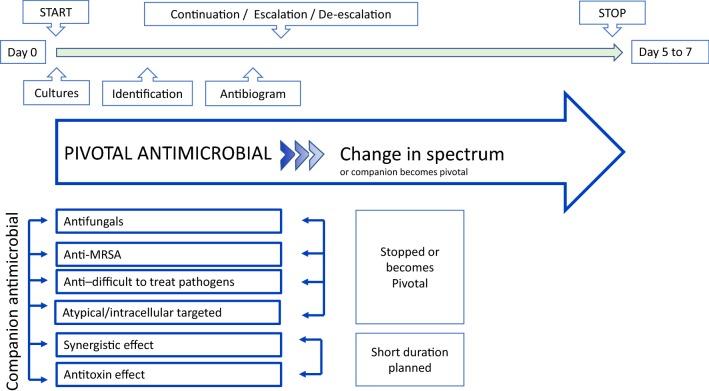
Antimicrobial de-escalation (ADE) is defined as the discontinuation of one or more components of combination empirical therapy, and/or the change from a broad-spectrum to a narrower spectrum antimicrobial. It is most commonly recommended in the intensive care unit (ICU) patient who is treated with broad-spectrum antibiotics as a strategy to reduce antimicrobial pressure of empirical broad-spectrum therapy and prevent antimicrobial resistance, yet this has not been convincingly demonstrated in a clinical setting. Even if it appears beneficial, ADE may have some unwanted side effects: it has been associated with prolongation of antimicrobial therapy and could inappropriately be used as a justification for unrestricted broadness of empirical therapy. Also, exposing a patient to multiple, sequential antimicrobials could have unwanted effects on the microbiome. For these reasons, ADE has important shortcomings to be promoted as a quality indicator for appropriate antimicrobial use in the ICU. Despite this, ADE clearly has a role in the management of infections in the ICU. The most appropriate use of ADE is in patients with microbiologically confirmed infections requiring longer antimicrobial therapy. ADE should be used as an integral part of an ICU antimicrobial stewardship approach in which it is guided by optimal specimen quality and relevance. Rapid diagnostics may further assist in avoiding unnecessary initiation of broad-spectrum therapy, which in turn will decrease the need for subsequent ADE.
抗菌药物降阶梯治疗(ADE)定义为停止联合经验性治疗的一种或多种药物,和/或从广谱抗菌药物转换为窄谱抗菌药物。它最常用于重症监护病房(ICU)患者接受广谱抗生素治疗的策略,以减少经验性广谱治疗的抗菌压力并预防抗菌药物耐药性,但在临床环境中尚未得到令人信服的证明。即使 ADE 似乎有益,它也可能有一些不良副作用:它与抗菌药物治疗时间延长有关,并且可能不恰当地被用作放宽经验性治疗广谱性的理由。此外,使患者暴露于多种连续的抗菌药物可能会对微生物组产生不良影响。出于这些原因,将 ADE 作为 ICU 中适当使用抗菌药物的质量指标来推广存在重要缺陷。尽管如此,ADE 在 ICU 感染管理中显然具有重要作用。ADE 最适用于需要更长抗菌药物治疗的微生物学确诊感染患者。ADE 应作为 ICU 抗菌药物管理方法的一个组成部分,根据最佳标本质量和相关性进行指导。快速诊断可能进一步有助于避免不必要的广谱治疗,从而减少后续 ADE 的需要。
 Zotero 插件