
局部浸润镇痛联合股神经和坐骨神经阻滞在全膝关节置换术后疼痛管理中的比较。
Comparison between local infiltration analgesia with combined femoral and sciatic nerve block for pain management after total knee arthroplasty.
机构信息
Department of Anesthesiology, Peking Union Medical College Hospital, CAMS&PUMC, No.1, Wangfujing, DongCheng District, Beijing, 100730, China.
Central Research Laboratory, Peking Union Medical College Hospital, Chinese Academy of Medical Sciences and Peking Union Medical College, No.1, Wangfujing, DongCheng District, Beijing, 100730, China.
出版信息
J Orthop Surg Res. 2020 Feb 7;15(1):41. doi: 10.1186/s13018-020-1577-z.
BACKGROUND
Total knee arthroplasty (TKA) is usually associated with moderate to severe postoperative pain. Peripheral nerve block (PNB) and local infiltration analgesia (LIA) are two major methods for postoperative analgesia. Femoral nerve block (FNB) leads to residual posterior knee pain; thus, currently sciatic nerve block (SNB) and LIA are two major options for supplementing FNB. However, the efficacy and safety of LIA compared with combined femoral and sciatic nerve block still remain controversial. Here, we conducted a study to analyze the postoperative analgesic efficacy of these two methods.
METHOD
Two hundred six patients undergoing TKA were enrolled in a retrospective cohort study. The patients received either PNB or LIA. All patients in PNB group were conducted combined femoral and sciatic nerve block. All patients were encouraged to use patient-controlled analgesia (PCA) after surgery. The postoperative visual analog scale (VAS) at rest or with movement during the first 24 h and 48 h was recorded. We analyzed the VAS of 24 h, VAS of 48 h, opioid consumption, and adverse effects between PNB group and LIA group. Chi-square test and nonparametric test were used in this study.
RESULTS
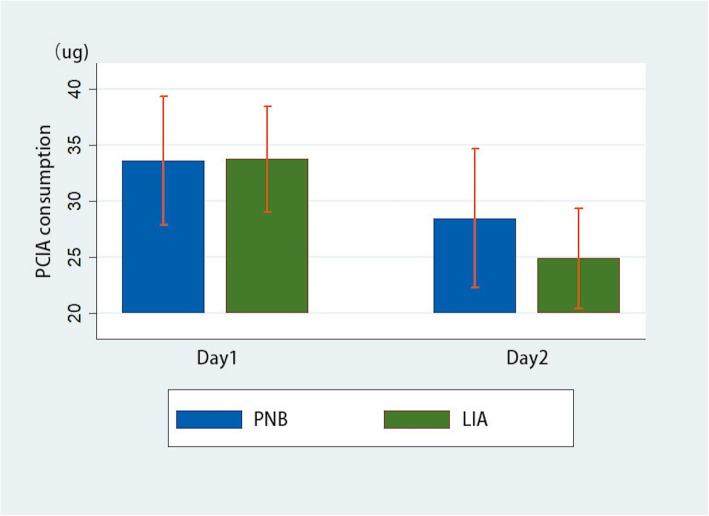
There were 82 patients in the PNB group and 124 patients in the LIA group. The patients' characteristics such as age, height, weight, and ASA showed no significant difference (P > 0.05). No significant differences were found (P > 0.05) between the two groups regarding VAS score at rest or with movement. The LIA group had less opioid consumption than the PNB group but without significant difference (P > 0.05). In both groups, the most common side effect was nausea, and the side effects showed no significant differences between groups (P > 0.05).
CONCLUSION
Local infiltration analgesia provided a similar analgesic effect and complications compared with combined femoral and sciatic nerve block in the short term. Considering less opioid consumption with local infiltration analgesia though without significant difference and its convenience, local infiltration analgesia provided better postoperative analgesia.
背景
全膝关节置换术(TKA)通常伴有中重度术后疼痛。外周神经阻滞(PNB)和局部浸润镇痛(LIA)是术后镇痛的两种主要方法。股神经阻滞(FNB)会导致膝关节后部残留疼痛;因此,目前坐骨神经阻滞(SNB)和 LIA 是补充 FNB 的两种主要选择。然而,LIA 与股神经和坐骨神经联合阻滞相比的疗效和安全性仍存在争议。在这里,我们进行了一项研究来分析这两种方法的术后镇痛效果。
方法
我们对 206 例接受 TKA 的患者进行了回顾性队列研究。这些患者接受了 PNB 或 LIA。PNB 组的所有患者均进行了股神经和坐骨神经联合阻滞。所有患者术后均鼓励使用患者自控镇痛(PCA)。记录术后 24 小时和 48 小时内静息和活动时的视觉模拟评分(VAS)。我们分析了 PNB 组和 LIA 组之间 24 小时 VAS、48 小时 VAS、阿片类药物消耗和不良反应。本研究采用卡方检验和非参数检验。
结果
PNB 组 82 例,LIA 组 124 例。两组患者年龄、身高、体重、ASA 等特征差异无统计学意义(P>0.05)。两组静息和活动时 VAS 评分差异无统计学意义(P>0.05)。LIA 组阿片类药物消耗少于 PNB 组,但差异无统计学意义(P>0.05)。两组最常见的不良反应是恶心,组间差异无统计学意义(P>0.05)。
结论
短期来看,局部浸润镇痛与股神经和坐骨神经联合阻滞具有相似的镇痛效果和并发症。考虑到局部浸润镇痛的阿片类药物消耗较少,但差异无统计学意义,且其操作方便,局部浸润镇痛可提供更好的术后镇痛效果。
 Zotero 插件