
噬菌体裂解蛋白LysRODI可预防小鼠的葡萄球菌性乳腺炎。
Phage Lytic Protein LysRODI Prevents Staphylococcal Mastitis in Mice.
作者信息
Gutiérrez Diana, Garrido Victoria, Fernández Lucía, Portilla Silvia, Rodríguez Ana, Grilló María Jesús, García Pilar
机构信息
DairySafe Group, Departamento de Tecnología y Biotecnología de Productos Lácteos, Instituto de Productos Lácteos de Asturias (IPLA-CSIC), Villaviciosa, Spain.
Departamento de Sanidad Animal, Instituto de Agrobiotecnología, CSIC-Gobierno de Navarra, Mutilva, Spain.
出版信息
Front Microbiol. 2020 Jan 23;11:7. doi: 10.3389/fmicb.2020.00007. eCollection 2020.
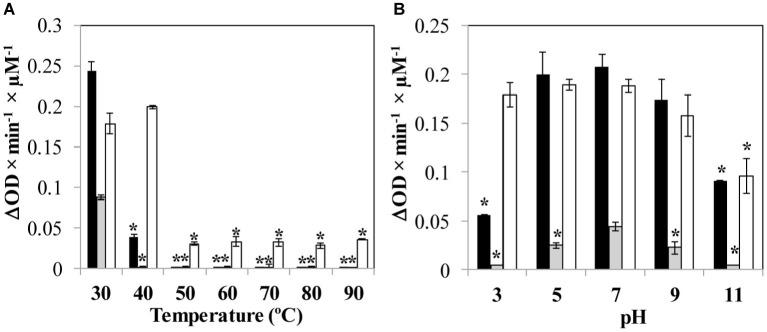
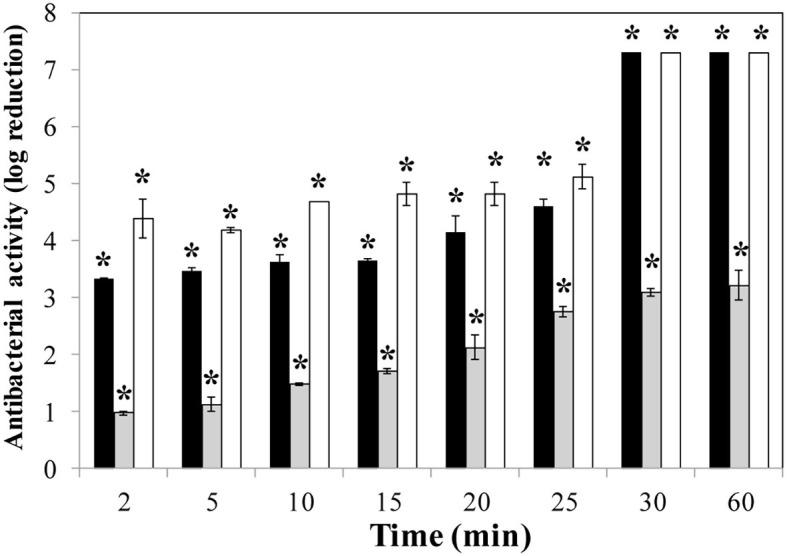
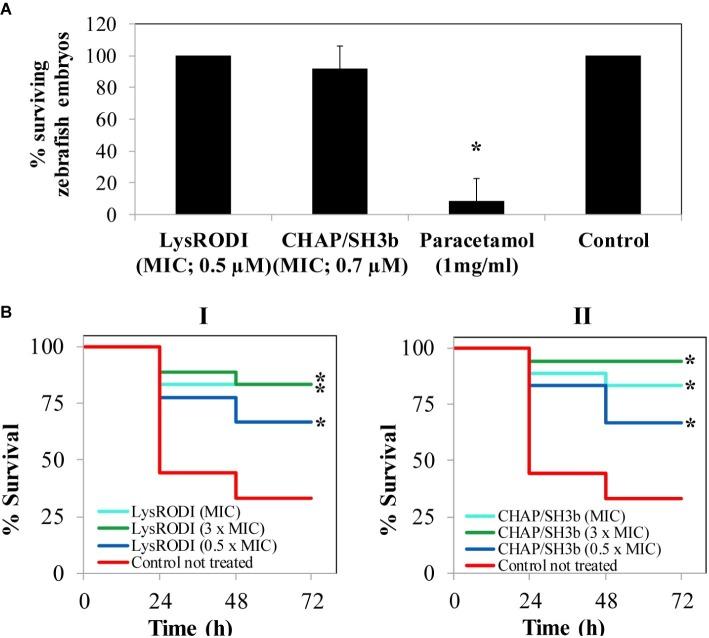
Phage lytic proteins are promising antimicrobials that could complement conventional antibiotics and help to combat multi-drug resistant bacteria that cause important human and animal infections. Here, we report the characterization of endolysin LysRODI (encoded by staphylophage phiIPLA-RODI) and its application as a prophylactic mastitis treatment. The main properties of LysRODI were compared with those of endolysin LysA72 (encoded by staphylophage phiIPLA35) and the chimeric protein CHAPSH3b (derived from the virion-associated peptidoglycan hydrolase HydH5 and lysostaphin). Time-kill experiments performed with and demonstrated that the killing rate of LysRODI and CHAPSH3b is higher than that of LysA72 (0.1 μM protein removed 10 CFU/ml of in 30 min). Of note, all proteins failed to select resistant mutants as bacterial exposure to sub-lethal concentrations of the proteins did not alter the MIC values. Additionally, LysRODI and CHAPSH3b were non-toxic in a zebrafish embryo model at concentrations near the MIC (0.5 and 0.7 μM, respectively). Moreover, these two proteins significantly reduced mortality in a zebrafish model of systemic infection. In contrast to LysRODI, the efficacy of CHAPSH3b was dose-dependent in zebrafish, requiring higher-dose treatments to achieve the maximum survival rate. For this reason, LysRODI was selected for further analysis in mice, demonstrating great efficacy to prevent mammary infections by and . Our findings strongly support the use of phage lytic proteins as a new strategy to prevent staphylococcal mastitis.
噬菌体裂解蛋白是很有前景的抗菌剂,可补充传统抗生素,并有助于对抗导致重要人类和动物感染的多重耐药细菌。在此,我们报告了内溶素LysRODI(由葡萄球菌噬菌体phiIPLA-RODI编码)的特性及其作为乳腺炎预防性治疗的应用。将LysRODI的主要特性与内溶素LysA72(由葡萄球菌噬菌体phiIPLA35编码)和嵌合蛋白CHAPSH3b(源自病毒体相关肽聚糖水解酶HydH5和溶葡萄球菌素)的特性进行了比较。用[具体细菌]进行的时间杀灭实验表明,LysRODI和CHAPSH3b的杀灭率高于LysA72(0.1 μM蛋白质在30分钟内可去除10 CFU/ml的[具体细菌])。值得注意的是,所有蛋白质均未筛选出抗性突变体,因为细菌暴露于亚致死浓度的蛋白质不会改变MIC值。此外,在斑马鱼胚胎模型中,LysRODI和CHAPSH3b在接近MIC的浓度下(分别为0.5和0.7 μM)无毒。此外,这两种蛋白质在斑马鱼全身感染模型中显著降低了死亡率。与LysRODI不同,CHAPSH3b在斑马鱼中的疗效呈剂量依赖性,需要更高剂量的治疗才能达到最大存活率。因此,选择LysRODI在小鼠中进行进一步分析,结果表明它在预防[具体细菌]引起的乳腺感染方面具有很高的疗效。我们的研究结果有力地支持了使用噬菌体裂解蛋白作为预防葡萄球菌性乳腺炎的新策略。

 Zotero 插件