
在常规应答率的情况下,与具有代表性的、基于一般人群的研究相比,英国生物银行中风险因素相关性的比较:前瞻性队列研究和个体参与者荟萃分析。
Comparison of risk factor associations in UK Biobank against representative, general population based studies with conventional response rates: prospective cohort study and individual participant meta-analysis.
机构信息
Department of Epidemiology and Public Health, University College London, London WC1E 6BT, UK
School of Biological and Population Health Sciences, Oregon State University, Corvallis, OR, USA.
出版信息
BMJ. 2020 Feb 12;368:m131. doi: 10.1136/bmj.m131.
OBJECTIVE
To compare established associations between risk factors and mortality in UK Biobank, a study with an exceptionally low rate of response to its baseline survey, against those from representative studies that have conventional response rates.
DESIGN
Prospective cohort study alongside individual participant meta-analysis of other cohort studies.
SETTING
United Kingdom.
PARTICIPANTS
Analytical sample of 499 701 people (response rate 5.5%) in analyses in UK Biobank; pooled data from the Health Surveys for England (HSE) and the Scottish Health Surveys (SHS), including 18 studies and 89 895 people (mean response rate 68%). Both study populations were linked to the same nationwide mortality registries, and the baseline age range was aligned at 40-69 years.
MAIN OUTCOME MEASURE
Death from cardiovascular disease, selected malignancies, and suicide. To quantify the difference between hazard ratios in the two studies, a ratio of the hazard ratios was used with HSE-SHS as the referent.
RESULTS
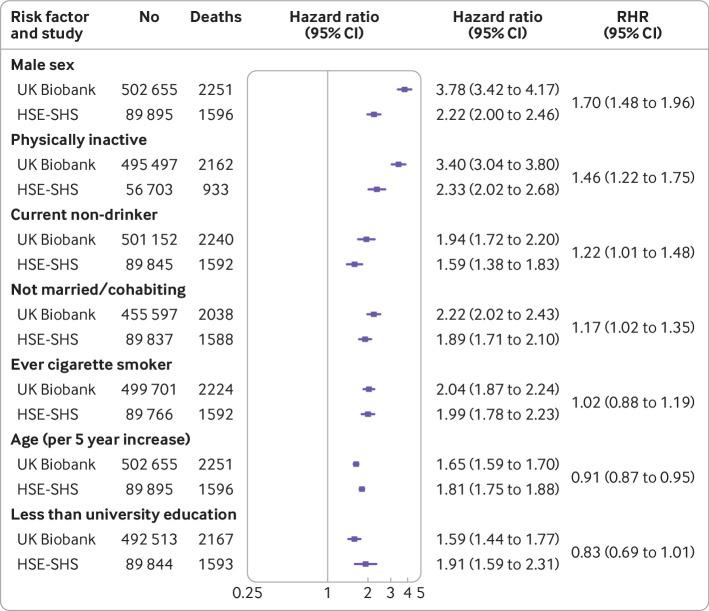
Risk factor levels and mortality rates were typically more favourable in UK Biobank participants relative to the HSE-SHS consortium. For the associations between risk factors and mortality endpoints, however, close agreement was seen between studies. Based on 14 288 deaths during an average of 7.0 years of follow-up in UK Biobank and 7861 deaths over 10 years of mortality surveillance in HSE-SHS, for cardiovascular disease mortality, for instance, the age and sex adjusted hazard ratio for ever having smoked cigarettes (versus never) was 2.04 (95% confidence interval 1.87 to 2.24) in UK Biobank and 1.99 (1.78 to 2.23) in HSE-SHS, yielding a ratio of hazard ratios close to unity (1.02, 0.88 to 1.19). The overall pattern of agreement between studies was essentially unchanged when results were compared separately by sex and when baseline years and censoring dates were aligned.
CONCLUSION
Despite a very low response rate, risk factor associations in the UK Biobank seem to be generalisable.
目的
比较英国生物样本库(UK Biobank)中与死亡率相关的风险因素与其他具有常规应答率的代表性研究之间的关联,该研究应答率极低。
设计
对 UK Biobank 进行前瞻性队列研究,同时对其他队列研究进行个体参与者荟萃分析。
设置
英国。
参与者
在 UK Biobank 分析中,对 499701 人(应答率为 5.5%)进行分析的分析样本;来自英格兰健康调查(HSE)和苏格兰健康调查(SHS)的汇总数据,包括 18 项研究和 89895 人(平均应答率为 68%)。两个研究人群都与同一个全国性死亡率登记处相关联,且基线年龄范围设定在 40-69 岁。
主要观察指标
心血管疾病、某些恶性肿瘤和自杀导致的死亡。为了量化两项研究中风险比的差异,采用风险比比值,以 HSE-SHS 作为参照。
结果
与 HSE-SHS 联盟相比,UK Biobank 参与者的风险因素水平和死亡率通常更为有利。然而,对于风险因素与死亡率终点之间的关联,研究之间存在密切的一致性。在 UK Biobank 中,平均 7.0 年的随访期间发生了 14288 例死亡,在 HSE-SHS 中,10 年的死亡率监测期间发生了 7861 例死亡,例如,心血管疾病死亡率方面,与从不吸烟相比,吸烟(曾吸烟)的年龄和性别校正后的风险比为 2.04(95%置信区间 1.87 至 2.24),在 HSE-SHS 中为 1.99(1.78 至 2.23),得出的风险比比值接近 1(1.02,0.88 至 1.19)。当按性别分别比较结果时,当调整基线年份和删失日期时,研究之间的总体一致性模式基本保持不变。
结论
尽管应答率非常低,但 UK Biobank 中的风险因素关联似乎具有普遍性。


 Zotero 插件