
发展中国家儿童细菌性肺炎及其相关因素的前瞻性队列研究。
Bacterial pneumonia and its associated factors in children from a developing country: A prospective cohort study.
机构信息
Department of Paediatrics, University Malaya Paediatric, Kuala Lumpur, Malaysia.
Child Health Research Group, University Malaya, Kuala Lumpur, Malaysia.
出版信息
PLoS One. 2020 Feb 14;15(2):e0228056. doi: 10.1371/journal.pone.0228056. eCollection 2020.
INTRODUCTION
Pneumonia in children is a common disease yet determining its aetiology remains elusive.
OBJECTIVES
To determine the a) aetiology, b) factors associated with bacterial pneumonia and c) association between co-infections (bacteria + virus) and severity of disease, in children admitted with severe pneumonia.
METHODS
A prospective cohort study involving children aged 1-month to 5-years admitted with very severe pneumonia, as per the WHO definition, over 2 years. Induced sputum and blood obtained within 24 hrs of admission were examined via PCR, immunofluorescence and culture to detect 17 bacteria/viruses. A designated radiologist read the chest radiographs.
RESULTS
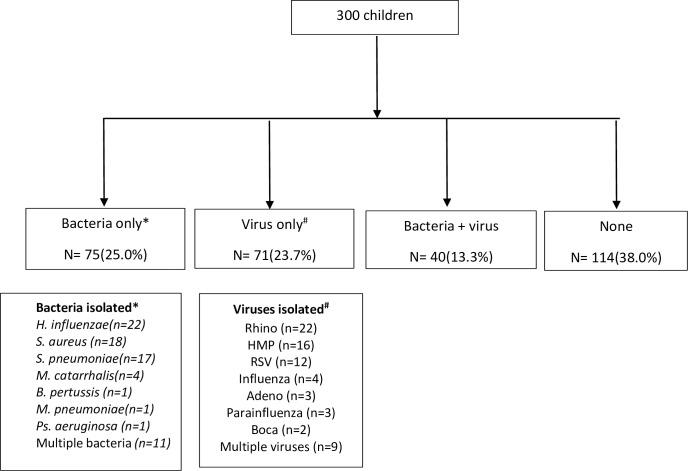
Three hundred patients with a mean (SD) age of 14 (±15) months old were recruited. Significant pathogens were detected in 62% of patients (n = 186). Viruses alone were detected in 23.7% (n = 71) with rhinovirus (31%), human metapneumovirus (HMP) [22.5%] and respiratory syncytial virus (RSV) [16.9%] being the commonest. Bacteria alone was detected in 25% (n = 75) with Haemophilus influenzae (29.3%), Staphylococcus aureus (24%) and Streptococcus pneumoniae (22.7%) being the commonest. Co-infections were seen in 13.3% (n = 40) of patients. Male gender (AdjOR 1.84 [95% CI 1.10, 3.05]) and presence of crepitations (AdjOR 2.27 [95% CI 1.12, 4.60]) were associated with bacterial infection. C-reactive protein (CRP) [p = 0.007]) was significantly higher in patients with co-infections but duration of hospitalization (p = 0.77) and requirement for supplemental respiratory support (p = 0.26) were not associated with co-infection.
CONCLUSIONS
Bacteria remain an important cause of very severe pneumonia in developing countries with one in four children admitted isolating bacteria alone. Male gender and presence of crepitations were significantly associated with bacterial aetiology. Co-infection was associated with a higher CRP but no other parameters of severe clinical illness.
引言
儿童肺炎是一种常见疾病,但确定其病因仍然难以捉摸。
目的
确定 a)病因,b)与细菌性肺炎相关的因素,以及 c)合并感染(细菌+病毒)与疾病严重程度之间的关系,在因严重肺炎住院的儿童中。
方法
这是一项前瞻性队列研究,涉及 2 年内根据世界卫生组织(WHO)定义因非常严重肺炎住院的 1 个月至 5 岁儿童。在入院后 24 小时内获得的诱导痰和血液通过 PCR、免疫荧光和培养进行检测,以检测 17 种细菌/病毒。指定的放射科医生阅读胸部 X 光片。
结果
共招募了 300 名平均(SD)年龄为 14(±15)个月的患者。在 62%的患者(n=186)中检测到了重要病原体。单独检测到病毒的患者占 23.7%(n=71),其中鼻病毒(31%)、人类偏肺病毒(HMPV)[22.5%]和呼吸道合胞病毒(RSV)[16.9%]最为常见。单独检测到细菌的患者占 25%(n=75),其中流感嗜血杆菌(29.3%)、金黄色葡萄球菌(24%)和肺炎链球菌(22.7%)最为常见。合并感染的患者占 13.3%(n=40)。男性(调整优势比 1.84[95%置信区间 1.10-3.05])和存在爆裂声(调整优势比 2.27[95%置信区间 1.12-4.60])与细菌感染相关。合并感染患者的 C 反应蛋白(CRP)[p=0.007]显著升高,但住院时间(p=0.77)和补充呼吸支持的需求(p=0.26)与合并感染无关。
结论
在发展中国家,细菌仍然是非常严重肺炎的重要病因,每 4 名住院的儿童中就有 1 名单独分离出细菌。男性和存在爆裂声与细菌病因显著相关。合并感染与 CRP 升高有关,但与其他严重临床疾病的参数无关。

 Zotero 插件