
为什么家庭痴呆症照顾者拒绝照顾者支持服务?在一项集群随机对照干预试验中分析拒绝的类型和相关的健康损害。
Why do family dementia caregivers reject caregiver support services? Analyzing types of rejection and associated health-impairments in a cluster-randomized controlled intervention trial.
机构信息
European University of Applied Science (EUFH), Werftstrasse 5, 18057, Rostock, Germany.
University of Applied Science Hamburg, Hamburg, Germany.
出版信息
BMC Health Serv Res. 2020 Feb 14;20(1):121. doi: 10.1186/s12913-020-4970-8.
BACKGROUND
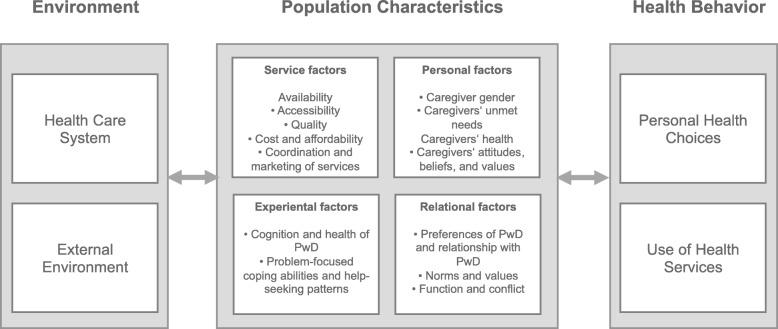
Although there are a number of support services accessible for most family dementia caregivers, many caregivers reject available and affordable support. Previous research suggests that rejections of support services may result from insufficient fit of available services with caregivers' unmet needs and a lack of acknowledgement of caregivers' unmet needs and associated support services. The present study investigates (a) the number, proportion and types of caregivers' rejection on recommended tailored support, (b) socio-demographic and clinical determinants of caregiver's rejection of both people with dementia (PwD) and caregivers, and (c) caregivers' health-related variables related to caregivers' rejection.
METHODS
Caregivers' rejection of tailored support services was identified based on a standardized, computerized unmet needs assessment conducted by dementia-specific qualified nurses. The present analysis is based on data of n = 226 dyads of caregivers and their community-dwelling PwD who participated in a general practitioner (GP)-based, cluster-randomized intervention trial. The trial was approved by the Ethical Committee of the Chamber of Physicians of Mecklenburg-Western Pomerania, registry number BB 20/11. Data analyses were conducted using Stata/IC 13.1. We conducted Welch's t-test, Pearson's product-moment correlation, and conditional negative binomial regression models with random effects for GP to account for over-dispersed count data.
RESULTS
In sum, n = 505 unmet needs were identified and the same number of tailored recommendations were identified for n = 171 family dementia caregivers from the intervention group at baseline. For n = 55 family dementia caregivers not a single unmet need and recommendation were identified. A total of 17.6% (n = 89) of the recommendations were rejected by caregivers. Rejection rates of caregivers differed by type of recommendation. Whereas caregivers' rejection rate on recommendations concerning mental health (3.6%), physical health (2.5%), and social, legal, and financial affairs (0%) were low, caregivers' rejection rates concerning social integration (especially caregiver supporting groups) was high (71.7%). Thus, the rejections of family dementia caregivers are mainly linked to the delegation to caregiver supporting groups. Caregivers' rejections were mainly related to personal factors of caregivers (n = 66), service-related factors (n = 6), relational factors (n = 1), and other factors (n = 17). Furthermore, our results showed that the number of caregivers' rejections was associated with a higher functional status of the PwD and are mainly associated with the rejection of caregiver supporting groups. Thus, caregivers visit supporting groups more often when the PwD shows low abilities in activities of daily living. Importantly, this is independent of the status of cognition and depression of the PwD as well as the physical and mental health of the family dementia caregivers.
CONCLUSIONS
Our results underline the importance of understanding factors that determine caregivers' rejection of support services. These need to be specifically addressed in tailored solutions for caregivers' support services.
TRIAL REGISTRATION
ClinicalTrials.gov Identifier: NCT01401582 (date: July 25, 2011, prospective registered).
背景
尽管大多数家庭痴呆症护理人员都可以获得许多支持服务,但许多护理人员拒绝了可用的和负担得起的支持。先前的研究表明,对支持服务的拒绝可能是由于可用服务与护理人员未满足的需求之间的适配不足,以及对护理人员未满足的需求和相关支持服务的认可不足所致。本研究调查了(a)推荐定制支持的护理人员拒绝的数量、比例和类型,(b)痴呆症患者和护理人员拒绝的社会人口统计学和临床决定因素,以及(c)与护理人员拒绝相关的护理人员健康相关变量。
方法
通过痴呆症特定合格护士进行的标准化、计算机化未满足需求评估,确定了护理人员对定制支持服务的拒绝。本分析基于 n = 226 对接受常规医生 (GP) 为基础、群组随机干预试验的社区居住的痴呆症患者及其家庭护理人员的数据。该试验已获得梅克伦堡-西波美拉尼亚医师协会伦理委员会的批准,注册号为 BB 20/11。使用 Stata/IC 13.1 进行数据分析。我们进行了 Welch's t 检验、Pearson 积矩相关和具有 GP 随机效应的条件负二项式回归模型,以解释过度分散的计数数据。
结果
总之,在基线时,干预组中 n = 171 名家庭痴呆症护理人员确定了 n = 505 项未满足的需求,并且确定了相同数量的定制建议。对于 n = 55 名没有一项未满足需求和建议的家庭痴呆症护理人员。共有 17.6%(n = 89)的建议被护理人员拒绝。护理人员拒绝的比率因建议类型而异。尽管护理人员对心理健康(3.6%)、身体健康(2.5%)和社会、法律和财务事务(0%)的建议拒绝率较低,但他们对社会融合(特别是护理人员支持小组)的拒绝率很高(71.7%)。因此,家庭痴呆症护理人员的拒绝主要与将责任委托给护理人员支持小组有关。护理人员的拒绝主要与护理人员的个人因素(n = 66)、服务相关因素(n = 6)、关系因素(n = 1)和其他因素(n = 17)有关。此外,我们的结果表明,护理人员拒绝的数量与痴呆症患者的功能状态较高有关,并且主要与护理人员支持小组的拒绝有关。因此,当痴呆症患者的日常生活活动能力较低时,护理人员更频繁地访问支持小组。重要的是,这与痴呆症患者的认知和抑郁状况以及家庭痴呆症护理人员的身心健康无关。
结论
我们的结果强调了了解决定护理人员拒绝支持服务的因素的重要性。这些需要在定制的护理人员支持服务解决方案中得到具体解决。
试验注册
ClinicalTrials.gov 标识符:NCT01401582(日期:2011 年 7 月 25 日,前瞻性注册)。
 Zotero 插件