
用稀土元素掩蔽磷酸盐可使二膦酰基胺-锌化学传感器对砷酸盐进行选择性检测。
Masking Phosphate with Rare-Earth Elements Enables Selective Detection of Arsenate by Dipycolylamine-Zn Chemosensor.
机构信息
Department of Biotechnology, Faculty of Science, Mahidol University, Rama 6 Road, Bangkok, 10400, Thailand.
Department of Chemistry, Faculty of Science, Chulalongkorn University, Phayathai Road, Pathumwan, Bangkok, 10330, Thailand.
出版信息
Sci Rep. 2020 Feb 14;10(1):2656. doi: 10.1038/s41598-020-59585-0.
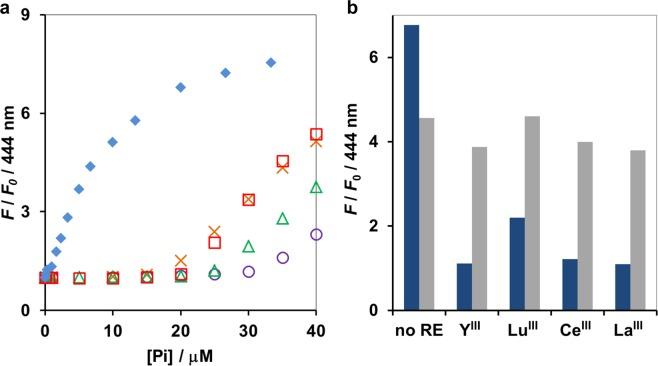
Functional reassessment of the phosphate-specific chemosensors revealed their potential as arsenate detectors. A series of dipicolylamine (Dpa)-Zn chemosensors were screened, among which acridine Dpa-Zn chemosensor showed the highest capability in sensing arsenate. The presence of excess Zn improved sensitivity and strengthened the binding between acridine Dpa-Zn complex to arsenate as well as phosphate. However, due to their response to phosphate, these sensors are not suited for arsenate detection when phosphate is also present. This study demonstrated for the first time that rare-earth elements could effectively mask phosphate, allowing the specific fluorescence detection of arsenate in phosphate-arsenate coexisting systems. In addition, detection of arsenate contamination in the real river water samples and soil samples was performed to prove its practical use. This sensor was further employed for the visualization of arsenate and phosphate uptake in vegetables and flowering plants for the first time, as well as in the evaluation of a potent inhibitor of arsenate/phosphate uptake.
功能再评估表明,磷酸盐特异性化学传感器有望成为砷酸盐的检测工具。我们筛选了一系列二吡啶胺(Dpa)-Zn 化学传感器,其中吖啶 Dpa-Zn 化学传感器在检测砷酸盐方面表现出最高的能力。过量 Zn 的存在提高了灵敏度,并加强了吖啶 Dpa-Zn 配合物与砷酸盐以及磷酸盐的结合。然而,由于它们对磷酸盐的响应,当磷酸盐也存在时,这些传感器不适合用于检测砷酸盐。本研究首次证明,稀土元素可以有效地掩蔽磷酸盐,从而可以在磷酸盐-砷酸盐共存体系中特异性地荧光检测砷酸盐。此外,我们还对实际河水和土壤样本中的砷酸盐污染进行了检测,以证明其实际用途。该传感器还首次用于可视化蔬菜和开花植物中砷酸盐和磷酸盐的摄取,并用于评估一种有效的砷酸盐/磷酸盐摄取抑制剂。



 Zotero 插件