
睡眠时长与质量的四年趋势:一项使用来自市售睡眠追踪器数据的纵向研究
Four-Year Trends in Sleep Duration and Quality: A Longitudinal Study Using Data from a Commercially Available Sleep Tracker.
作者信息
Robbins Rebecca, Affouf Mahmoud, Seixas Azizi, Beaugris Louis, Avirappattu George, Jean-Louis Girardin
机构信息
Division of Sleep and Circadian Disorders, Harvard Medical School, Boston, MA, United States.
Brigham and Women's Hospital, Boston, MA, United States.
出版信息
J Med Internet Res. 2020 Feb 20;22(2):e14735. doi: 10.2196/14735.
BACKGROUND
Population estimates of sleep duration and quality are inconsistent because they rely primarily on self-reported data. Passive and ubiquitous digital tracking and wearable devices may provide more accurate estimates of sleep duration and quality.
OBJECTIVE
This study aimed to identify trends in sleep duration and quality in New York City based on 2 million nights of data from users of a popular mobile sleep app.
METHODS
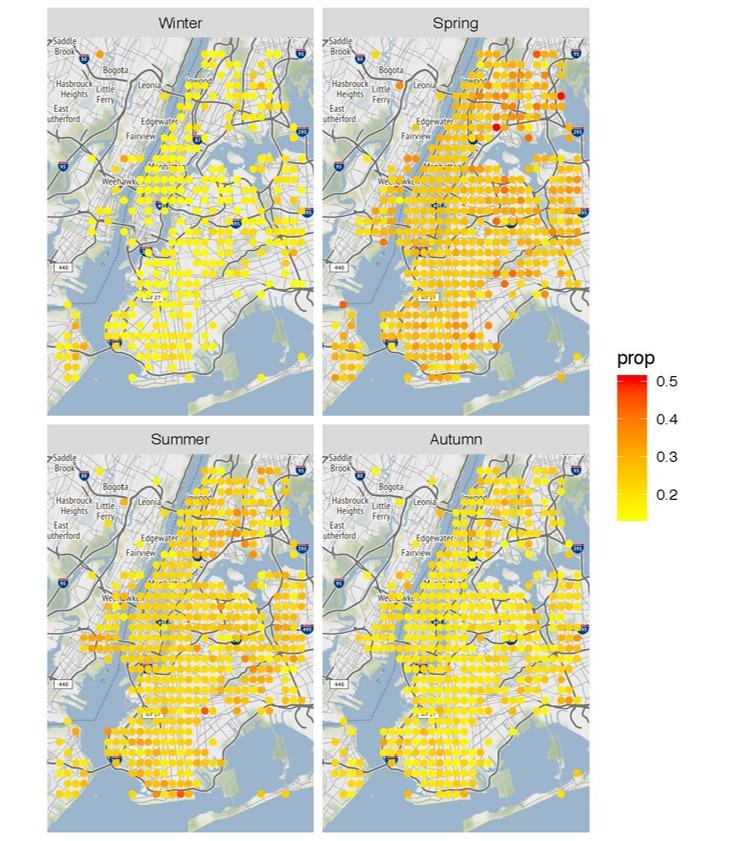
We examined sleep duration and quality using 2,161,067 nights of data captured from 2015 to 2018 by Sleep Cycle, a popular sleep-tracking app. In this analysis, we explored differences in sleep parameters based on demographic factors, including age and sex. We used graphical matrix representations of data (heat maps) and geospatial analyses to compare sleep duration (in hours) and sleep quality (based on time in bed, deep sleep time, sleep consistency, and number of times fully awake), considering potential effects of day of the week and seasonality.
RESULTS
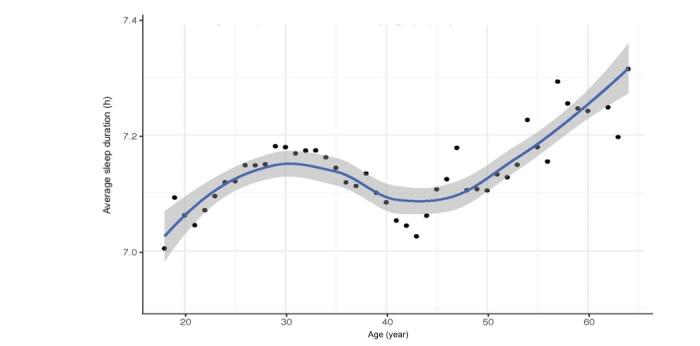
Women represented 46.43% (1,003,421/2,161,067) of the sample, and men represented 53.57% (1,157,646/2,161,067) of individuals in the sample. The average age of the sample was 31.0 years (SD 10.6). The mean sleep duration of the total sample was 7.11 hours (SD 1.4). Women slept longer on average (mean 7.27 hours, SD 1.4) than men (mean 7 hours, SD 1.3; P<.001). Trend analysis indicated longer sleep duration and higher sleep quality among older individuals than among younger (P<.001). On average, sleep duration was longer on the weekend nights (mean 7.19 hours, SD 1.5) than on weeknights (mean 7.09 hours, SD 1.3; P<.001).
CONCLUSIONS
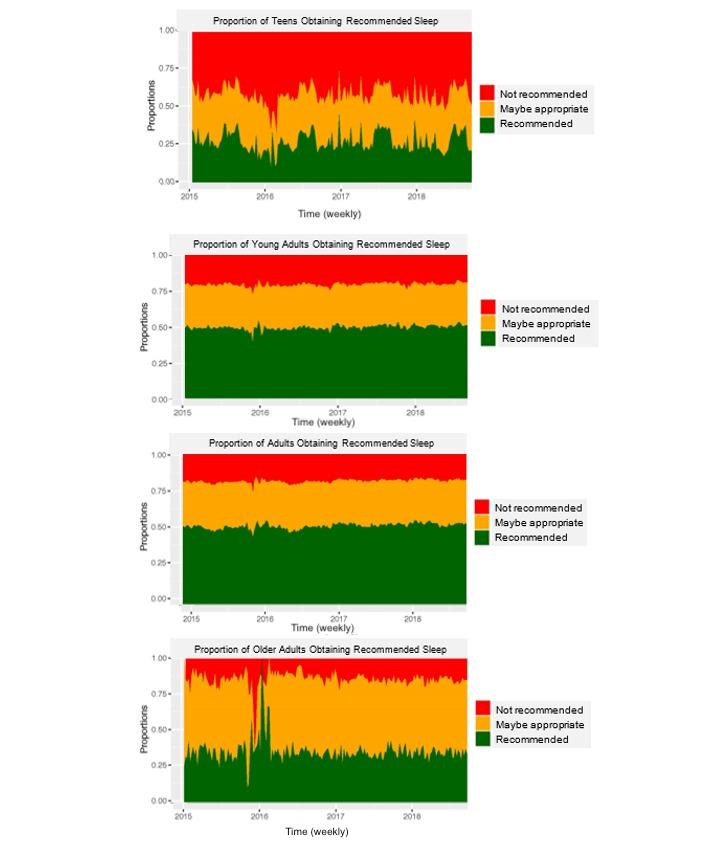
Our study of data from a commercially available sleep tracker showed that women experienced longer sleep duration and higher sleep quality in nearly every age group than men, and a low proportion of young adults obtained the recommended sleep duration. Future research may compare sleep measures obtained via wearable sleep trackers with validated research-grade measures of sleep.
背景
由于主要依赖自我报告数据,睡眠时长和质量的人群估计结果并不一致。被动且普遍存在的数字追踪和可穿戴设备可能会提供更准确的睡眠时长和质量估计。
目的
本研究旨在基于一款热门移动睡眠应用程序用户的200万晚数据,确定纽约市睡眠时长和质量的趋势。
方法
我们使用了一款热门睡眠追踪应用程序Sleep Cycle在2015年至2018年期间收集的2,161,067晚数据来研究睡眠时长和质量。在本分析中,我们探讨了基于年龄和性别等人口统计学因素的睡眠参数差异。我们使用数据的图形矩阵表示(热图)和地理空间分析来比较睡眠时长(以小时为单位)和睡眠质量(基于卧床时间、深度睡眠时间、睡眠一致性以及完全清醒次数),同时考虑一周中的日期和季节性的潜在影响。
结果
女性占样本的46.43%(1,003,421/2,161,067),男性占样本个体的53.57%(1,157,646/2,161,067)。样本的平均年龄为31.0岁(标准差10.6)。总样本的平均睡眠时长为7.11小时(标准差1.4)。女性平均睡眠时间更长(平均7.27小时,标准差1.4),高于男性(平均7小时,标准差1.3;P<0.001)。趋势分析表明,年长者的睡眠时长比年轻人更长,睡眠质量也更高(P<0.001)。平均而言,周末晚上的睡眠时长(平均7.19小时,标准差1.5)比工作日晚上更长(平均7.09小时,标准差1.3;P<0.001)。
结论
我们对来自一款市售睡眠追踪器数据的研究表明,在几乎每个年龄组中,女性的睡眠时间都比男性更长,睡眠质量也更高,而且只有一小部分年轻人达到了推荐的睡眠时长。未来的研究可以将通过可穿戴睡眠追踪器获得的睡眠测量结果与经过验证的研究级睡眠测量结果进行比较。



 Zotero 插件